GLASGOW, Scotland (AP) — The tears came in a flood for Azizulhasni Awang as soon as he won.
He made his move in the keirin on the second-to-last bend, moved in front on the back straight, and crossed the finish line as the Commonwealth Games champion with his trademark mini wheelie.
Then the emotional Azizulhasni shed tears of joy while circling the Sir Chris Hoy Velodrome, when he got off his bike and raised the Malaysia flag, and during an emotional medal ceremony.
Malaysia's anthem rang out for only the second time in the history of Commonwealth Games cycling. It could have been Azizulhasni again but in 2010 in New Delhi he lost the keirin gold medal by disqualification for dangerously sprinting between rivals. Teammate Josiah Ng was promoted to first place.
The 38-year-old Azizulhasni has indicated he will retire after the world track championships in China in October. But his results this year have convinced Malaysian officials that he should keep racing to the 2028 Los Angeles Olympics.
Azizulhasni won the World Cup keirins in Perth, Australia, in March and in front of family and compatriots in Nilai, Malaysia, in April and claimed the annual series title.
The Pocket Rocketman — he's 5-foot-6 (1.68 meters) — is one of the greatest keirin riders ever. He was the world champion in 2017 and won an Olympic bronze in 2016 and silver in 2021.
But along with the medals and accolades, he's had his fair share of setbacks. A year after the Delhi DQ, he crashed in a World Cup keirin and had his calf skewered by a 20-centimeter splinter of the wooden track. He still got up and finished third.
He missed the 2022 Commonwealth Games because he was recovering from open heart surgery to correct a coronary artery anomaly he had endured since birth. At the 2024 Paris Olympics he was DQ’ed for getting ahead of the derny motorized pacer.
“Azizul is brave, committed, intrinsically driven, fearless and possesses an unwavering belief in himself,” coach John Beasley told The Star newspaper last week. ”Yes, he will be 40 at the Los Angeles Olympics, but history has shown that athletes can still succeed at that age."

Mohd Azizulhasni Awang of Malaysia celebrates winning gold in the Men's Keirin Final at the track cycling at the Commonwealth Games in Glasgow, Scotland, Friday, July 31, 2026. (AP Photo/Manish Swarup)

Silver medalist Leigh Hoffman of Australia, left, gold medalist Mohd Azizulhasni Awang of Malaysia, centre, and bronze medalist Harry Ledingham-Horn of England, right, during the medal ceremony of the Men's Keirin Final at the track cycling at the Commonwealth Games in Glasgow, Scotland, Friday, July 31, 2026. (AP Photo/Manish Swarup)

Mohd Azizulhasni Awang of Malaysia celebrates winning gold in the Men's Keirin Final at the track cycling at the Commonwealth Games in Glasgow, Scotland, Friday, July 31, 2026. (AP Photo/Manish Swarup)
PHOENIX (AP) — Three western U.S. states would take less water from the Colorado River under a federal proposal released Friday to stave off a crisis in the beleaguered waterway.
The U.S. Bureau of Reclamation proposal spares four other states from facing mandatory cuts for now. It's meant to be flexible, allowing deeper cuts in drier times while giving the states more time to collectively agree on how to manage the dwindling resource that flows through dams to produce hydropower.
The Lower Basin states of Arizona, California and Nevada could together be forced to reduce their use by up to 3 million acre-feet (130 billion cubic feet) annually through 2036 — about the amount that Arizona and Nevada receive and enough to serve more than 25 million people a year. The actual reductions would be determined every two years based on conditions throughout the basin.
“The Department has a responsibility to ensure the Colorado River system remains reliable and resilient for the millions of Americans, communities and industries that depend on it,” Interior Secretary Doug Burgum said in a statement.
Under the proposal, California, Nevada and Arizona would divide half the cuts based on a plan they already developed. Beyond that, priority water rights come into play.
Arizona and Nevada have faced mandatory reductions before, but the proposal outlines deeper cuts that could impact agriculture, cities and tribes. It could translate into higher water prices, more reliance on groundwater and leaving fields unplanted, experts say.
The proposal comes after years of deadlocked negotiations among the states and threats of lawsuits if a proposal didn't comply with longstanding laws and guidelines that govern the river, some of which expire at the end of 2026. A record-dry winter also left two key Colorado River reservoirs at a combined record low. Federal officials are expected to finalize the proposal in the coming days.
More than 40 million people in seven U.S. states, several tribal nations and Mexico rely on the flows of the 1,450-mile (2,334-kilometer) river. Decades of overuse, along with rising temperatures, drought and climate change, mean it no longer provides what was promised in 1922.
The river's health often is determined by how much water is in Lake Mead and Lake Powell, the two largest human-made reservoirs in the U.S. Together, the reservoirs are at their lowest point since they began filling, according to a recent paper by Colorado River experts, and approaching levels where they could no longer produce hydropower.
How the water is allocated and conserved — especially amid a decades-long drought — has led to contentious arguments among the states, including threats of lawsuits. Both basins drew up proposals but didn't decide together on a single plan.
Because the states didn't reach an agreement, the federal government stepped in with its own proposal to buoy the river.
Leaders in Arizona, which has the lowest priority rights in the Lower Basin, called the federal proposal flawed. California officials said it's an important milestone but not the finish line. Nevada's governor called the proposed reductions unrealistic and devastating.
The Lower Basin states have been united in wanting all seven states to share in specific, measurable cuts. The Upper Basin states of Colorado, New Mexico, Utah and Wyoming, meanwhile, repeatedly pushed back, saying it's illegal and that states have long lived with what the river provides. While the federal proposal mandates cuts in the Lower Basin, the Upper Basin states can proceed with voluntary water cuts primarily among agricultural users.
The four Upper Basin state governors gave the document a favorable initial assessment but said they were still reviewing it.
“We are encouraged that new operating guidelines will better reflect existing water supply which must underpin any practicable plan going forward,” the governors said in a joint statement.
The Arizona Department of Water Resources said enacting 3 million-acre feet of cuts in the Lower Basin would devastate its water users and economy. The Central Arizona Project, which manages much of the state's allocation used primarily in metro Phoenix and Tucson, said the proposal doesn't accurately portray Arizona's rights.
Exactly how the cuts trickle down to each state is largely up to the states themselves, though the federal government is expected to offer suggestions in the coming days.
Arizona Department of Water Resources director Tom Buschatzke said it will be painful. Farmers in Southern California and Yuma, Arizona, produce the majority of North America's leafy greens in the winter.
“Those are a lot of potential devastating impacts — and a lot of uncertainties for all of us,” Buschatzke said.
Cities in metro Phoenix don't rely entirely on the Colorado River and likely will keep everyone's taps running, but water rates will increase in some areas, said Rhett Larson, a water law professor at Arizona State University. The city of Gilbert, for example, has increased residential water rates by 50% since April 2025, he said.
“We are not running out of water. We’re running out of cheap water,” Larson said.
This story has been updated to correct the Interior Secretary's first name. He is Doug Burgum, not Dough Burgum.
The Associated Press receives support from the Walton Family Foundation for coverage of water and environmental policy. The AP is solely responsible for all content. For all of AP’s environmental coverage, visit https://apnews.com/hub/climate-and-environment

FILE - Water flows down the Colorado River downriver from Hoover Dam in northwest Arizona, on Aug. 14, 2022, near the Lake Mead National Recreation Area. (AP Photo/John Locher, File)
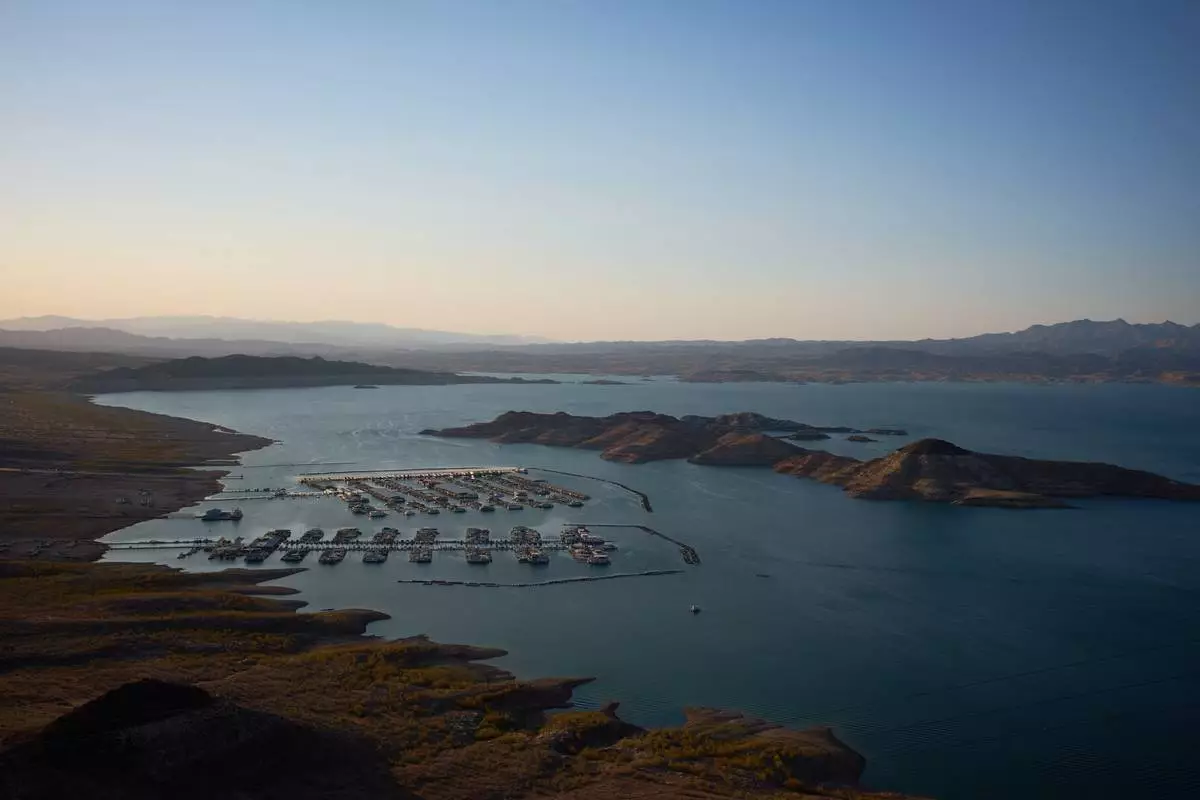
Boats are moored at a marina on Lake Mead at the Lake Mead National Recreation Area on Tuesday, June 30, 2026, near Boulder City, Nev. (AP Photo/John Locher)
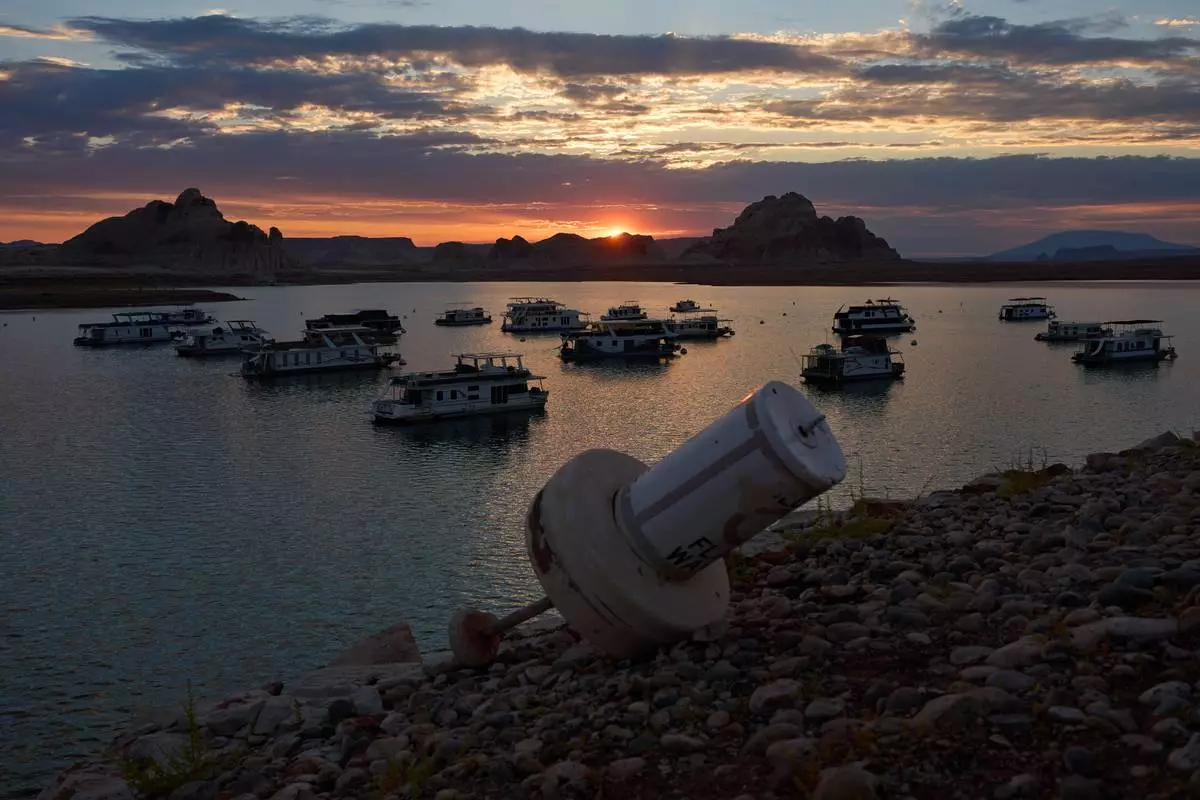
FILE - A formerly floating buoy now sits high and dry above Lake Powell at the Glen Canyon National Recreation Area, July 15, 2026, near Page, Nev. (AP Photo/John Locher, File)