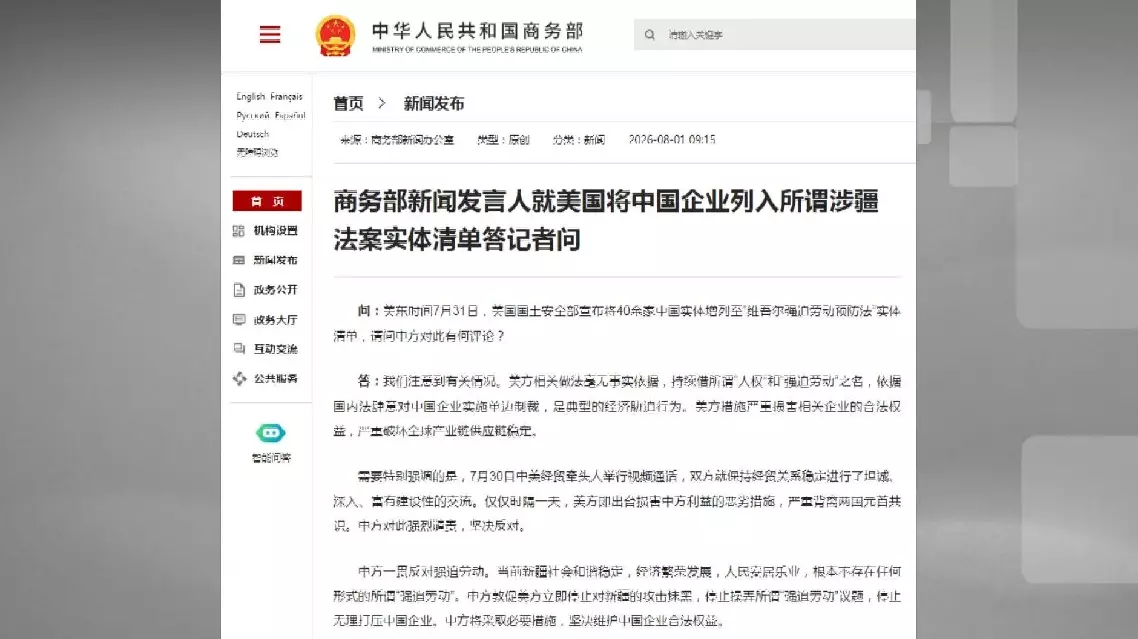
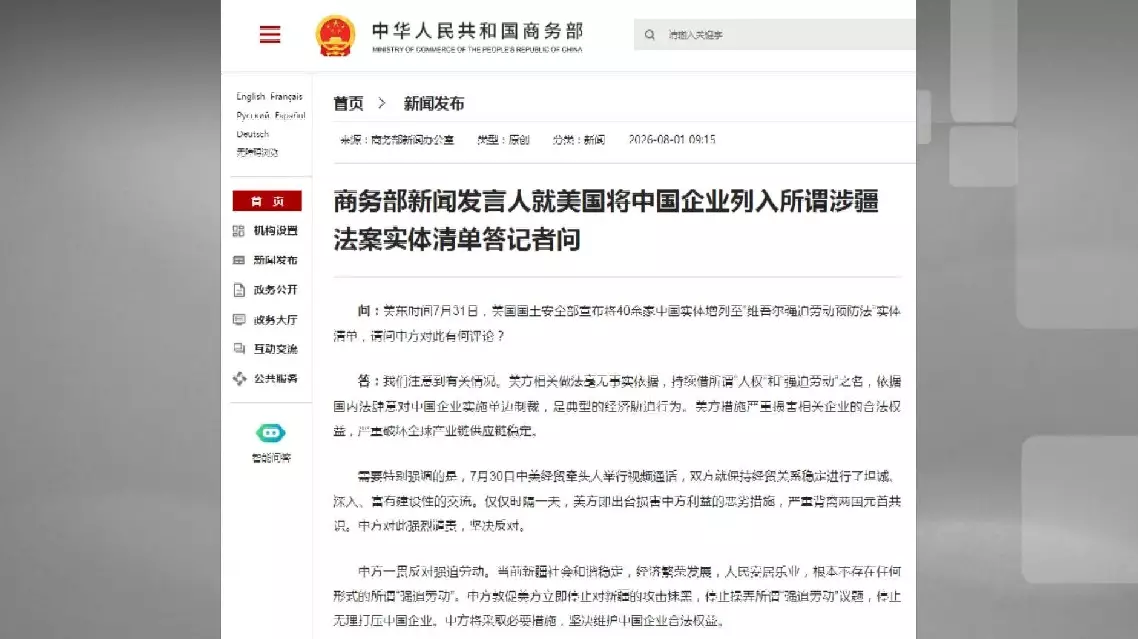
China's Ministry of Commerce expressed strong condemnation and resolute opposition on Saturday against the United States' announcement of adding over 40 Chinese entities to the so-called "Uyghur Forced Labor Prevention Act Entity List."
The U.S. actions lack a factual basis, as it continues to abuse the so-called "human rights" and "forced labor" pretexts to impose unilateral sanctions on Chinese enterprises in accordance with its domestic laws, a spokesperson for the ministry said, adding that such move is typical economic coercion.
The U.S. measures have seriously undermined the legitimate rights and interests of the relevant Chinese enterprises and severely disrupted the stability of global industrial and supply chains, the spokesperson said.
The spokesperson specifically noted that on July 30, Chinese and U.S. economic and trade lead officials held a video call, during which the two sides had candid, in-depth and constructive exchanges on maintaining the stability of bilateral economic and trade relations.
However, just one day later, the U.S. introduced these malicious measures that harm China's interests, seriously departing from the consensus reached between the two heads of state, the spokesperson added.
China has always opposed forced labor. At present, Xinjiang enjoys social stability, economic prosperity and a peaceful life for its people, with no so-called "forced labor" in any form whatsoever, the spokesperson said.
The spokesperson urged the U.S. to immediately stop its attacks and smears against Xinjiang, stop manipulating the so-called "forced labor" issue, and stop wantonly suppressing Chinese companies.
China will take necessary measures to resolutely safeguard the legitimate rights and interests of its enterprises, the spokesperson said.
China opposes U.S. suppression of Chinese firms over so-called "forced labor prevention"
China opposes U.S. suppression of Chinese firms over so-called "forced labor prevention"
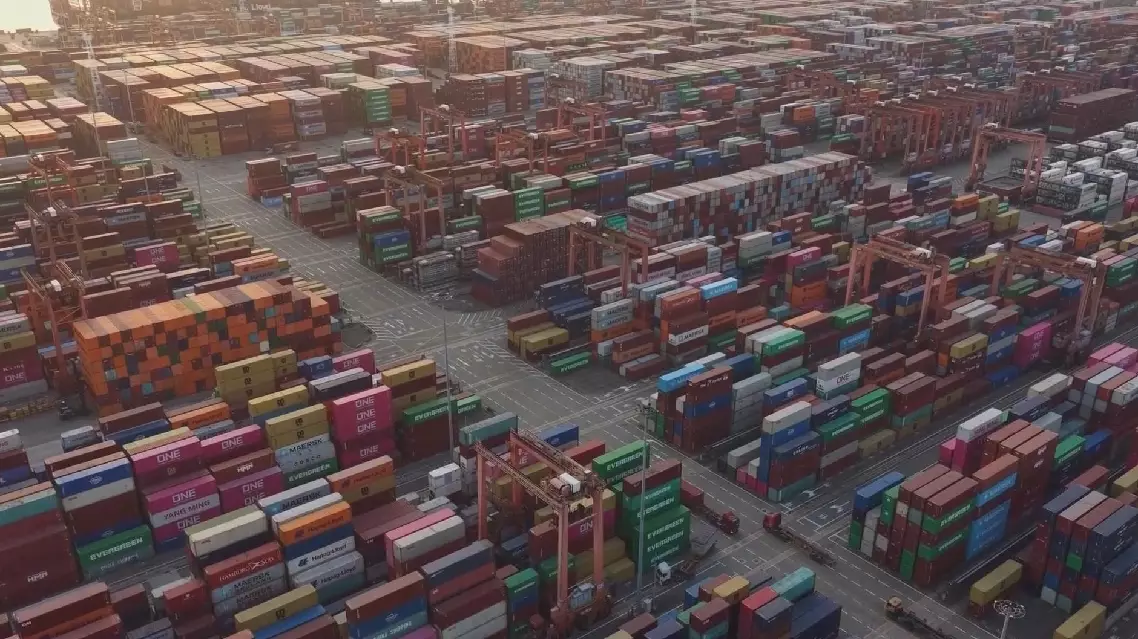
The World Trade Organization (WTO) released the latest data on Friday which showed that global merchandise trade growth exceeded expectations in the first quarter of 2026, as surging trade in electronic components related to artificial intelligence (AI) offset the negative impact of the Middle East conflict.
According to the data, the seasonally adjusted volume of world merchandise trade rose by 1.9 percent quarter on quarter and 3.2 percent year on year in the first quarter of this year.
In value terms, global merchandise trade increased by 2 percent from the previous quarter and by 11 percent from the same quarter of 2025.
The year-on-year growth rate recorded in the first quarter of 2026 is particularly noteworthy, given that trade growth in the first quarter of 2025 had been largely driven by front-loading of imports in North America ahead of expected tariff hikes.
The robust trade in AI-related electronic components more than offset the adverse effects of the outbreak of the war in the Middle East, including disruptions to shipments through the Strait of Hormuz and slower GDP growth in net fuel-importing countries due to higher energy prices.
While no specific data are available on global trade volumes of AI-enabling products, their U.S. dollar-denominated trade value surged by over 40 percent year on year in the first quarter.
The conflict has severely hit merchandise trade in the Middle East. The region's seasonally adjusted export and import volumes dropped by 9.7 percent and 11.9 percent year on year, respectively, in the first quarter, and even sharper declines are expected for the second quarter.
At the same time, AI-related investment spending lifted trade volumes in Asia during the first quarter. Asia's seasonally adjusted exports and imports were up 12.9 percent and 14.6 percent year on year, respectively. Much of Asia's trade expansion came from intra-regional circulation of AI-enabling goods.
In North America, first-quarter exports rose by 7.0 percent year on year, while imports fell by 10.7 percent year on year.
The WTO expects that the next quarter's trade data will more fully reflect the disruptions to shipments through the Strait of Hormuz.
WTO says global goods trade growth exceeds expectations in Q1