Slovak President Peter Pellegrini said on Wednesday that his country advocates for dialogue between China and the European Union (EU) and stands ready to serve as a "safe island" for Chinese investment within the bloc.
During his state visit to China from Monday to Wednesday, Chinese President Xi Jinping held talks with Pellegrini and called on Slovakia to play a constructive role in promoting the sound and steady development of China-EU relations.
Slovakia was among the first countries to establish diplomatic relations with the People's Republic of China and one of the earliest European countries to engage in Belt and Road cooperation. In this context, Pellegrini talked about his country's role in promoting China-EU cooperation in an interview with the China Media Group (CMG).
"Cooperation, I think, is the only recipe to solve this problem, and Slovakia will advocate for this kind of dialogue between European Union and China. I'm following it very carefully that now there is a tension between China and European Union. My answer is, and the role of Slovakia should be in this way, and we discuss this with Mr. President: we should try to solve these problems or small tensions via dialogue behind the table, not to start some isolation or confrontation, because only cooperation brings solutions or win-win situations, not confrontations. We have to avoid confrontations," Pellegrini said.
"In reality, we'll find a solution that there will be a win-win position for China and European Union. We presented Slovakia as a very safe island also for Chinese investment at the EU territory for the future. Because there is trust, there is good environment for Chinese entrepreneurs there. And of course, combined with this high-level relations and very friendly relations with China, it makes a perfect combination to attract more Chinese investment to Slovakia," he said.

Slovakia advocates for China-EU dialogue, serves as "safe island" for Chinese investment: president
China needs to continuously improve intellectual property system to support the future industries, said an expert on development planning after the country's top intellectual property regulator announced to further strengthen intellectual property protection.
The National Intellectual Property Administration (CNIPA) of China told a press conference on Wednesday that the plan for intellectual property rights (IPR) protection and utilization for the 15th Five-Year Plan period (2026-2030) will be implemented in the near future. It will serve the country's development priorities across all aspects of IPR, including creation, protection, utilization, management, services and international cooperation.
The protection of IPR will be central to fostering comprehensive innovation, high-quality development, and high-standard opening up, as well as economic and social development, according to the CNIPA.
Dong Yu, executive deputy dean of China Institute for Development Planning in Tsinghua University, voiced his support for the CNIPA policy in a recent interview with the China Media Group.
Dong said that, on the one hand, artificial intelligence (AI) should be used in scientific and technological innovation to unlock its potential, and on the other hand, the regulatory framework should be refined to address issues such as IP ownership, recognition of results, and risk prevention.
"We are not simply rejecting or fully embracing [AI]. We need to figure out which areas and links the technology can play a greater role in. We want AI to contribute more to scientific and technological progress, while also preventing corresponding risks," said Dong.
In the digital economy, data has become critical for innovation. Yet issues of ownership, rights protection, and the circulation of data held by platform enterprises remain unresolved.
The plan also explores data IP protection rules to address these challenges.
"Aspects like data definition, trading, and other links all need institutional designs, and the latest plan has made forward-looking arrangements for these issues. It will provide ample space for the development of the data market, the circulation of data, and the growth of data as a factor of production," Dong said.
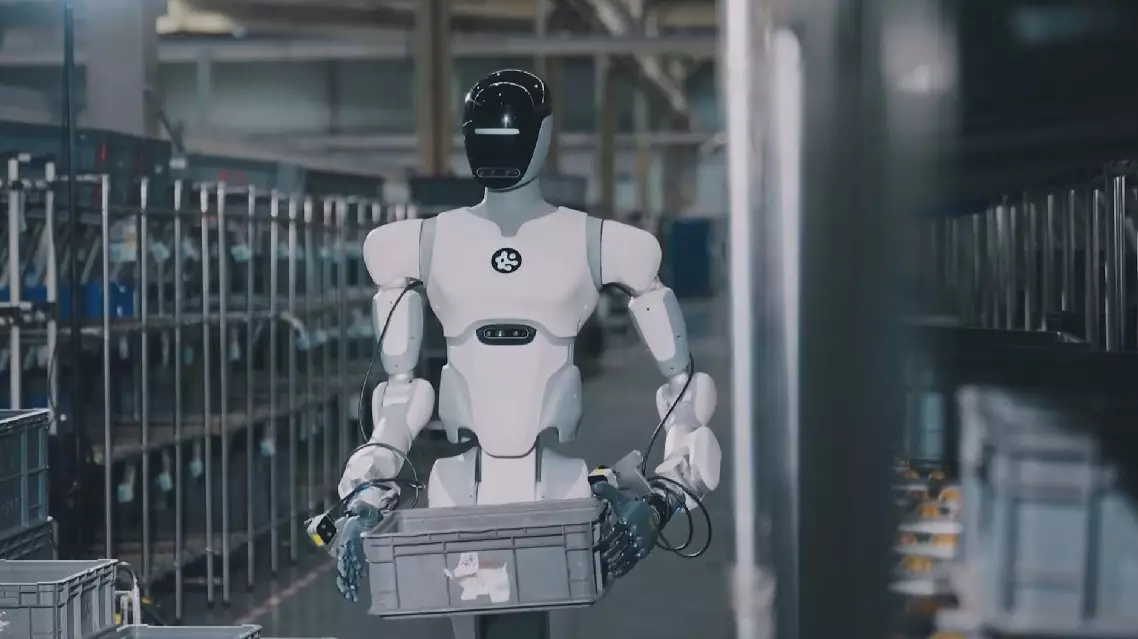
China needs to continuously improve intellectual property system to support future industries: expert