
Skip to Content Facebook Feature Image

August’s total solar eclipse will sweep over Spain, Iceland and Greenland

News

August’s total solar eclipse will sweep over Spain, Iceland and Greenland
News

News

August’s total solar eclipse will sweep over Spain, Iceland and Greenland

2026-08-01 19:25 Last Updated At:19:30

For the first time in more than a century, a total solar eclipse is coming to mainland Spain with an even longer encore next summer.

Toss in a crescendoing meteor shower and a six-planet parade on the same day, and the heavens will be overflowing with awe.

Daytime darkness will descend Aug. 12 across the Iberian Peninsula close to sunset — plus slivers of Greenland and Iceland — as the sun, moon and Earth align perfectly in the sky.

Starting near the North Pole before tracking south, totality will last up to two minutes and 18 seconds, an appetizer for an even longer solar show next year — a 6 ½-minute extravaganza that will sweep from Spain to North Africa and the Middle East.

It will take 1 ½ hours for the umbra, or moon’s sun-blocking shadow, to race along the 5,130-mile (8,260-kilometer) course, most of it over an empty Atlantic. Maximum totality will occur off Iceland’s west coast. By the time it reaches a small patch of Portugal and then Spain with its massive crowds, totality will have dwindled to a minute or so. The spectacle will end in the Mediterranean.

Hundreds of millions more on the sidelines are in for a treat as well.

A partial eclipse will delight as far away as Alaska and Siberia, enveloping Canada, the northern U.S., and much of Europe and West Africa.

The closer to totality’s course, the more the sun will vanish behind the moon – 94% coverage in Dublin and 83% in Oslo, Norway. Montreal will see an 18% bite out of the sun, tapering to 9% in New York and 2% in Norfolk, Virginia.

Special eclipse glasses are crucial. even if a morsel of sun is showing.

Adding to the cosmic wonder, the day begins with six of our neighboring planets forming an arc in the sky before dawn and end with the Perseid meteor shower peaking after nightfall under the new moon. Streaking meteors could photobomb totality, with some of the brighter planets and stars visible in the background.

Eclipse mapmaker Michael Zeiler is chasing an even more elusive interloper: the northern lights.

For his 13th total solar eclipse, Zeiler will be on a cruise ship in a Greenland fjord, sailing as a guest lecturer. He’ll point a video camera toward the north to capture any aurora forming during totality. A massive outburst from the sun would be the icing on his eclipse cake.

“What gets me excited is viewing rare phenomena,” Zeiler said in an email.

He’s not the only one revved up.

The European Space Agency will host a live webcast from Spain’s Astrophysical Observatory of Javalambre and a public celebration in Leon. NASA will provide its own coverage, as will the Italian-based Virtual Telescope Project and others.

“For me, it’s not just a scientific moment. It’s not just an incredible alignment of heavenly bodies. It’s also a very human moment,” said ESA’s director of science Carole Mundell. “It’s a real human connection between us with our feet planted on the Earth and the cosmos.”

Two of ESA’s space telescopes will observe the eclipsed sun and its corona, or outer atmosphere. Proba-3, the space agency’s artificial eclipse-making satellite duo, will be in the wrong part of its orbit during totality as seen from Earth, but will try to sneak in some before-and-after shots.

U.S. college research teams are also pitching in, launching more than 60 high-altitude balloons from Spain and Iceland to study Earth’s atmosphere and other changes during the eclipse when the temperature momentarily drops. They launched 10 times as many balloons during the 2024 total solar eclipse that captivated North America.

“A couple of minutes isn’t a lot of time, but it’s still plenty to affect the atmosphere and to make that cold, dark shadow of the moon on Earth,” said Montana State University’s Angela Des Jardins, who leads the NASA-funded balloon project.

Southwest Research Institute’s Amir Caspi also expects a scientific bonanza from his study aboard a NASA high-altitude plane. Four cameras will record the corona in nine wavelengths as the jet chases the eclipse at 460 mph (740 kph), extending totality to nearly three minutes in the air. Caspi anticipates thousands of images gathered from each camera during those precious 180 seconds.

"It’s true the eclipse is short, but it’s still incredibly valuable," he said.

An exceptionally long total solar eclipse is in store for 2027, yielding nearly three times more observation time.

The southern tip of Spain will take center stage on Aug. 2, 2027, with up to six minutes and 23 seconds of totality extending into Morocco, Algeria, Libya, Egypt, Saudi Arabia, Yemen and Somalia.

Then on Jan. 26, 2028, a ring-of-fire eclipse will round out Spain’s celestial trifecta — “a lucky coincidence,” according to ESA’s Mundell.

It’s all the more extraordinary considering Spain’s last full solar eclipse — not counting the Canary Islands — occurred two days before the Titanic’s sinking in 1912. Because that rare hybrid eclipse toggled between a ring-of-fire and just a few seconds of totality for Spain, some consider 1905 for the country’s last pull-out-all-the-stops solar eclipse.

The Royal Observatory of Belgium’s Andrei Zhukov can’t get enough of them regardless of their length or origin. His Proba-3 science mission has created more than 60 simulated total solar eclipses over the past two years, with the longest lasting five hours and 38 minutes from two satellites flying in formation.

“We’re looking forward to more eclipses,” Zhukov said, “natural or artificial.”

The Associated Press Health and Science Department receives support from the Howard Hughes Medical Institute’s Department of Science Education and the Robert Wood Johnson Foundation. The AP is solely responsible for all content.

FILE - In this image provided by NASA the Artemis II crew, counterclockwise from top left, Mission Specialist Christina Koch, Mission Specialist Jeremy Hansen, Commander Reid Wiseman and Pilot Victor Glover pose with eclipse viewers during a lunar flyby on April 6, 2026. (NASA via AP, File)

FILE - In this image provided by NASA the Artemis II crew, counterclockwise from top left, Mission Specialist Christina Koch, Mission Specialist Jeremy Hansen, Commander Reid Wiseman and Pilot Victor Glover pose with eclipse viewers during a lunar flyby on April 6, 2026. (NASA via AP, File)

FILE - This image provided by NASA and captured by the Artemis II crew from lunar orbit, April 6, 2026, shows the Moon eclipsing the Sun. (NASA via AP, File)

FILE - This image provided by NASA and captured by the Artemis II crew from lunar orbit, April 6, 2026, shows the Moon eclipsing the Sun. (NASA via AP, File)
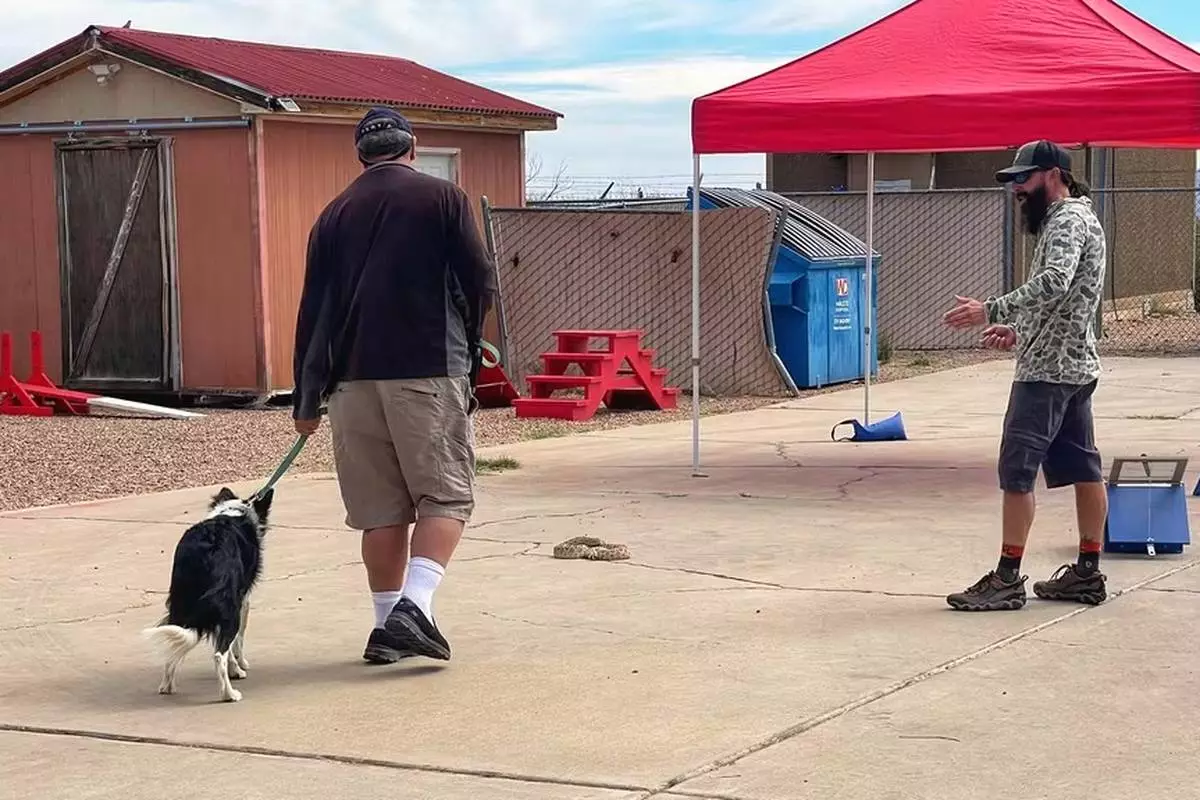
TUCSON, Ariz. (AP) — Ripley, a medium-sized dog with a strong prey drive, curiously approached Brian, a large western diamondback rattlesnake, until she got a quick zap on the neck meant to simulate a venomous viper’s bite.

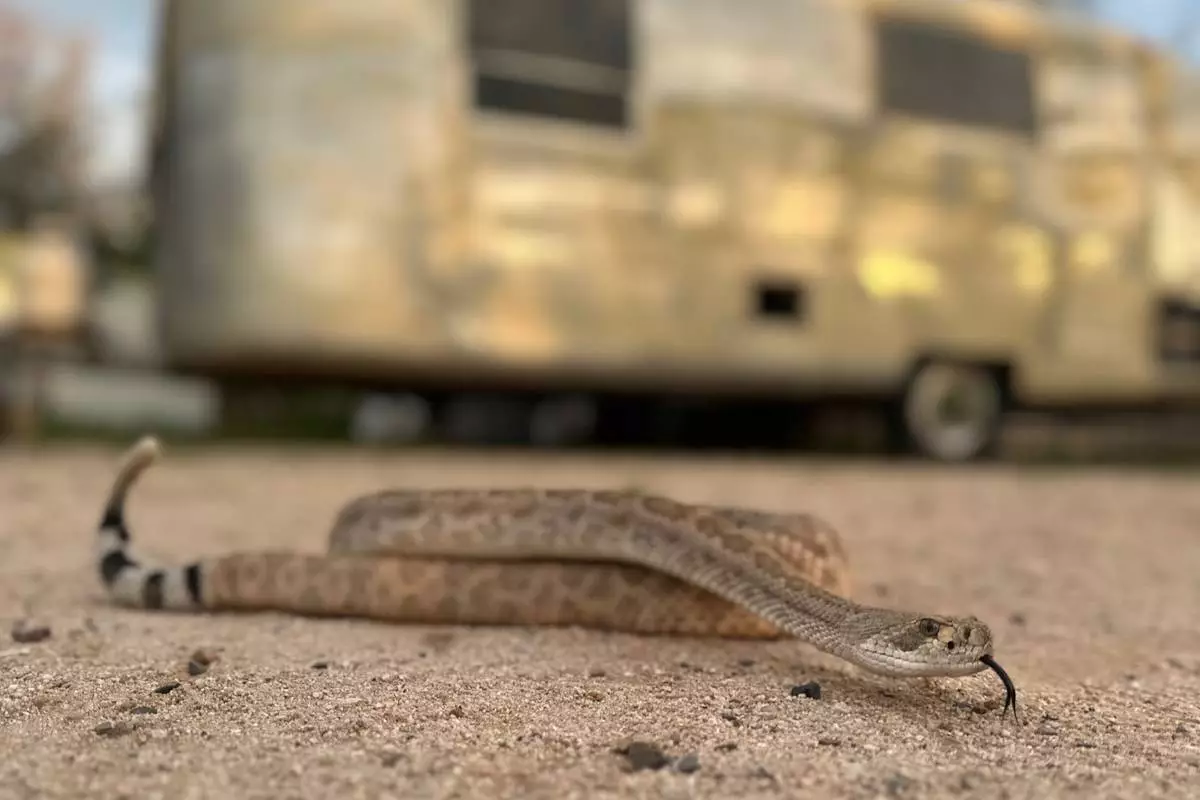
Suddenly, the 2-year-old blue heeler mix wanted nothing to do with Brian’s textured brown skin or furiously rattling tail. Ripley was never in danger because Brian had his venom glands removed years ago.

Dog trainer J.J. Belcher of Sublime Canine in Tucson, Arizona, said the single shock delivered one recent morning from an electronic training collar should be sufficient to keep Ripley away from venomous snakes that can sicken or even kill a dog. Belcher said Ripley can come back in a year for a free training session to make sure the lesson stuck.

Ripley’s owners, Amber Schneider and Wendy Timm, said they opted for the training because the dog regularly hunts small animals.

“We have an acre of natural desert and respect all the snakes, but she’s very curious about wildlife,” said Timm. “We are doing this because we want to keep our dog safe.”

The American Society for the Prevention of Cruelty to Animals says as many as 150,000 dogs are bitten by venomous snakes each year in the United States. In the rattlesnake hot spot of Arizona, emergency veterinarian Dr. Sarah Carotenuto says the Veterinary Specialty Center of Tucson treats four to six dogs daily for rattlesnake bites, along with an occasional cat.

Training programs to protect canines from poisonous snakes are offered around the U.S., especially in the Western deserts, woods and grasslands that are home to western diamondbacks. The snakes can reach over 5 feet long (1.5 meters) and strike in less than a second when they feel threatened.

There are also classes from Illinois to Florida to guard animals against eastern diamondbacks, timber rattlers and other venomous snakes.

Carotenuto said the snakebite survival rate for pets is 94% with quick treatment, which can cost thousands of dollars depending on how much antivenom and hospitalization is needed.

“Do bring us your dog quickly, but please don’t bring us the snake!” emphasized Carotenuto. Some people have brought in the guilty snake, but it’s unnecessary to identify the exact species before administering antivenom effective against all kinds of rattlers.

Carotenuto, who teaches at the University of Arizona’s College of Veterinary Medicine, said she’s participating in a research study there into whether rattlesnake-aversion training works, and which method is most effective.

Like Belcher, most trainers insist that the use of the electronic collar is necessary to ensure a dog will avoid poisonous snakes.

“It’s a very fast and effective form of training,” said Belcher, who has traveled around the Western U.S. for more than two decades teaching rattlesnake avoidance to thousands of pet and working dogs, including search-and-rescue animals and the occasional police dog.

He acknowledged the growing debate about the use of electronic training collars, a method that the American Humane Society has opposed as cruel.

The ASPCA doesn’t explicitly oppose electronic collars, but insists they be used correctly.

“This type of training can be highly effective — however, we recommend that such training be conducted only under the guidance of a trainer knowledgeable in the principles of avoidance learning,” said Pamela Reid, vice president of ASPCA's behavioral sciences team.

“It is imperative to weigh the dog’s risk of a snakebite against the potential fallout from using an electronic collar,” she said.

Training a dog to come reliably when it’s called and to “leave it” when it is interested in something dangerous “can go a long way toward keeping a dog safe,” she said.

Belcher said he has developed an alternative positive-reinforcement program for clients who are squeamish about electronic collars, but nobody has wanted to pay the $2,500 he would charge for the multiple sessions. A single visit with the collar costs $125.

Another trainer, Mike Parmley in Salt Lake City, teaches as many as 500 dogs every year, usually in small classes of four to six. He uses an electronic collar set on a low level, emphasizing, “You don’t have to shock the hell out of the dog.”

He aims to help dogs steer clear of the Salt Lake area's Great Basin rattlesnakes.

“They are a pretty big problem up here in the foothills,” said Parmley, who owns Barley’s Canine Recreation Center. “They came out a lot earlier this year because of a trend of warmer weather, and we had more than 100 dogs signed up by early June.”

Here are some tips from trainers and veterinarians for protecting your dog:

— Learn about snakes in your area. Venomous snakes exist across the U.S., with various rattler species not only in the West but as far east as New York and North Carolina.

— Clear your yard of long grass and other foliage or debris that can attract small rodents hunted by snakes. Trimming back growth can eliminate hiding places.

— Stay on well-worn trails while hiking and keep your dog on a leash.

— Don’t let your guard down even if your dog has had avoidance training. A viper can surprise and attack a person or pet without warning.

— Seek emergency care immediately if your dog is bitten because the venom will move quickly through its body, destroying tissue.

For more AP pet stories, go to https://apnews.com/hub/pets

This undated photo shows trainer J.J. Belcher, right, using his western diamondback rattler Brian to teach a dog to avoid poisonous snakes in Tucson, Ariz. (J.J. Belcher via AP)

This undated photo shows trainer J.J. Belcher, right, using his western diamondback rattler Brian to teach a dog to avoid poisonous snakes in Tucson, Ariz. (J.J. Belcher via AP)

In this undated photo shows Brian the rattlesnake, which is used to train dogs to avoid dangerous vipers, in Tucson, Ariz. (J.J. Belcher via AP)

In this undated photo shows Brian the rattlesnake, which is used to train dogs to avoid dangerous vipers, in Tucson, Ariz. (J.J. Belcher via AP)

Recommended Articles