Skip to Content Facebook Feature Image

Infantino's World Cup private investment plan has drawn seismic FIFA backlash. Here's what to know

Sport

Infantino's World Cup private investment plan has drawn seismic FIFA backlash. Here's what to know
Sport

Sport

Infantino's World Cup private investment plan has drawn seismic FIFA backlash. Here's what to know

2026-08-01 03:29 Last Updated At:03:31

GENEVA (AP) — Gianni Infantino truly looked the “King of Soccer,” as U.S. President Donald Trump likes to call him, as the two allies sat together watching the World Cup final less than two weeks ago.

Sure, there were some boos inside MetLife Stadium near New York, when the two men walked across the turf to present the trophy and medals to Spain and Argentina players on July 19.

More Images
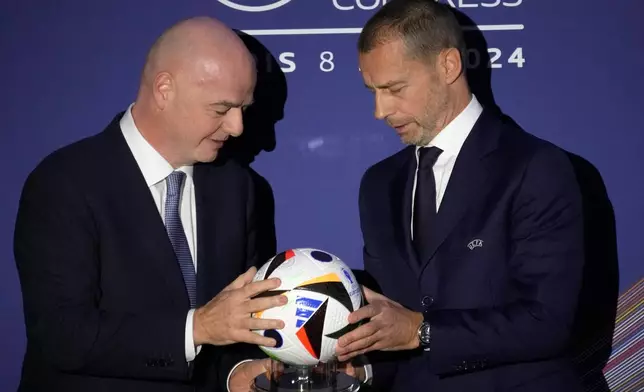
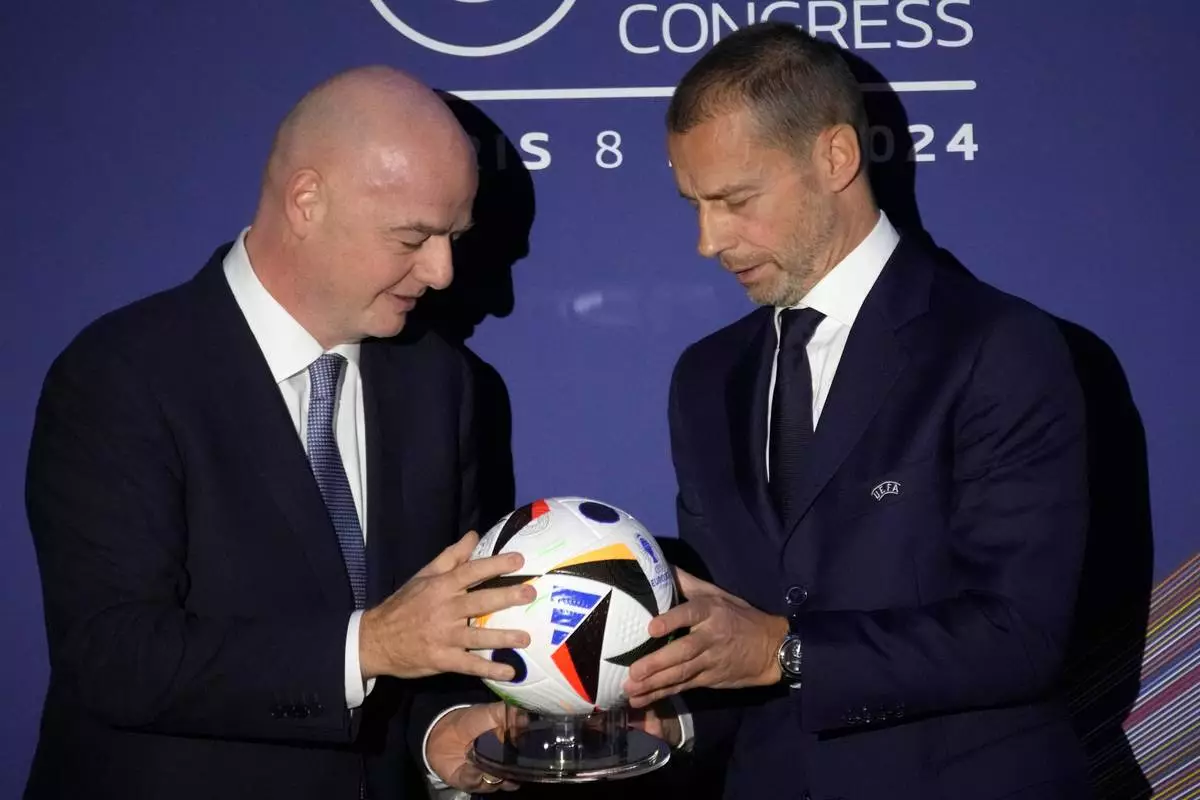
FILE - UEFA President Aleksander Ceferin, right, and FIFA President Gianni Infantino pose during the 48th UEFA congress in Paris, Thursday, Feb. 8, 2024. (AP Photo/Christophe Ena, File)
FILE - UEFA President Aleksander Ceferin, right, and FIFA President Gianni Infantino pose during the 48th UEFA congress in Paris, Thursday, Feb. 8, 2024. (AP Photo/Christophe Ena, File)

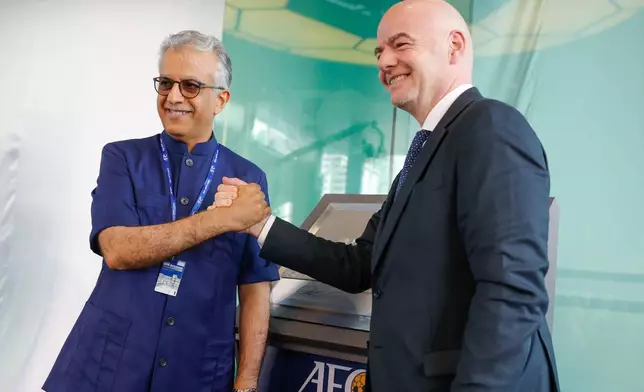
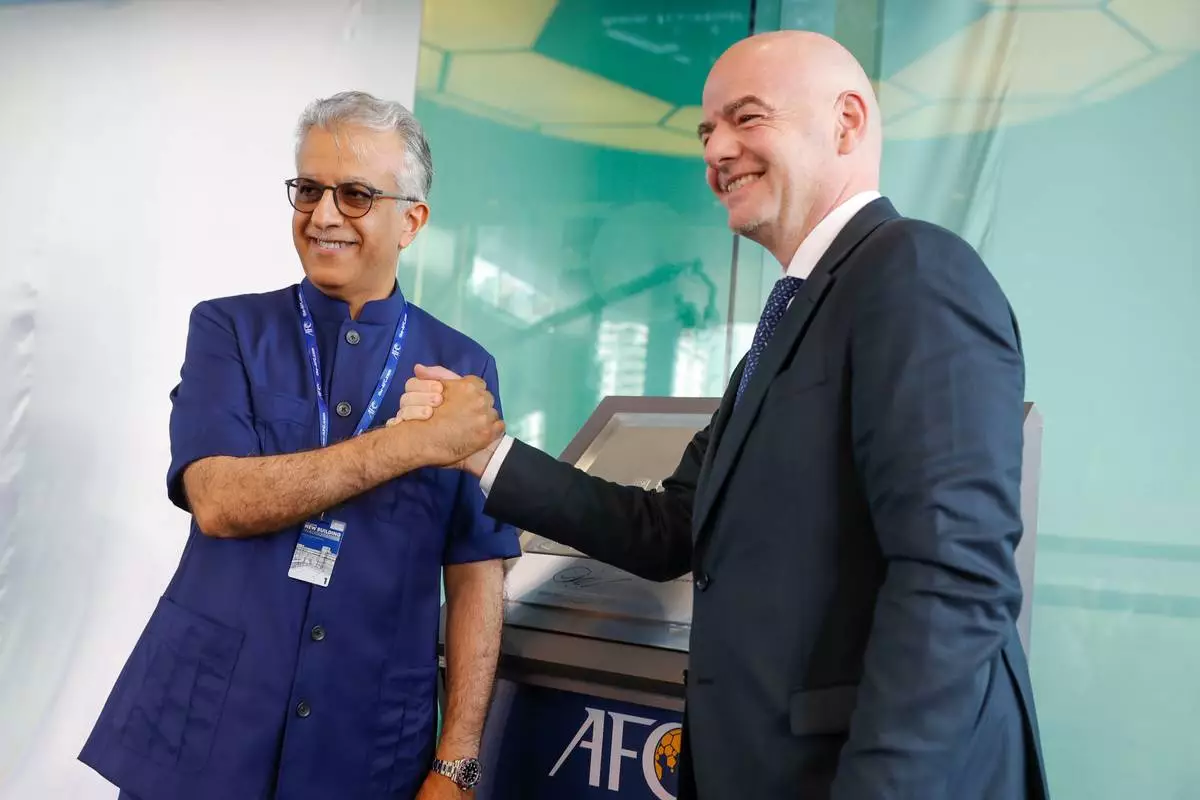
FILE - Asia Football Confederation President Salman Bin Ibrahim Al-Khalifa, left, poses with FIFA President Gianni Infantino during an inauguration ceremony for the new building of the Asia Football Confederation in Kuala Lumpur, Malaysia Tuesday, Oct. 30, 2018. (AP Photo/Vincent Thian, File)
FILE - Asia Football Confederation President Salman Bin Ibrahim Al-Khalifa, left, poses with FIFA President Gianni Infantino during an inauguration ceremony for the new building of the Asia Football Confederation in Kuala Lumpur, Malaysia Tuesday, Oct. 30, 2018. (AP Photo/Vincent Thian, File)

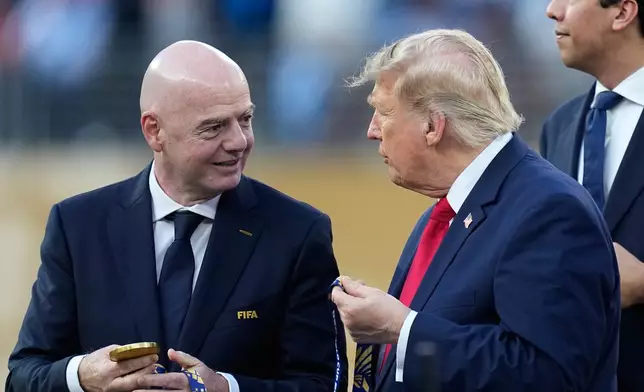
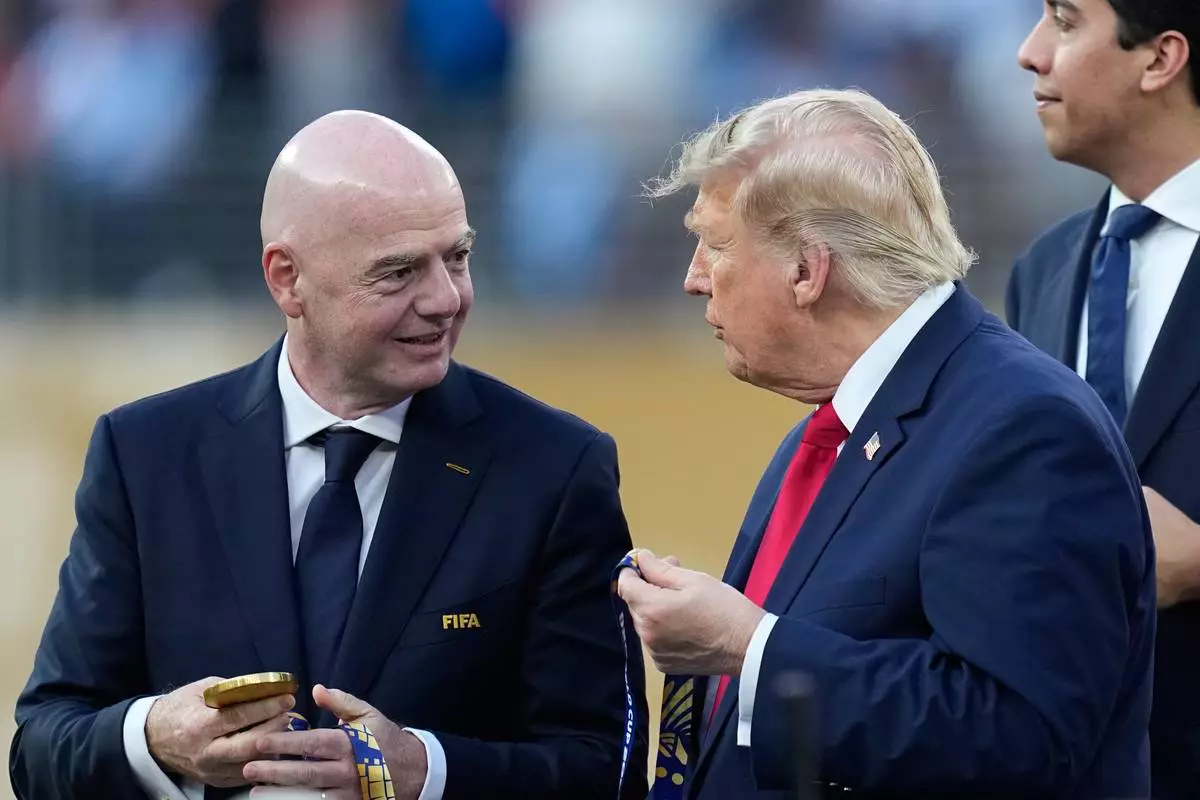
President Donald J. Trump speaks with FIFA President Gianni Infantino during the awards ceremony at the end of the World Cup final soccer match between Spain and Argentina in East Rutherford, N.J., near New York, Sunday, July 19, 2026. (AP Photo/Ashley Landis)
President Donald J. Trump speaks with FIFA President Gianni Infantino during the awards ceremony at the end of the World Cup final soccer match between Spain and Argentina in East Rutherford, N.J., near New York, Sunday, July 19, 2026. (AP Photo/Ashley Landis)

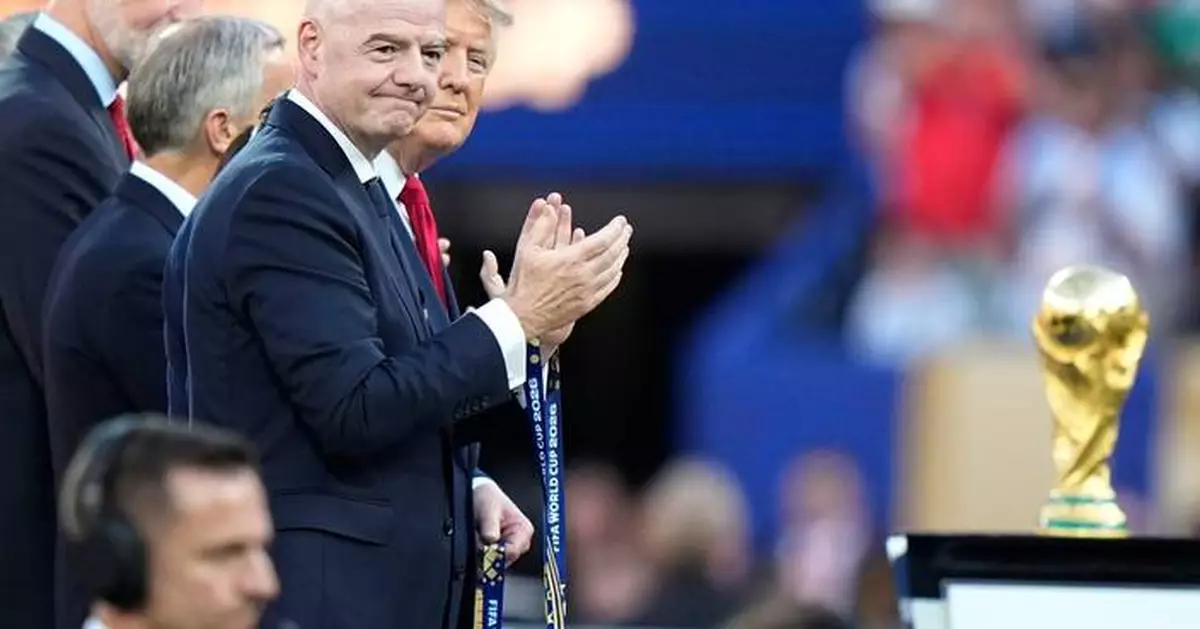
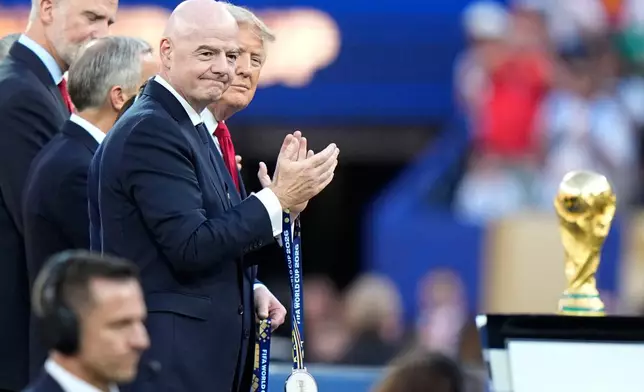
U.S. President Donald J. Trump and FIFA President Gianni Infantino applaud to welcome the players during the presentation ceremony after the World Cup final soccer match between Spain and Argentina in East Rutherford, N.J., near New York, Sunday, July 19, 2026. (AP Photo/Frank Franklin II)

U.S. President Donald J. Trump and FIFA President Gianni Infantino applaud to welcome the players during the presentation ceremony after the World Cup final soccer match between Spain and Argentina in East Rutherford, N.J., near New York, Sunday, July 19, 2026. (AP Photo/Frank Franklin II)

Still, that 104th and final game capped a biggest-ever tournament seen as a vindication for the FIFA president — a consensus success on the field and a financial bonanza for global soccer. Infantino could look ahead to his likely re-election coronation next March.

The sunny scene must now feel an age ago since Infantino caused a seismic rift in global soccer.

The intensifying fallout might shockingly cost the 56-year-old Infantino a job in which he seemed untouchable until this week.

Infantino's misstep was inviting private investors, led by Joshua Kushner, to buy a stake in future profits from World Cups and all FIFA events.

The Swiss-Italian official had largely shrugged aside the World Cup's politically motivated incidents that raised criticism and concern in the soccer world: The Iran team and a World Cup referee from Somalia could not stay in the United States, fans were denied entry visas, and soccer’s rule of law was ignored after Trump intervened to let U.S. player Folarin Balogun avoid a mandatory one-game ban.

Infantino left New York City last week with letters pledging election support from about 200 of FIFA’s 211 national member federations who vote for their leader every four years.

But the most powerful man in soccer, known for always thinking ahead, had a new, huge and secret project in mind.

Infantino's proposal would create a subsidiary — known as FIFA Forward Enterprise (FFE) — for the money-making parts of the not-for-profit soccer body's work: Running tournaments like the World Cup, selling broadcasting and sponsorship, tickets and hospitality.

Private equity and petrostate sovereign wealth money has been normalized in European club soccer, yet they still seem unthinkable for many observers in the World Cup — soccer's ultimate prize is about glory, not money, and fans have long believed the World Cup belongs to them.

FIFA proposes raising $4.2 billion from investors buying stakes amounting to about 20% in FFE, based on an equity valuation of $20 billion. The “anchor investor” would be Thrive Eternal launched by Joshua Kushner, whose brother Jared Kushner is a son-in-law of Trump.

FIFA’s 211 member federations — already effective owners of the governing body as a non-profit association under Swiss law — were offered $20 million each. The deadline to accept is Sept. 19.

The members already are due $10 million each from FIFA over the next four years, funded largely by its record $15 billion revenue over 2023-26 tied to the World Cup just ended. FIFA says under FFE, that would double to $20 million each, then rise to $22 million each through 2034, and $24 million to 2038.

That’s a huge sum for tiny soccer federations in places like Andorra, Montserrat and Papua New Guinea. Deep-pocketed soccer powers like England, Spain or France have other priorities.

Some FIFA vice presidents, some of FIFA’s top executives, all the European soccer federations ...

... the soccer bodies of Asia and North America, Britain’s Prime Minister, the global group of national leagues, a lot of fans worldwide.

Infantino was looking increasingly friendless Friday. His senior adviser, former Goldman Sachs banker Carlos Cordeiro, resigned and called it a bad deal. FIFA chief operating officer Kevin Lamour gave a stinging statement to The Associated Press in defense of colleagues that all but invited his boss to fire him.

A key move Thursday was European soccer body UEFA vowing to boycott all FIFA competitions until Infantino drops the plan. Europe’s teams routinely dominate and win FIFA trophies like the men’s World Cup and Club World Cup that are its biggest revenue earners.

They collectively fear that private investors will seek — and demand — value from more games and bigger competitions that threaten the balance of global soccer. That could jeopardize attention and revenues for club soccer, including the Champions League.

Fixture calendars are already congested, elite players are at their limits, broadcast and sponsor money is not unlimited.

All are angry that Infantino seems not to have consulted anyone while planning the project over the last year, when he was so focused with spending time in Trump's orbit. Even Trump said Friday he had not spoken with the FIFA chief on his plan to sell stakes in the tournament.

Infantino's traditional support base in Africa, which has 54 of the 211 voting members, has been neutral so far about the offers of game-changing money for many of them.

The 10-nation South American group CONMEBOL has said nothing so far. It is led by FIFA vice president Alejandro Dominguez of Paraguay, who is relying on Infantino expanding the 2030 World Cup to 64 teams. That would give more games to minority co-hosts Argentina, Paraguay and inaugural 1930 World Cup host Uruguay, who currently are set to get just one game each of the 104. The rest are in Spain, Portugal and Morocco.

There is no set FIFA meeting or event scheduled through the end of August.

Infantino was on Friday in Morocco, a main ally in soccer politics, for the Women's Africa Cup of Nations.

The next FIFA competition is the Women’s Under-20 World Cup starting Sept. 5 in Poland — one the UEFA members say they will boycott.

The Sept. 19 deadline for the 211 to accept Infantino's $20 million cash offer is key, though that could quickly be overtaken by events.

If the UEFA-led resistance succeeds in stopping the sell-off plan, would it satisfy Infantino's opponents to leave him in office?

Does Infantino have the credibility to stay in office after interventions Friday by Lamour and Cordeiro that surely would make most presidencies untenable?

Nov. 18 is the deadline for candidates to enter the next presidential contest, exactly four months ahead of the vote in Rabat, Morocco, where FIFA has its African headquarters.

Infantino was re-elected unopposed in 2019 in Paris and 2023 in Kigali, Rwanda. FIFA statutes allow him one more four-year term in office. The FFE spinoff has seemed a way to create a commissioner-like role for Infantino beyond 2031, likely paying much more than his current annual salary and bonus deal of more than $6 million.

It would take 106 votes to ensure a majority in a contested election. Continents surely do not vote uniformly en bloc, but most of Europe's 55, plus CONCACAF's 35 and Asia's 46 would be a solid base.

Speculation on a likely direct challenger typically lands on Paris Saint-Germain's Qatari president Nasser al-Khelaïfi and the Canadian FIFA vice president Victor Montagliani.

Such talk seemed fanciful until this week, despite long-term unease with Infantino's style and previous attempts to force through unpopular projects.

The talk has never seemed more likely to become action.

AP soccer: https://apnews.com/hub/soccer and AP World Cup coverage
FILE - UEFA President Aleksander Ceferin, right, and FIFA President Gianni Infantino pose during the 48th UEFA congress in Paris, Thursday, Feb. 8, 2024. (AP Photo/Christophe Ena, File)
FILE - UEFA President Aleksander Ceferin, right, and FIFA President Gianni Infantino pose during the 48th UEFA congress in Paris, Thursday, Feb. 8, 2024. (AP Photo/Christophe Ena, File)

FILE - Asia Football Confederation President Salman Bin Ibrahim Al-Khalifa, left, poses with FIFA President Gianni Infantino during an inauguration ceremony for the new building of the Asia Football Confederation in Kuala Lumpur, Malaysia Tuesday, Oct. 30, 2018. (AP Photo/Vincent Thian, File)
FILE - Asia Football Confederation President Salman Bin Ibrahim Al-Khalifa, left, poses with FIFA President Gianni Infantino during an inauguration ceremony for the new building of the Asia Football Confederation in Kuala Lumpur, Malaysia Tuesday, Oct. 30, 2018. (AP Photo/Vincent Thian, File)

President Donald J. Trump speaks with FIFA President Gianni Infantino during the awards ceremony at the end of the World Cup final soccer match between Spain and Argentina in East Rutherford, N.J., near New York, Sunday, July 19, 2026. (AP Photo/Ashley Landis)
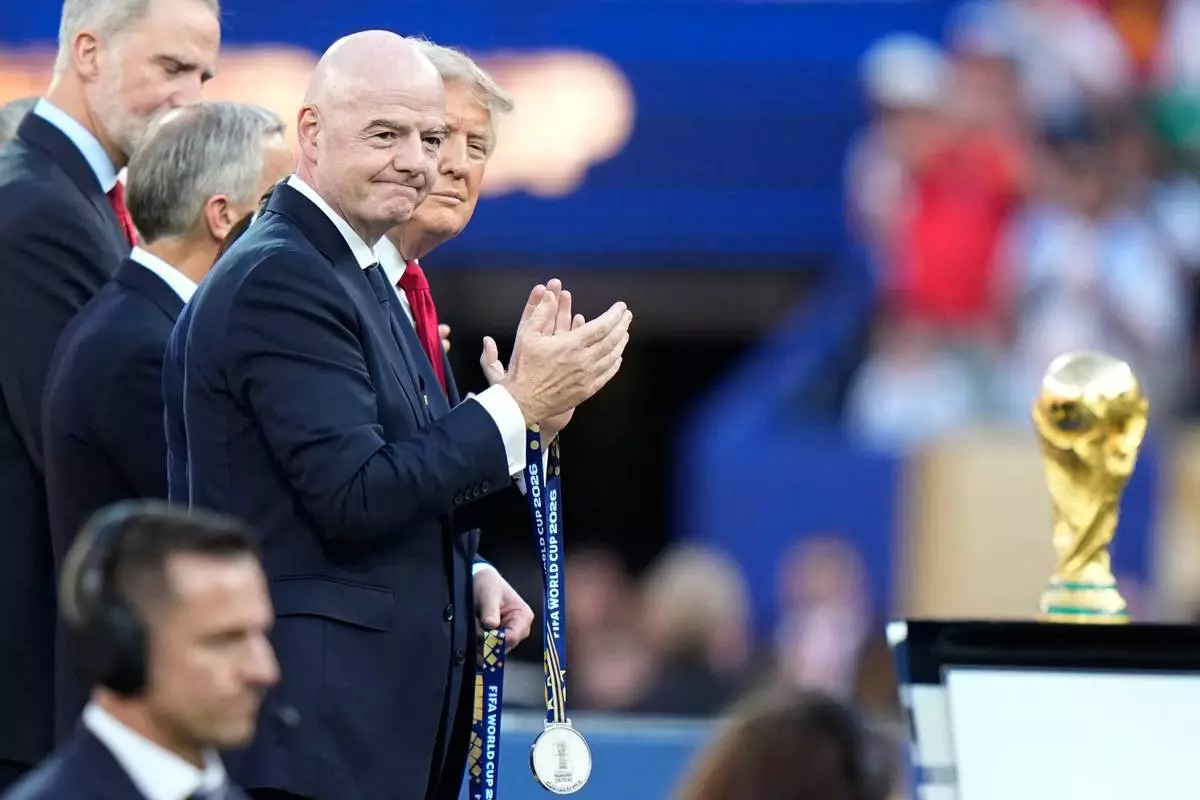
President Donald J. Trump speaks with FIFA President Gianni Infantino during the awards ceremony at the end of the World Cup final soccer match between Spain and Argentina in East Rutherford, N.J., near New York, Sunday, July 19, 2026. (AP Photo/Ashley Landis)

U.S. President Donald J. Trump and FIFA President Gianni Infantino applaud to welcome the players during the presentation ceremony after the World Cup final soccer match between Spain and Argentina in East Rutherford, N.J., near New York, Sunday, July 19, 2026. (AP Photo/Frank Franklin II)

U.S. President Donald J. Trump and FIFA President Gianni Infantino applaud to welcome the players during the presentation ceremony after the World Cup final soccer match between Spain and Argentina in East Rutherford, N.J., near New York, Sunday, July 19, 2026. (AP Photo/Frank Franklin II)
BUENOS AIRES, Argentina (AP) — It took a World Cup to transform a remote cluster of islands that’s home to more sheep than people into a cultural juggernaut.

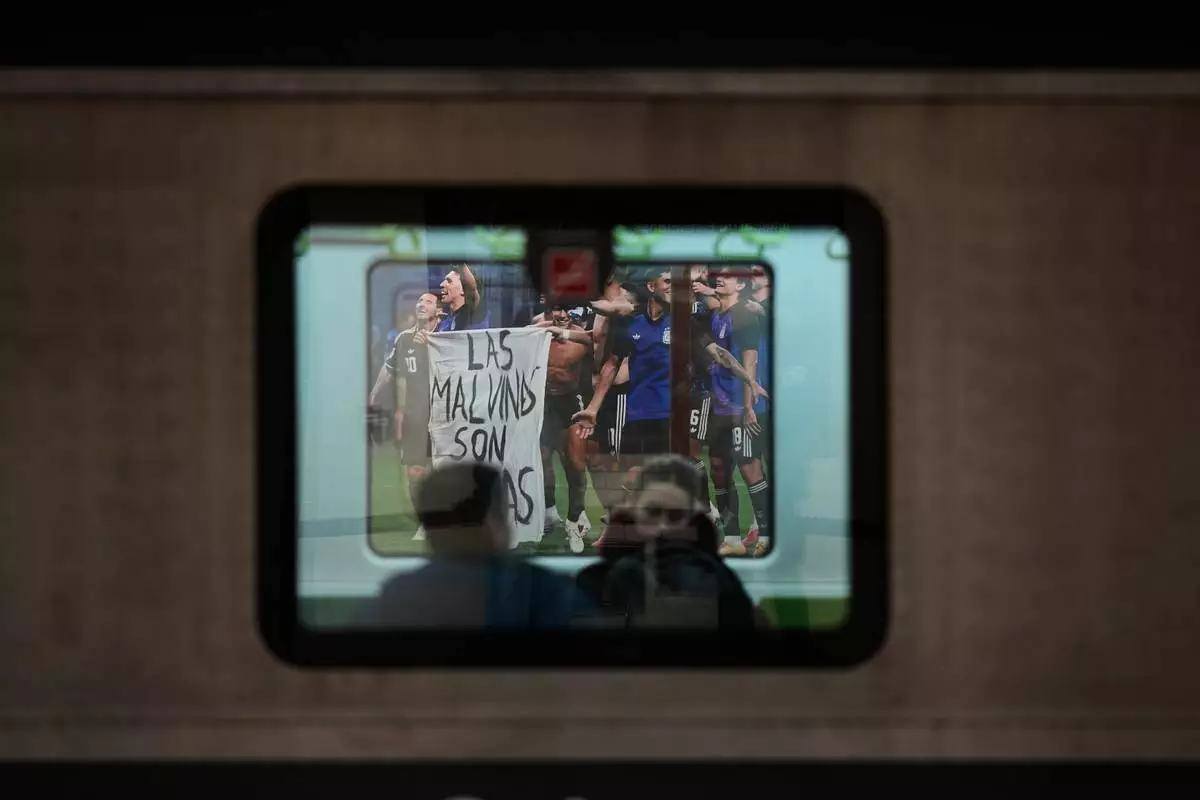
A decision by Argentina’s players to unfurl a banner about the disputed Falkland Islands after defeating England in the World Cup semifinals carried a historical cause onto the T-shirts, bedroom walls and Instagram feeds of a new generation. In the weeks since, the image that has endured from the tournament in soccer-crazed Argentina hasn't been of Lionel Messi. It’s been the crudely painted sign reading: “The Malvinas are Argentine.”

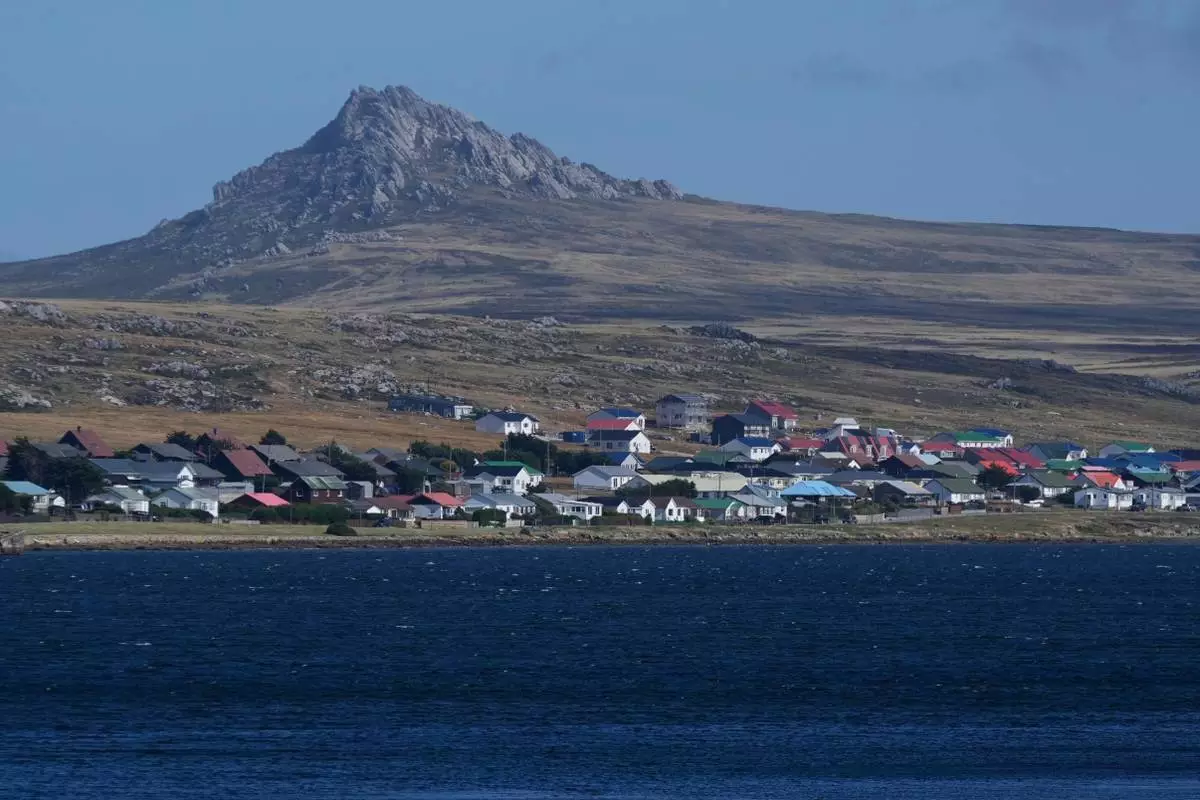
The South Atlantic archipelago, known in Argentina as the Malvinas, is claimed by both Argentina and Britain, which fought a 10-week war over the territory in 1982.

The banner spawned a marketing bonanza in Argentina, appearing on stickers, tote bags, sneakers, artwork and soccer jerseys. It was draped over bars, painted onto subway walls and tattooed onto calves and forearms. Thousands of Argentines downloaded “Malvinas Sans,” a typeface modeled on the banner’s hand-painted lettering. Colorful murals of the islands and of war veterans popped up across the country.

“The World Cup is now over, and yet people are still talking about the Malvinas because the Malvinas somehow became part of the World Cup,” said Edgardo Esteban, an author and veteran of the war. “Kids in schools are asking me, ‘What’s this Malvinas thing?’ Now there’s a passing of the torch.”

None of Argentina’s players had been born when the country’s military dictatorship invaded the Falklands in 1982, holding the islands for 73 days before British forces recaptured them in a war that killed 649 Argentine and 255 British troops.

But they grew up in a country haunted by the humiliation of that ill-fated invasion, widely seen as a desperate bid for popularity by the weakened junta that fell a year later. As Argentina emerged from the trauma of the brutal dictatorship, many veterans and families of conscripts killed in the war felt their sacrifices had been sidelined by a nascent democracy that sought to distance itself from the disaster.

“As veterans, we spent a long time feeling silenced, forgotten, pushed aside,” Esteban said.

It took a different World Cup to break that silence. When Argentina played England in the quarterfinals in Mexico City in 1986, Argentine soccer great Diego Maradona scored two goals — including his notorious handball known as the “Hand of God,” which he dedicated to those killed in the war and said was revenge for the Malvinas.

Over the decades, Argentina’s claim on the islands became enshrined in its constitution. The Malvinas appeared on road signs. Each year, the country's leaders honor the war dead with wreath-laying ceremonies.

Britain has administered the Falkland Islands since 1833 and says the people who live on the islands should determine their status, pointing to a 2013 referendum in which residents voted overwhelmingly to remain a British protectorate.

The islands, which lie 480 kilometers (300 miles) off Argentina’s coast, are home to some 3,600 people, roughly 450,000 sheep and over 1 million penguins, according to government figures.

Ahead of this year's semifinal against England, Argentine Security Minister Alejandra Monteoliva warned fans that Malvinas-themed signs would not be allowed inside the stadium due to FIFA’s ban on political messages.

As Argentine players ran onto the field to celebrate their victory, supporters tossed what appeared to be a white bed sheet onto the pitch. Midfielder Giovani Lo Celso pulled it open to reveal the message hand-painted in bold black letters: “Las Malvinas son Argentinas,” or “The Malvinas are Argentine.” Teammates Cristian Romero and Lisandro Martínez helped spread the banner wide before TV cameras and cheering fans.

After the match, British politicians and fans took to social media to vent their anger, helping amplify a wave of online posts criticizing both Argentina and its national team, digital researchers said.

On Wednesday, FIFA charged Argentina’s soccer federation for players parading the banner and charged two players for striking Spain opponents moments after the final.

In Argentina, the banner became a sensation, eclipsing for many both the disappointment of the team's defeat to Spain and the flood of hostile commentary.

“Despite not having won the tournament or brought home the trophy, every single player was welcomed back as a popular hero,” said Juan Rattenbach, an Argentine political expert on the Malvinas.

Iván Marcasiano, 36, owns a Buenos Aires print shop that has struggled to keep up with explosive demand for T-shirts printed with players holding the banner.

“The players had the courage to display a flag on the field that fans had been banned from bringing into the stadium. That gesture, showing that it’s up to ordinary Argentines to carry our demands forward, really resonated with young people,” Marcasiano said.

“They reached an audience that might never have participated in this kind of activism or historical remembrance before.”

When Marcasiano offered on Instagram to screen-print the image onto fans’ Argentina jerseys free of charge, 3,500 people — from teenagers to war veterans — showed up at his shop in a single day, he said.

It remains unclear if the Malvinas frenzy is a flash-in-the-pan obsession or evidence of a lasting resurgence of the political cause.

Activists have scrambled to harness the momentum. They are invoking national sovereignty to rally opposition to libertarian President Javier Milei's free-market agenda, including legislation that would loosen restrictions on foreign land ownership in Argentina.

But experts said the real political impact may lie beyond Argentina: introducing tens of millions of viewers worldwide to a dispute over a chain of islands few could have found on a map. Global Google searches for the Malvinas jumped 2,400% after Argentina’s semifinal against England, according to Google Trends, the largest increase in search interest since the platform began tracking data.

“Britain’s strategy since 1982 has been to keep the issue of the Malvinas out of the spotlight,” Rattenbach said. “Now, no one can deny its visibility.”

FILE - Mount Tumbledown stands tall behind Stanley on the Falkland Islands, also known as Islas Malvinas, Monday, March 16, 2026. (AP Photo/Ricardo Mazalan, File)

FILE - Mount Tumbledown stands tall behind Stanley on the Falkland Islands, also known as Islas Malvinas, Monday, March 16, 2026. (AP Photo/Ricardo Mazalan, File)

People ride a subway train stopped at a station displaying a photo of Argentina's soccer players holding a banner reading "The Malvinas are Argentine," referring to the Falkland Islands also known as Malvinas, taken after the team's World Cup semifinal soccer match between Argentina and England, in Buenos Aires, Argentina, Monday, July 27, 2026. (AP Photo/Natacha Pisarenko)

People ride a subway train stopped at a station displaying a photo of Argentina's soccer players holding a banner reading "The Malvinas are Argentine," referring to the Falkland Islands also known as Malvinas, taken after the team's World Cup semifinal soccer match between Argentina and England, in Buenos Aires, Argentina, Monday, July 27, 2026. (AP Photo/Natacha Pisarenko)

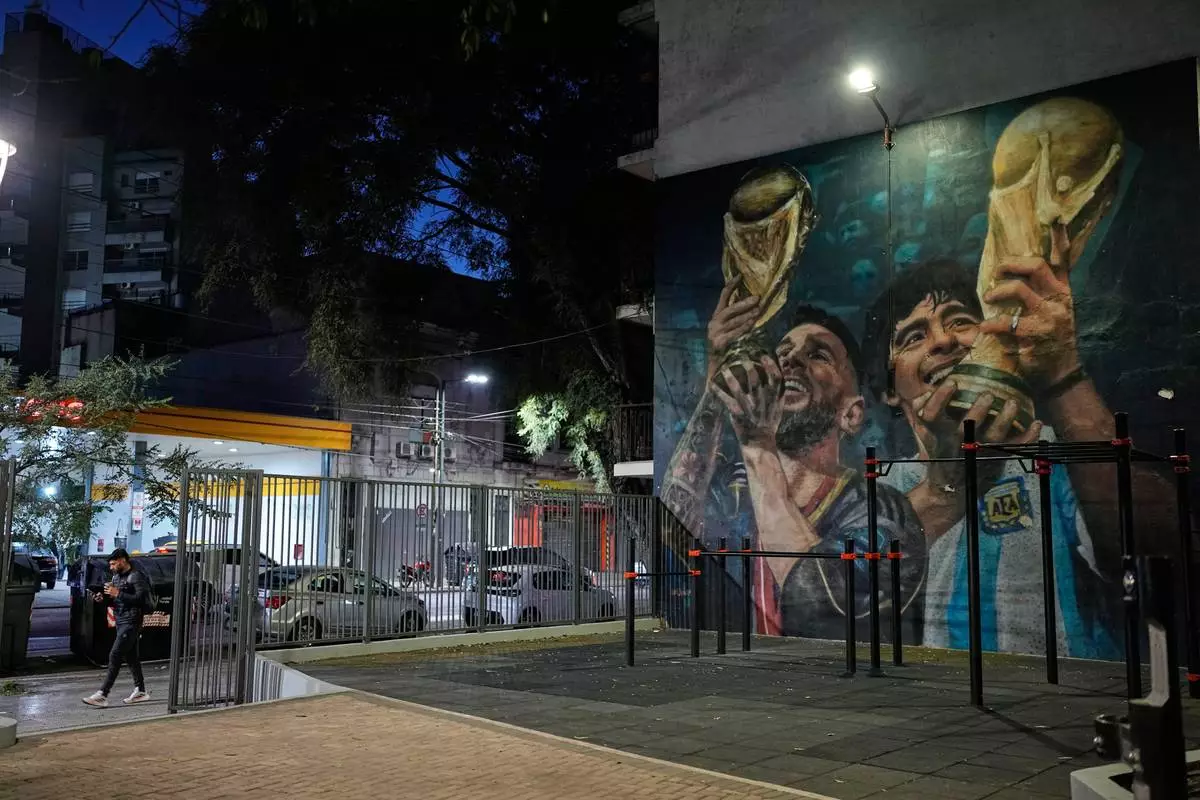
A mural of Argentine soccer players Lionel Messi and Diego Maradona decorate a wall in Buenos Aires, Argentina, early Thursday, July 30, 2026. (AP Photo/Natacha Pisarenko)

A mural of Argentine soccer players Lionel Messi and Diego Maradona decorate a wall in Buenos Aires, Argentina, early Thursday, July 30, 2026. (AP Photo/Natacha Pisarenko)

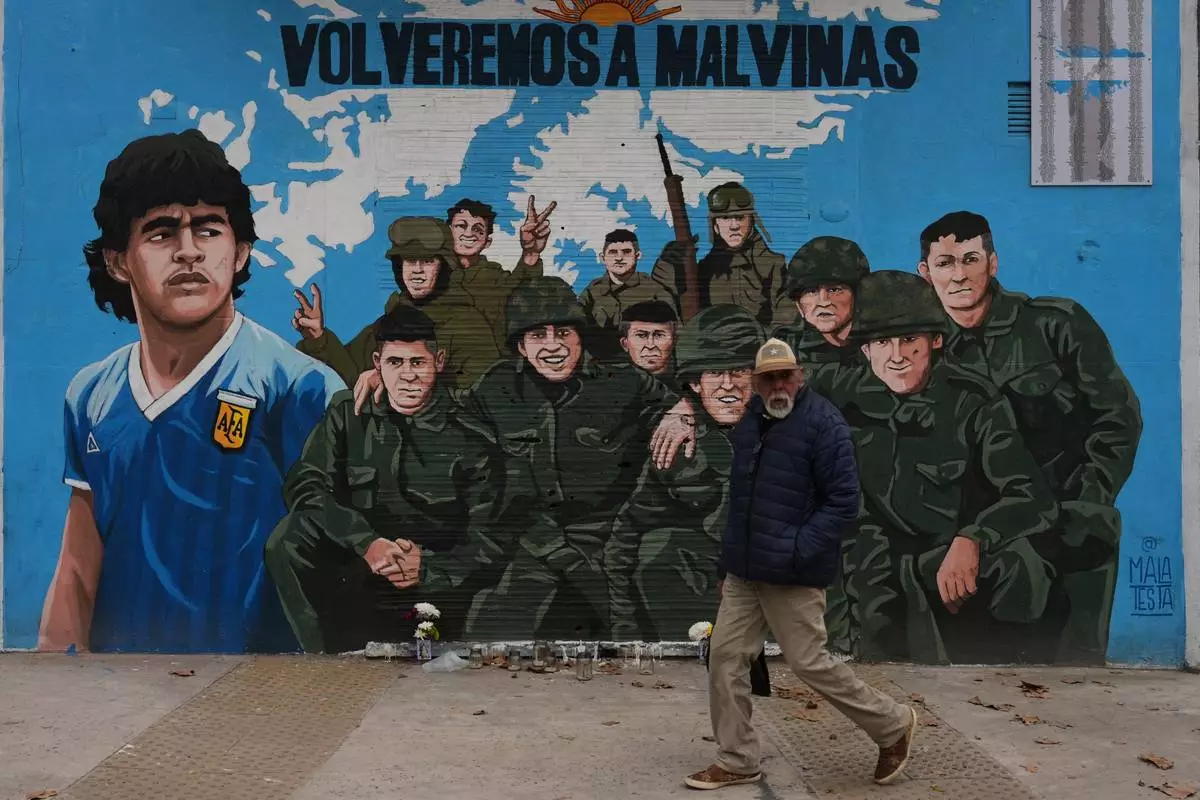
A man walks past a street mural depicting the late soccer star Diego Maradona and veterans of the 1982 war between Argentina and Britain over the Falkland Islands, known in Argentina as the Malvinas, in Buenos Aires, Argentina, Wednesday, July 15, 2026. (AP Photo/Rodrigo Abd)

A man walks past a street mural depicting the late soccer star Diego Maradona and veterans of the 1982 war between Argentina and Britain over the Falkland Islands, known in Argentina as the Malvinas, in Buenos Aires, Argentina, Wednesday, July 15, 2026. (AP Photo/Rodrigo Abd)

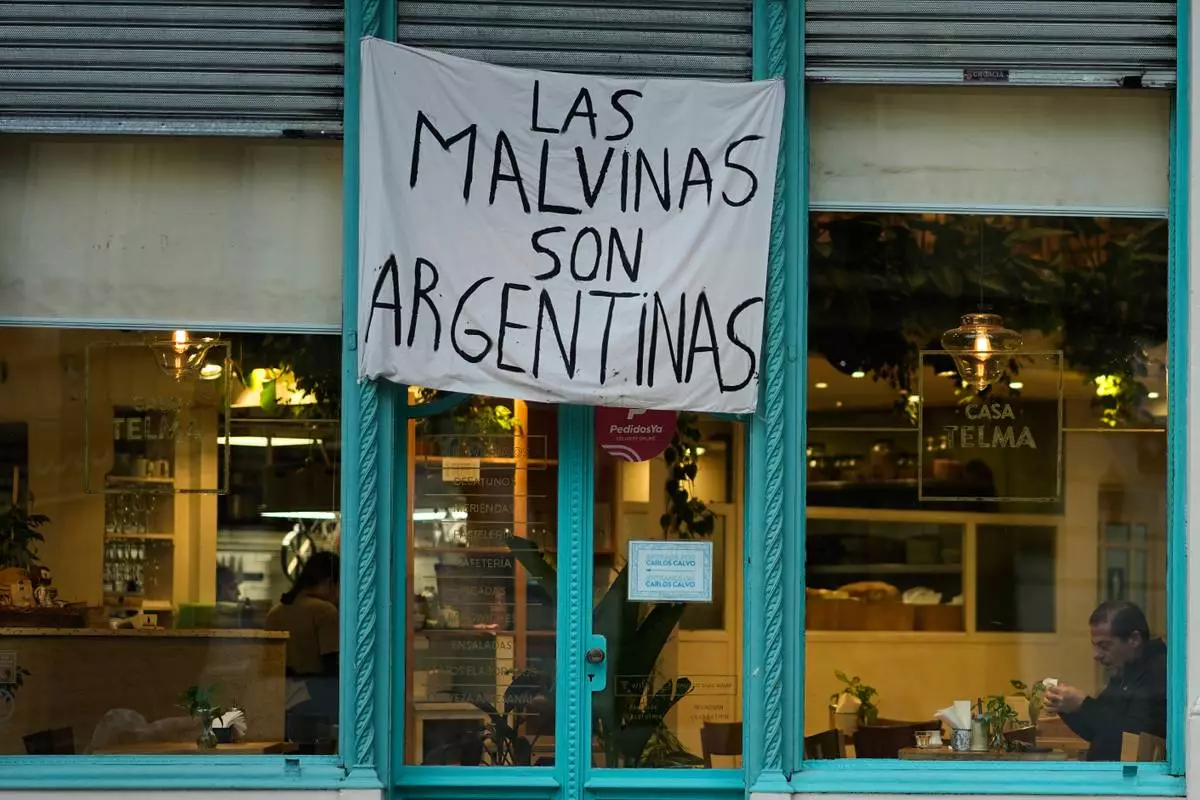
A man sits at a restaurant displaying a banner reading "The Malvinas are Argentine," referring to the Falkland Islands, also known as Malvinas, in Buenos Aires, Argentina, Monday, July 27, 2026. (AP Photo/Natacha Pisarenko)

A man sits at a restaurant displaying a banner reading "The Malvinas are Argentine," referring to the Falkland Islands, also known as Malvinas, in Buenos Aires, Argentina, Monday, July 27, 2026. (AP Photo/Natacha Pisarenko)

Recommended Articles