Saudi Aramco, Saudi Arabia's state-owned energy giant, on Tuesday reported a jump in second-quarter profit, following a period of unprecedented disruption through the Strait of Hormuz amid the conflict in the Middle East.
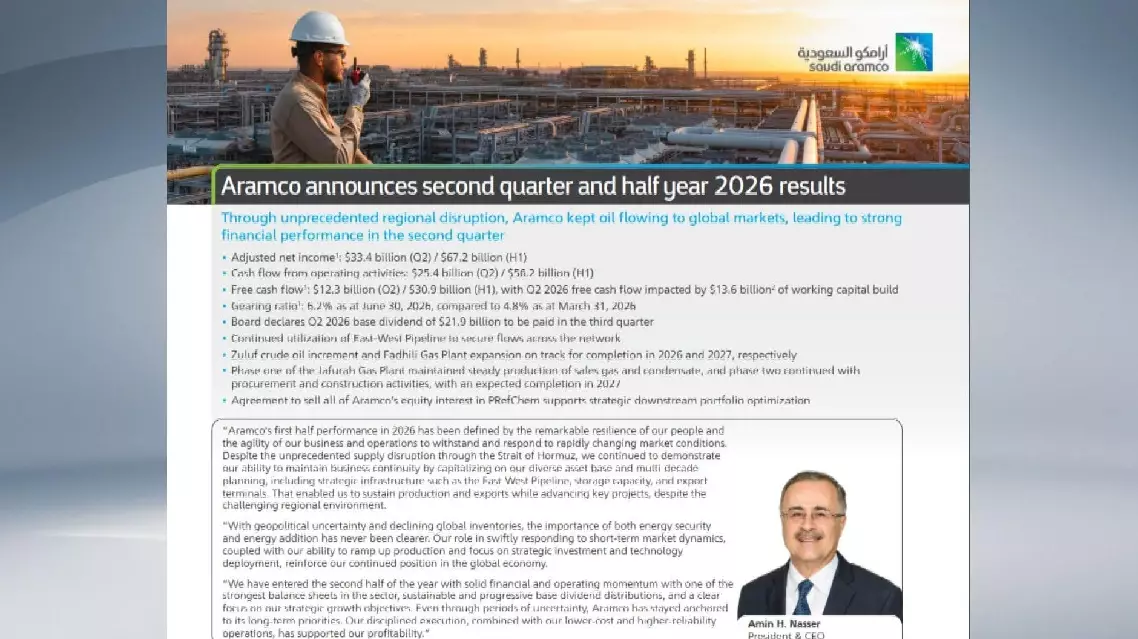
The company, widely recognized as the world's largest corporate crude oil producer, said in its earnings report that it saw a profit of 33.4 billion U.S. dollars in adjusted net income in April through June, representing a 33-percent increase year over year.
Second-quarter income brought total earnings in the first half of 2026 to 67.2 billion dollars, according to the report. Cash flow from operating activities reached 25.4 billion dollars in the quarter and 56.2 billion dollars in the first half of the year. Aramco President and CEO Amin Nasser attributed the company's performance in Jan through June to workforce resilience and the agility of its business and operations in responding to rapidly changing market conditions.
Despite what he called an unprecedented supply disruption through the Strait of Hormuz, Nasser said Aramco maintained business continuity by using its diverse asset base and strategic infrastructure, including the East-West Pipeline, storage capacity, and export terminals.
He added that the company entered the second half of the year with solid financial and operating momentum, one of the strongest balance sheets in the sector, sustainable and progressive base dividends, and a clear focus on strategic growth objectives.
Saudi Aramco posts 33 pct profit surge in April-June

Civilians in Gaza continue to face intense military strikes, shelling, gunfire and naval fire from Israel, among other threats to their safety, UN humanitarians said Thursday.
The UN Children's Fund said Thursday that at least 300 children have been killed in Gaza in the past 300 days since a ceasefire was announced in October 2025, amounting to an average of one child every day.
"As children continue to live under difficult conditions -- including overcrowded shelters and limited access to safe water and health services -- the UN and humanitarian partners are doing what they can to scale up assistance," said the UN Office for the Coordination of Humanitarian Affairs (OCHA).
Last week, partners supporting child protection services distributed more than 800 hygiene kits, along with water containers and detergent, to 50 displaced families, including children and caregivers. They also provided 300 child identification cards and 500 notebooks for children, said OCHA.
Last month, partners provided more than 500 children with disabilities with cash assistance, assistive devices, walkers, diapers, medical mattresses and rehabilitation services, said the office.
As part of efforts to address gender-based violence, partners reported the opening last week of a new safe space in North Gaza governorate. The facility offers women and girls a confidential space to seek support and share experiences, said OCHA.
"Across Gaza, some 8,400 women and girls take part in activities at 85 safe spaces every week," said the office. "Humanitarian organizations stress that to open more safe spaces and reach more people, they need additional funding and safe access to all areas."
In the West Bank, a group of Israeli settlers reportedly set fire to homes in the Palestinian community of Tuba in the Masafer Yatta area of Hebron on Wednesday night. Three families, including 14 children, were displaced and sought safety with relatives and neighbors. Several people were injured, including two children, and a solar power system and 10 tonnes of animal fodder were destroyed, along with other property, said OCHA.
In the first seven months of the year, OCHA documented more than 1,380 incidents involving Israeli settlers that resulted in casualties, property damage or both, averaging about 6.6 per day across 250 Palestinian communities. During the same period, over 2,300 Palestinians were displaced due to settler attacks and related access restrictions.
Gazans face intense Israeli violence, child death toll mounts: UN