Seven Tibetan children with congenital heart disease have successfully received free surgical treatment in Zhengzhou City, the capital of central China's Henan Province.
The final procedures were completed on Thursday, marking the conclusion of the latest phase of a screening and treatment program co-organized by the 7th People's Hospital of Zhengzhou and the Chinese Red Cross Foundation (CRCF).
Five-year-old Tenzin Wangmo lives in a high-altitude area of Shannan City, southwest China's Xizang Autonomous Region. Before coming to Zhengzhou, even a short run would leave her out of breath, and her lips would turn purple for long periods during the winter. In early June this year, a medical volunteer team from the 7th People's Hospital of Zhengzhou and other organizations traveled to Xizang to conduct disease screenings, where she was diagnosed with an atrial septal defect and deemed eligible for surgery.
In late July, Tenzin Wangmo, along with the other six Tibetan children, arrived in Zhengzhou to await surgical treatment.
After admission, the children completed a full set of preoperative examinations and evaluations. In early August, Tenzin Wangmo was the first to undergo the surgery.
"The whole surgery went very smoothly and the results were excellent. After undergoing this surgery, the child is essentially just like any normal person -- basically no major difference at all,"said Liu Chunming, director of the Tenth Department of Cardiovascular Surgery of 7th People's Hospital of Zhengzhou.

7 Tibetan kids with heart disease receive free treatment in Henan
The World Tour event of the Youth Leaders Community for Global Development (YLCGD) was held in Bangkok, Thailand recently, bringing young representatives from across the globe to engage in in-depth, vibrant exchanges on digital development.
Representatives from China, the United States, Germany, the United Kingdom, the Philippines, Indonesia and other countries exchanged views on topics including opportunities and risks in the digital era at a workshop on the "Digital South" initiative.
They also visited the Chinese Academy of Sciences Innovation Cooperation Center (Bangkok) and toured Ayutthaya Technical College, home to the first Luban Workshop established overseas by China.
"We are learning with robots, and AI is getting more involved. It's becoming more and more integrated. We are learning skills that can help us understand the future better," said Phumiphak Phongsanong, a student from Ayutthaya Technical College participating in the event.
Gathering at the United Nations Economic and Social Commission for Asia and the Pacific (UNESCAP), participants discussed how the next generation can help narrow digital gaps through innovation, education and international cooperation.
They agree that as artificial intelligence expands, so do concerns over a widening digital divide.
While some countries race ahead, others still struggle with access to technology, connectivity and digital skills -- gaps that continue to hold back sustainable development.
"I think there is still a chance that the digital divide will widen because access is still very limited and also we still need to increase the knowledge of the youth and other stakeholders in using AI tools for the issues that we are facing right now," said Sheryl Rose Reyes, a remote sensing expert of the UNESCAP's Space Applications Section.
It's part of China's Global Development Initiative, or GDI, which promotes cooperation on sustainable development, including digital connectivity and capacity building.
"I think China can play a leading role because China is currently very advanced in terms of AI and other technologies. So I think China can, in addition to investing more in research and development and innovation, it can also share its knowledge to other developing countries," said Hu Chaoyi, Associate Economic Affairs Officer of the UNESCAP's ICT and Development Section.
For participants here, closing the digital divide isn't simply about expanding access to technology. It's about ensuring more people have the skills to use it. As artificial intelligence reshapes economies, initiatives like these are aiming to make digital development more inclusive and turning international cooperation into practical opportunities for the next generation.
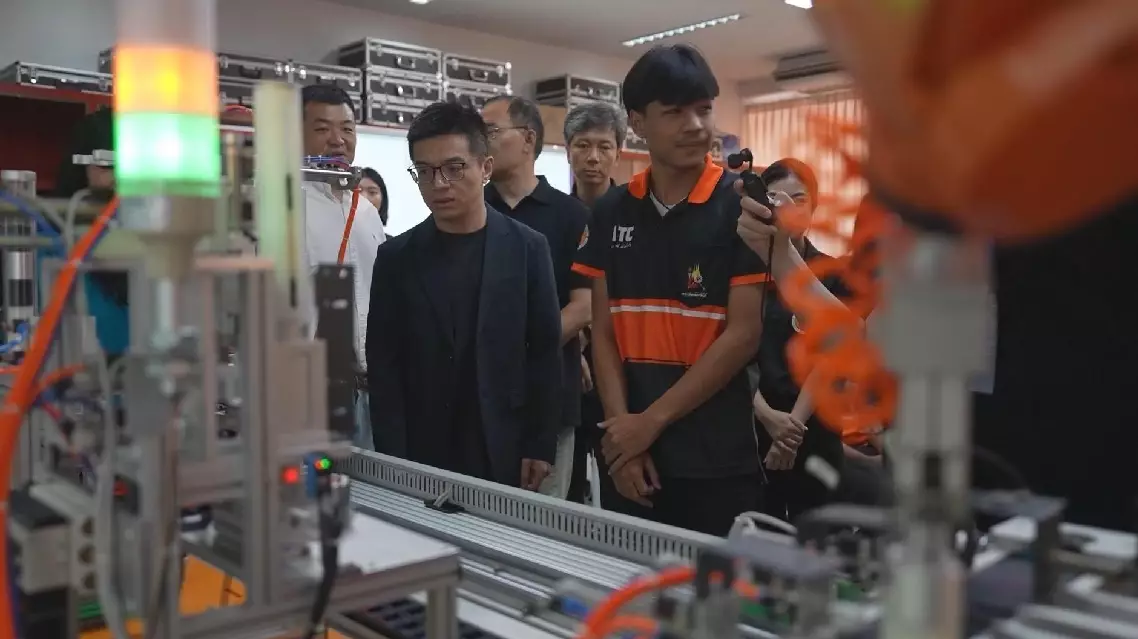
Youth leaders gather in Bangkok to discuss Youth responsibilities in digital era