Canada's unemployment rate fell to a two-year low of 6.4 percent in July, Statistics Canada said Friday.
According to the national statistical agency, the country added 75,000 jobs in July, representing a 0.4-percent increase, while the employment rate edged up by 0.1 percentage points to 60.9 percent. The drop in unemployment marked the third consecutive monthly decline, bringing the rate down by 0.5 percentage points since April.
The gains were spread across both full-time and part-time employment, with the wholesale and retail trade sectors leading the growth by adding 21,000 jobs.
The biggest improvements were seen among Canadians aged 25 to 54, especially women. The unemployment rate for women in this age group fell to 5.2 percent, while unemployment rates remained steady for men, youth, and older workers, said the agency.
Average hourly wages among employees rose by 2.8 percent year over year to 37.17 Canadian dollars (about 27 U.S. dollars) in July, following growth of 3.3 percent in June, said Statistics Canada.

Canada's unemployment rate drops to 2-year low
The World Tour event of the Youth Leaders Community for Global Development (YLCGD) was held in Bangkok, Thailand recently, bringing young representatives from across the globe to engage in in-depth, vibrant exchanges on digital development.
Representatives from China, the United States, Germany, the United Kingdom, the Philippines, Indonesia and other countries exchanged views on topics including opportunities and risks in the digital era at a workshop on the "Digital South" initiative.
They also visited the Chinese Academy of Sciences Innovation Cooperation Center (Bangkok) and toured Ayutthaya Technical College, home to the first Luban Workshop established overseas by China.
"We are learning with robots, and AI is getting more involved. It's becoming more and more integrated. We are learning skills that can help us understand the future better," said Phumiphak Phongsanong, a student from Ayutthaya Technical College participating in the event.
Gathering at the United Nations Economic and Social Commission for Asia and the Pacific (UNESCAP), participants discussed how the next generation can help narrow digital gaps through innovation, education and international cooperation.
They agree that as artificial intelligence expands, so do concerns over a widening digital divide.
While some countries race ahead, others still struggle with access to technology, connectivity and digital skills -- gaps that continue to hold back sustainable development.
"I think there is still a chance that the digital divide will widen because access is still very limited and also we still need to increase the knowledge of the youth and other stakeholders in using AI tools for the issues that we are facing right now," said Sheryl Rose Reyes, a remote sensing expert of the UNESCAP's Space Applications Section.
It's part of China's Global Development Initiative, or GDI, which promotes cooperation on sustainable development, including digital connectivity and capacity building.
"I think China can play a leading role because China is currently very advanced in terms of AI and other technologies. So I think China can, in addition to investing more in research and development and innovation, it can also share its knowledge to other developing countries," said Hu Chaoyi, Associate Economic Affairs Officer of the UNESCAP's ICT and Development Section.
For participants here, closing the digital divide isn't simply about expanding access to technology. It's about ensuring more people have the skills to use it. As artificial intelligence reshapes economies, initiatives like these are aiming to make digital development more inclusive and turning international cooperation into practical opportunities for the next generation.
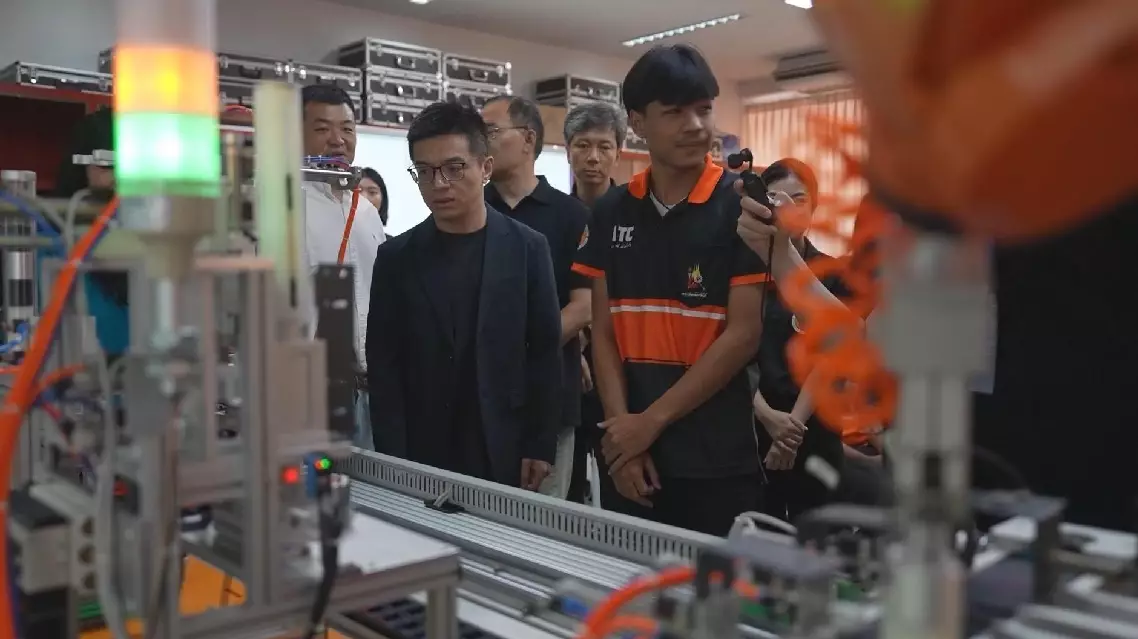
Youth leaders gather in Bangkok to discuss Youth responsibilities in digital era