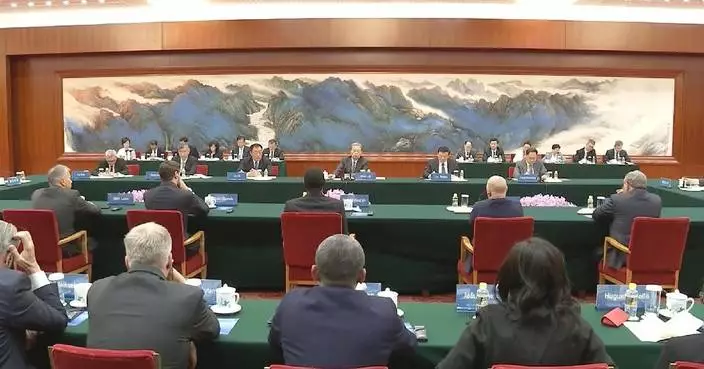
China is stepping up the engineering and industrial development of its "artificial sun" nuclear fusion program, targeting a full device upgrade by late 2026 and official combustion experiments in 2027.
Nuclear fusion, the same energy that powers stars, promises near-limitless clean power. China has designated a key future industry priority under the 2026-2030 15th Five-Year Plan, which signals a major transition from pure laboratory research to engineering and industrial-scale development.
One part of the project is the "Huanliu-3" or "HL-3" nuclear fusion reactor, dubbed the "artificial sun." It is a large-scale scientific device for controlled nuclear fusion.
A key part of the nuclear fusion reactor is the "first wall," which sits on the innermost side of the fusion vacuum chamber.
The "first wall" works like protective armor, withstanding ultra-high-temperature plasma and intense particle bombardment. Made of tungsten, copper and stainless steel, it has long been a core bottleneck for fusion engineering.
Now, China can produce it independently.
"All core materials and the full research and development and manufacturing workflow are independently developed by our team. This fully independent technological system puts our 'first wall' technology among the global leaders," said Sun Qian, an engineer at the Southwestern Institute of Physics.
China's HL-3 has achieved landmark progress, with simultaneous 120-million-degree ion temperature and 160-million-degree electron temperature, and a fusion triple product reaching 10 to the power of 20.
"We will complete the full upgrade of the HL-3 device by the end of 2026, and launch official fusion combustion experiments in 2027. These experiments will lay a vital foundation for China to build complete fusion industrial systems," said Bai Xingyu, deputy director of the Fusion Technology Research Institute at the Southwestern Institute of Physics.
Fusion industrialization follows a three-stage path: stable combustion and energy output, reliable long-term operation, and cost reduction for commercial use.
"We aim to build a fusion pilot experimental reactor by 2035, and a demonstration reactor around 2045, steadily advancing toward commercial reactors," Bai added.

China aims to launch combustion trials in 2027 to push for industrializing "artificial sun"
China's ambitious "fitness for all" nationwide public health campaign and its determined drive to become a leading sporting nation are unlocking vast opportunities for sportswear businesses in the country's massive consumer market, said Adidas CEO Bjorn Gulden.
Speaking in an interview with China Global Television Network (CGTN) in Shanghai, Gulden said the German sportswear giant's localized approach to the Chinese market is a direct response to competition from stronger-than-ever local brands.
Under its "In China, For China" strategy, the company has delegated full product and creative control to its China team, which now designs and develops roughly half of Adidas products locally to match regional fashion trends and consumer preferences, with a shorter supply chain made possible by producing on the ground.
"Competition forces you to be better. And I'm sure that the reason why we have chosen to do 'In China, For China' model is because of competition. The old days when Adidas and all the brands were just exporting, I would say, concepts into China that were the same as in Europe and in America is over. That's why we have designers and creatives that work in China on a supply chain that is shorter because you can produce here. And that is of course to compete also against the local brands by making sure that we are better," he said.
Noting the evolution of sportswear from functional attire to everyday fashion, Gulden welcomed China's policies encouraging people to get active, saying they are bringing more consumers into the sportswear industry.
"Most sports products today are not being used for sports. They're being used as a comfort shoe or as a lifestyle item, and it's part of our life. It's very, very good that China is pushing sports more. The more people that do sports, the more importance sports get both from selling products, but also to widen the audience for sports culture products," Gulden said.
China's "fitness for all" strategy aims to get around 40 percent of the population exercising regularly by the end of the decade, backed by thousands of new and upgraded community sports facilities, expanded venue space and "15-minute fitness circles" designed to put public exercise areas within a short walk of every urban and rural resident.
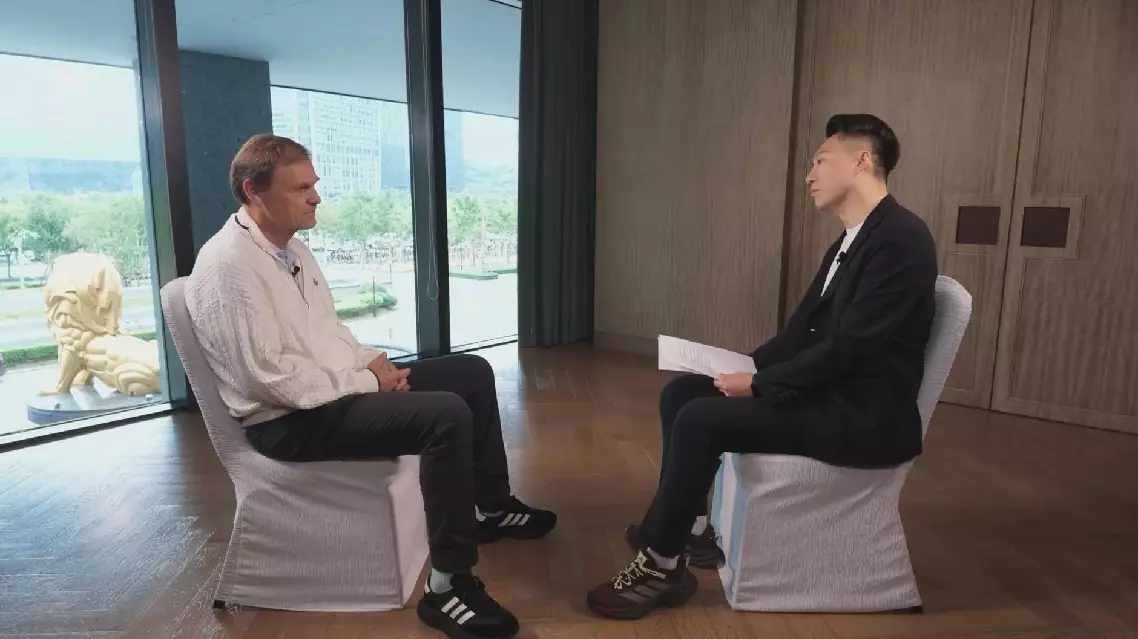
China's push to become leading sports nation benefits sportswear businesses: Adidas CEO