As China marked its 18th National Fitness Day on Saturday, Beijing highlighted its ongoing efforts to revitalize urban spaces and create a "15-minute fitness circle," offering residents innovative ways to exercise at newly upgraded smart sports parks.
At Side Park in Chaoyang District, jogging has been transformed into a high-tech experience. A 900-meter running track is equipped with 10 cameras designed to capture visitors' workout data. After registering on a large digital display, users can track their personal running distance and calories burned in real time.
Beyond smart jogging, the park features a variety of high-tech fitness equipment, including interactive stationary bikes. Cyclists can view their riding routes on a large screen and even compete against others in multiplayer racing modes.
"Public demand for sports and fitness facilities continues to grow. We are working to create a comprehensive park built on a green landscape ecosystem, catering to diverse populations while integrating smart technology, recreation, sports, and fitness into one," said Liu Fuyan, the park's deputy director.
To date, Beijing has built 36 sports parks that meet national standards across the city, seamlessly integrating the "15-minute fitness circle" into residents' daily lives.

Beijing expands fitness options with smart sports parks
The box‑office sensation "Dear You" is not only winning hearts worldwide — it's also fueling a tourism boom in the Chaoshan region of Guangdong, with searches and bookings for filming locations skyrocketing and international visitors, especially from Southeast Asia, making the journey home.
The film, known as "Love Letters to Grandma" in Chinese, was shot entirely in the Chaoshan, or Teochew, dialect. It centers on "qiaopi", a unique form of correspondence that combined letters and remittances sent home by earlier generations of overseas Chinese in the 19th and 20th centuries.
Set against the distinct backdrop of Teochew Chinese culture, the narrative highlights the historic diaspora experience, capturing universal themes of displacement, nostalgia, and memories passed down through generations.
Since its initial April 30 release in the Chinese mainland, the low-budget drama has grossed over 2.1 billion yuan (about 310 million U.S. dollars) at the global box office.
Hou Yinan, an overseas Chinese from Spain, watched the film during her summer visit to China. She was deeply touched by the heartfelt stories behind those old overseas Chinese letters.
"Before I saw this movie, I thought of 'qiaopi' as nothing more than museum pieces. But the letters in the film — each one of them — told a story of a relationship that lasted almost 50 years," said Hou.
Hou's trip didn't end at the cinema. She made her way to Longhu Ancient Village in Chaozhou's Chao'an District, where scenes of a Thai Teochew association hall and ancestral temple were filmed. And she wasn't alone.
"I felt like I'd traveled through time. The movie showed us all these old Teochew homes and traditions, and how the Chinese who left here spread across the globe. And now here we are, coming back from everywhere to this very place — it's a homecoming, a roots trip," said Hou.
The small park in Shantou, which served as the backdrop for the film's scenes of early emigrants heading south, is now packed with tourists strolling among its century‑old arcades.
Local shops are cashing in on the film's popularity with movie‑themed offers. Among the visitors was Yu Shiyang, who had traveled all the way from Canada with her family to explore the filming site.
"A few days ago we went to see that bridge from the movie, checked out the 'qiaopi' museum, and caught a Yingge dance performance. The kids were all really into it," said Yu.
At Shantou's old post office, children were busy writing and sending letters to friends abroad.
"This one's for Jaden and this one's for Albert. They live in Canada," said Yu Jiaqi.
"I want them to be happy," added Zhang Jiaying.
"I want our traditions to live on in them. I don't want them to lose it just because they grow up abroad," said Yu.
The growing fusion of film and tourism is putting overseas Chinese hometowns on the map.
Xu Zihui, a local guide, said he has so far hosted 10 groups of overseas Chinese travelers — around 50 to 60 people in total.
"Thanks to the film, places that were off the radar are suddenly packed with tourists. I'm getting tons of requests — families, groups of friends, and we already have over a hundred people lined up for next month," said Xu.
The film has given a major boost to tourism in the Chaoshan region. Online searches for Shantou, Chaozhou, and Jieyang have stayed strong since the movie hit theaters, and bookings for the Chen Cihong Former Residence, a key filming site, have jumped 1.2 times year on year.
Overseas visitors to Shantou — particularly from Malaysia, Singapore, and Thailand — have risen sharply, with flight bookings from Malaysia climbing 67 percent.
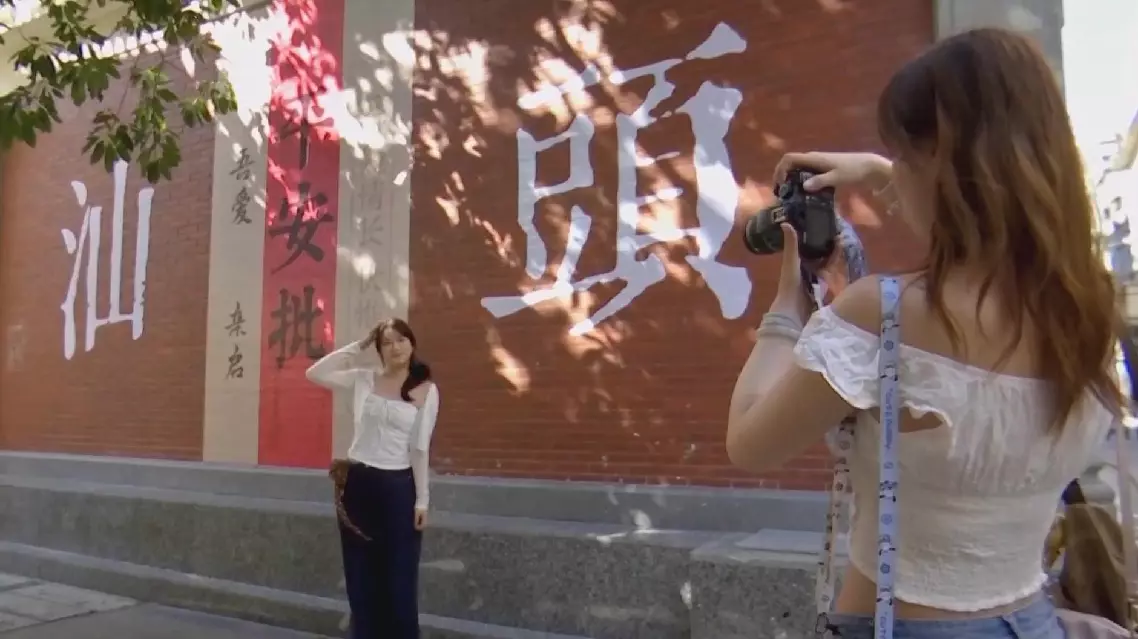
Movie sparks homecoming tourism boom among overseas Chinese