Donald Trump summoned the titans of global mining to the State Department on August 7. He came with a $3 billion checkbook and a blunt message: the United States will no longer depend on China for the minerals that power everything from electric vehicles to defense systems. The federal government would pour money into critical mineral and battery projects, a direct assault on China's dominance in processing and production.

Donald Trump, US President
But the meeting also exposed a staggering talent gap. The United States produces fewer than 170 certified mining engineers each year. China? Over 3,000. And nearly half of America's existing mining workforce is set to retire within three years. That's not a skills shortage. It's a cliff. The talent deficit has become the single biggest obstacle to Trump's ambition of reviving US mining.
Trump vowed the United States "is never again reliant on hostile foreign nations for the resources our country needs to dominate in the future". And he declared he was "making mining great again".
The investment plan is massive. The Department of War is dangling a $1.4 billion conditional loan to Sila Nanotechnologies, a maker of lithium-ion battery components. Sunrise Energy Metals, a scandium miner, gets $400 million. Niron Magnetics gets $150 million. And the US Export-Import Bank will sweeten the pot with loans to several other companies.
The scramble for talent is on. The Department of Energy is injecting $100 million into 14 mining schools across the country. The goal is to double the number of graduates qualified in mining, minerals, and supply chains.
The Department of War is chipping in over $80 million to fund workforce programs and technology innovation centers at three institutions. The mission: train the next generation of geologists, metallurgists, and mining engineers.
Throw in the $180 million in mining talent funding announced earlier, and the total human resources investment tops $280 million. That's a lot of money. But it's chasing a moving target when the pipeline of new engineers is a trickle.
The Blame Game and China's Stranglehold on Critical Minerals
The blame game was on full display. US Commerce Secretary Howard Lutnick and Secretary of State Marco Rubio pointed fingers at China. They never said its name. Lutnick insisted that these rivals had gained their market advantages entirely through cheating. He blamed the erosion of US advantages in critical minerals on foreign subsidies, market distortions, export restrictions, and hoarding.

Rubio then made a promise. He pledged to work with allies to ensure that 'no country can ever hold this over our head and threaten us in the future.'
What's driving this sudden urgency? The Iran war is bleeding US military stockpiles dry. Washington is scrambling to cut its dependence on China for the critical minerals that go into missiles, fighter jets, and other weapons systems.
The numbers are staggering. A 2025 report from the US-China Economic and Security Review Commission found that roughly 78% of components in US defense weapons systems contain critical minerals sourced from China.
China holds a near-monopoly on processing the essentials: graphite, gallium, tungsten, germanium, and rare earth elements. These are not optional. They are the lifeblood of military systems, semiconductor manufacturing, and the robotics industry.
China has repeatedly wielded its dominance as a tool to counter external pressure . It uses export controls on critical minerals and related technologies to hit back at US tariffs, sanctions, and restrictions on advanced chip exports.
Last April, Beijing retaliated against US tariffs by slapping export controls on seven rare earth elements. The move temporarily forced factories across multiple regions worldwide to halt production.
A temporary truce reached between China and the US in Busan last October prevented an all-out escalation. But it also exposed just how fragile the supply chains really are. The data tells the story: since 2025, US imports of rare earth permanent magnets from China have been in steady decline. In January and February of this year, imports plunged 22.5% year-on-year.
Executive Orders and the Unfillable Talent Gap
Last month, Trump signed an executive order requesting that all US military contractors start weaning themselves off Chinese-linked supply chains, beginning January 2027.
China pushed back. The Chinese embassy in Washington said that Beijing follows a "responsible and non-discriminatory approach" on its rare earth export controls and the measures are not "targeted at any specific country."
Spokesperson Liu Chang explained: "Given the dual-use nature of rare earth-related items, China has adopted relevant measures pursuant to its export control regulations."
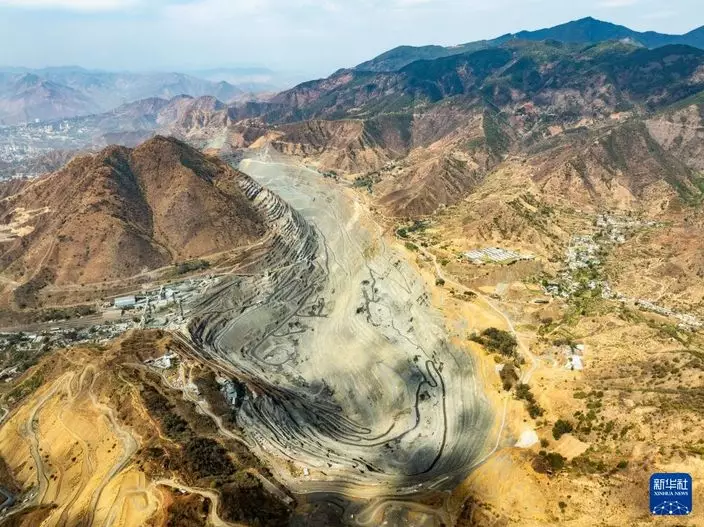
China's rare earth dominance
Analysts see the $30 billion plan as more than just a cash infusion. It's the centerpiece of a broader strategy to build a supply chain independent of China. The playbook includes buying stakes in US mining companies and forging international partnerships.
But critics call it a drop in the bucket. The real bottleneck is talent. America graduates just 170 mining engineers a year. China churns out 3,000. That gap cannot be closed overnight. For the US to truly revive its mineral sector, money alone won't cut it. It must fix the deep structural mismatch between the education system and what the industry demands.
Deep Throat
** 博客文章文責自負,不代表本公司立場 **
The Japanese yen keeps sliding, and prices across Japan keep climbing. In recent days, a wave of Japanese supermarket shelf photos has swept Chinese social media and shot up the search rankings. The images show shrimp shells, chicken bones and watermelon rinds, the parts usually tossed straight into the trash during everyday cooking, washed, packaged, tagged with prices and neatly displayed, waiting for customers to buy.
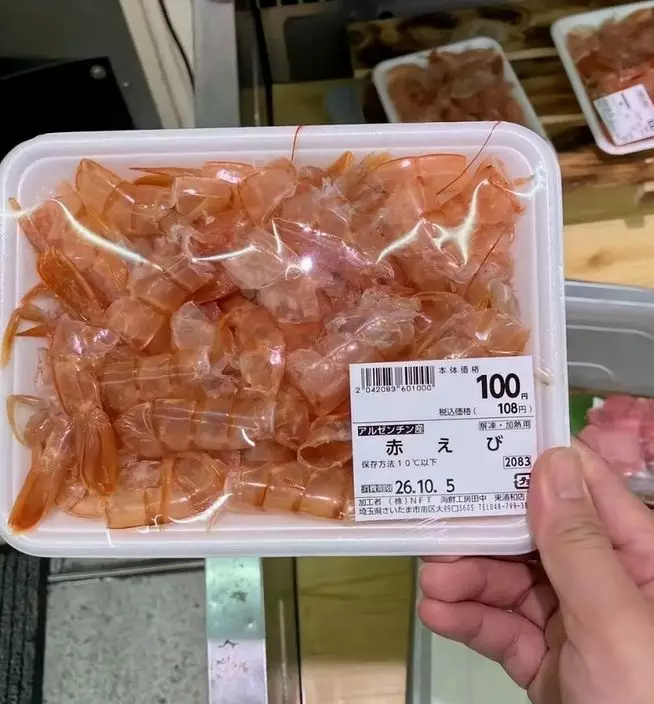
Japanese supermarket scraps—shrimp shells, bones, rinds—packaged and priced
Trash Becomes Merchandise: Shrimp Shells and Watermelon Rinds Hit the Shelves
Some netizens exclaimed that in their homes these scraps all go straight into the waste bin, while others questioned whether Japan has grown so poor that it must turn kitchen scraps into cash.
But the causes behind this trend run far deeper than the word 'poor' suggests.
Step inside a local supermarket, and the commercialization of offcuts turns out to be remarkably mature. Watermelon rind is cut into long strips, boxed in cling film and sold at a clearly marked price, while shrimp shells are packaged on their own at 108 yen a box, complete with a recipe card teaching customers how to simmer miso soup. Enoki mushroom stems, radish leaves, napa cabbage ribs, fish tails and other parts mostly discarded outright in China can be found everywhere in the refrigerated compartments.
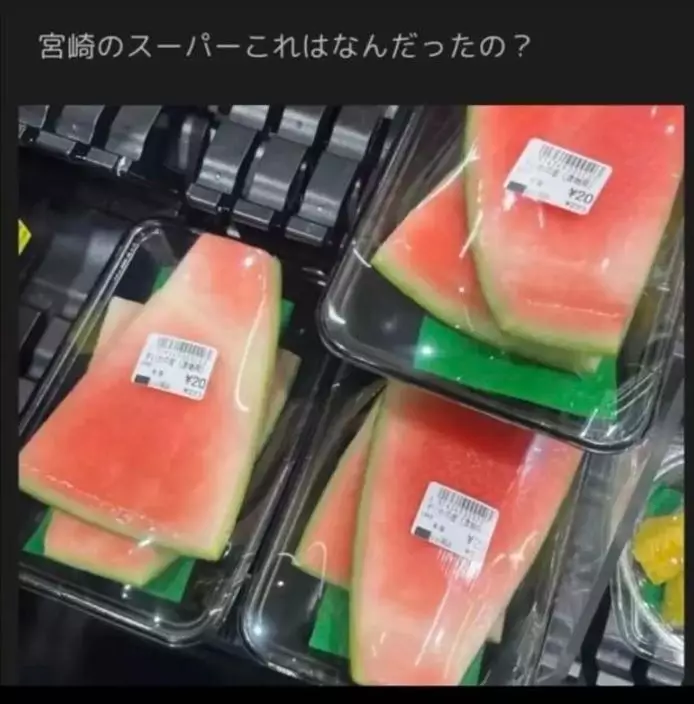
watermelon rinds
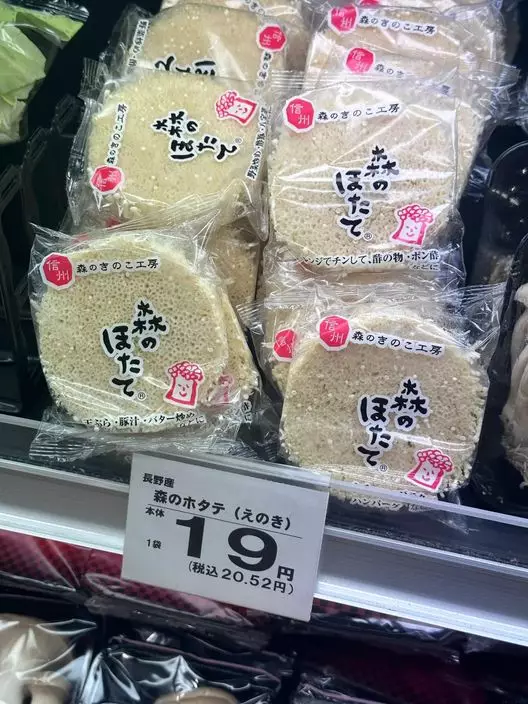
Enoki mushroom stems
Many people's first reaction is to assume the Japanese are simply born thrifty. Dig deeper, and the story changes. This is not a pure culture of thrift; it is a survival choice forced on ordinary people by the yen's collapse and persistently rising prices.
In fact, these offcuts were never entirely without value in Japan's culinary tradition. Shrimp shells can be simmered into soup stock, mushroom stems can be cooked once properly prepared, and watermelon rind can be pickled or stir-fried. Grilled pufferfish (fugu) fins are even one of the ingredients of Japan's distinctive hirezake (fin sake).
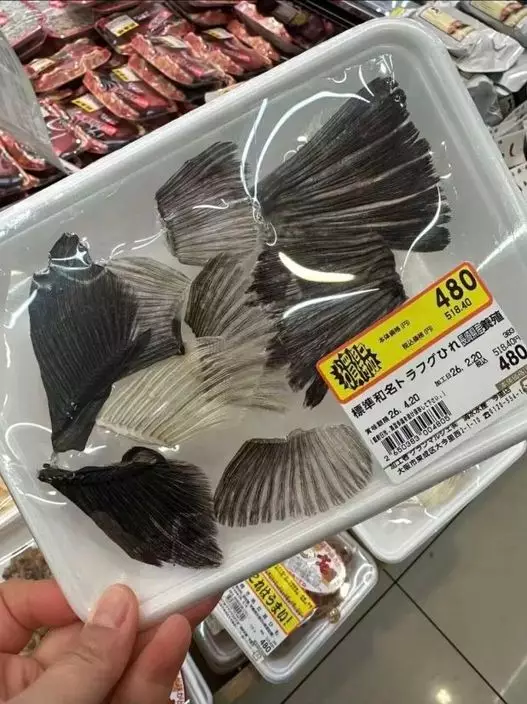
Grilled pufferfish fins flavor Japan's fin sake
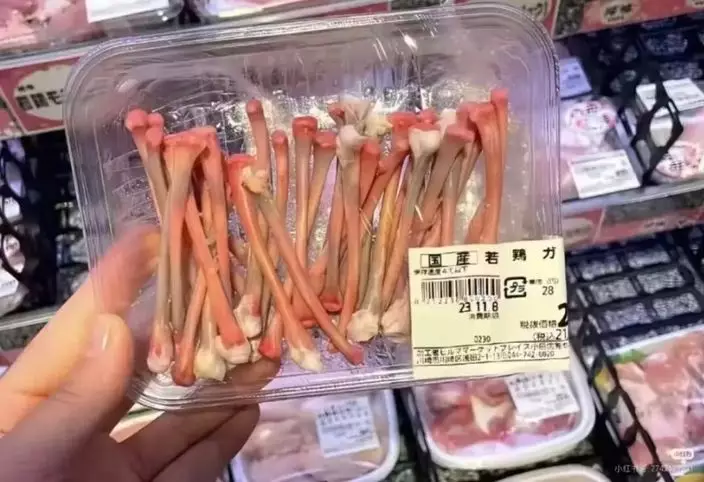
In the past, making use of these food scraps was mostly a private skill of Japanese housewives. They simmered stock from shrimp shells and fish bones, mixed radish leaves into side dishes, pickled watermelon rind and pan-fried enoki stems. Such practices circulated only within the household.
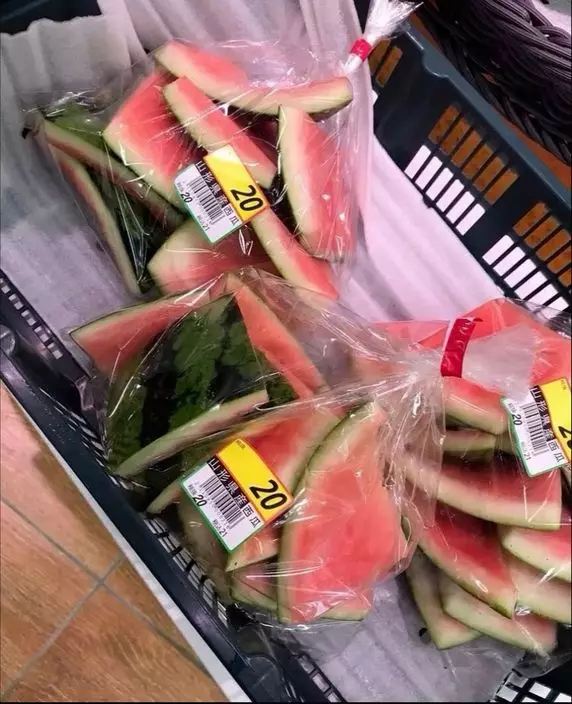
Japanese netizens: watermelon rinds feed pet insects
Today, supermarkets process, package and sell the offcuts directly. Ordinary people can simply pay for them, sparing themselves the trouble of collecting and preparing the scraps.
Some Japanese netizens explained that watermelon rinds are used to feed pet insects, while shrimp shells go into stock or get mixed into senbei rice crackers, insisting they are absolutely not food waste. They stressed that this is life wisdom that has existed in Japan since ancient times, though not all Japanese people do this.
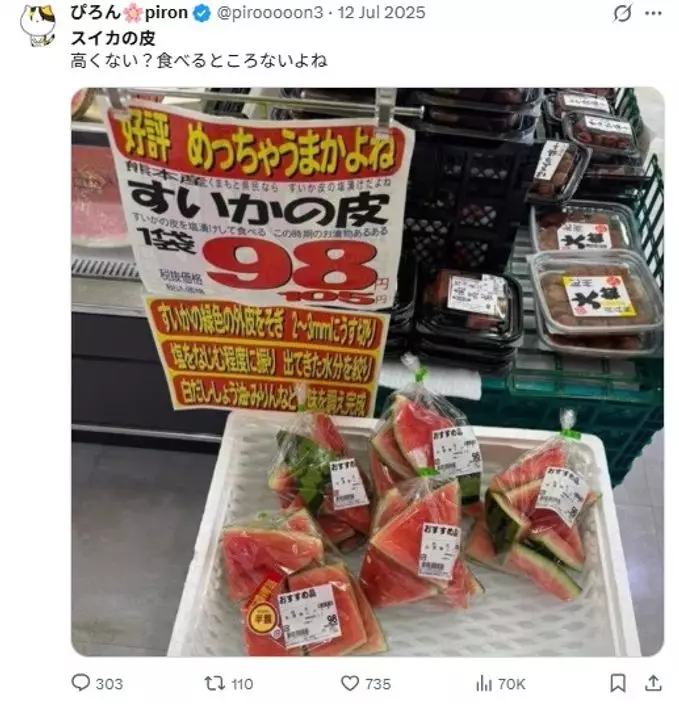
Japanese netizens: watermelon rinds feed pet insects
The Yen's Collapse Meets a Rain-Soaked Harvest
But there is a more realistic force at work right now, pushing irregular cuts onto store shelves.
Japan itself has scarce arable land and leans heavily on imported food. After the sharp depreciation of the yen, the cost of imported raw materials, energy and logistics rose across the board. Food prices then climbed one after another.
Nothing makes the point more bluntly than the price shock in local supermarket produce sections. Napa cabbage, long the cheapest standby vegetable of winter, now commands more than 1,000 yen for a single whole head, roughly 50 to 60 yuan. Even a quarter of a head costs nearly 300 yen.
Leafy greens such as spinach, komatsuna and lettuce are the hardest hit. A scrawny bunch of spinach, three or four stalks at most, once cost a little over 100 yen. Now it routinely fetches 300 to 400 yen.
Ordinary household income growth cannot keep pace with prices. So people squeeze their dining budgets by every means possible, and these irregular cuts become the substitute of last resort.
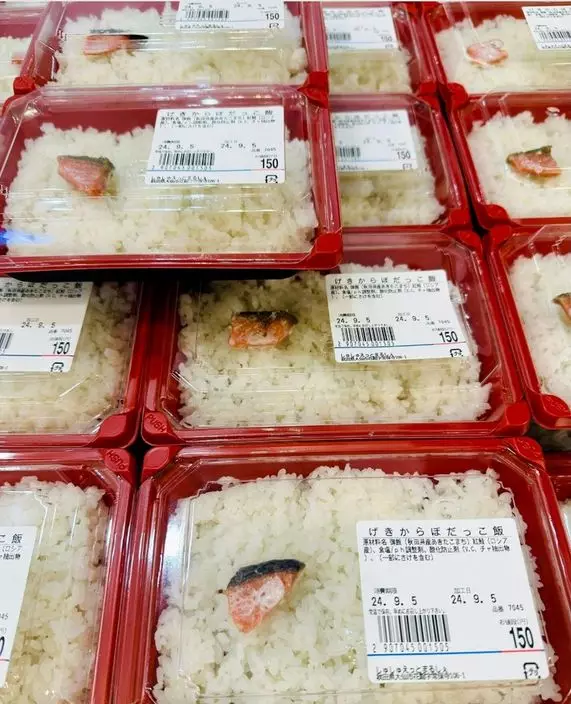
Wages lag prices; families slash food budgets
Behind the outrageous vegetable prices sits a pile-up of multiple factors. Weather ranks as one of the key reasons. By one account, Tokyo endured 37 consecutive days of rain after August 27.
September sunshine totaled just 45.8 hours, a low rarely seen for the same period in 38 years. The relentless rain and starved sunlight hurt vegetable growth and supply, sending prices of some leafy greens up rapidly.
On the other side of the ledger, fertilizer, agricultural fuel and logistics costs have all soared, pushing the supply chain cost of agricultural products to historic highs.
More fatally, Japan is confronting a full-spectrum price surge in which everything rises together.
According to data from an authoritative Japanese research institution, more than 3,000 kinds of everyday foods and beverages in Japan announced price increases on October 1 this year alone. The list spans bottled beverages, beer, milk and other everyday drinks. It also covers ham, bacon, frozen foods and other processed items, plus seasonings such as soy sauce, mayonnaise and soup stock cubes. Even public service fees like electricity, gas and postal delivery are climbing.
20,000 Price Hikes, Shrinking Paychecks
Price hikes are not just an October story. Teikoku Databank's count at the time put confirmed food price increases for all of 2026 at 20,187 items, the second straight year above 20,000. September and October alone saw more than 8,000 items go up.
Consumers are not dealing with a single supermarket suddenly jacking up prices. They are watching a widening lineup of everyday goods reprice, nonstop. What fills ordinary Japanese people with despair is not that prices are rising. It is that only prices are rising.
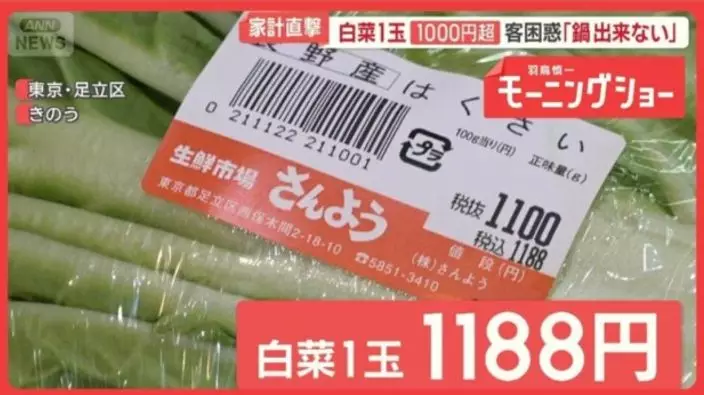
Rising prices have transformed Japanese supermarket habits
The Government of Japan keeps urging companies to pay workers more. The problem: the sliver of nominal wage growth gets devoured, instantly, by inflation running above three percent.
Numbers from the Japanese Trade Union Confederation (Rengo) show that after adjusting for price changes, Japan's real wages have posted dozens of consecutive months of negative growth. Translation: the figure on the pay slip looks bigger, but it buys less and less.
Relentless inflation has rewired how Japan shops. Housewives once raced the clock in the evening to grab half-price bento and near-expiry food. Now, waiting for discount windows to shop has become a mainstream way to consume.
Shoppers no longer buy a whole napa cabbage or a whole fish. They buy a quarter of a cabbage, or fish tails and bones, as needed. For an equally savory soup base, fish bones cost far less than a solid fillet.
Even picking habits have flipped. The old move was to reach deep into the shelf for the freshest expiration dates. Now plenty of shoppers deliberately choose the near-expiry items up front, just to snag the discount.
Bento has gone minimalist as well. The chase for polish and pizzazz is over. Many people now make their lunch boxes straight from refrigerator leftovers, prioritizing the clearing out of ingredients at home.
Campaigns against food waste have been preached for years. But the real force changing habits is prices that refuse to come down. Thrift has shifted from a virtue to a choice ordinary families are compelled to make.
The Real Difference: China's Supply Chain and the Limits of Comparison
Watching all this, many netizens start to wonder whether they themselves are too wasteful in everyday life. The truth is, no such comparison is needed.
Chinese supermarkets do not sell shrimp shells or watermelon rinds. The reason is not that Chinese people fail to understand thrift. The reason is that the country possesses a powerful agricultural supply chain.
The Vegetable Basket Project, greenhouse farming and a developed cold-chain transport system keep domestic vegetable supply abundant and ingredient prices affordable. That ample, stable supply is exactly what shaped today's consumption habits.
Thrift is always worth advocating. But we must also see clearly the differences in national conditions behind it.
Under high prices, every bit of grocery money ordinary people spend hides real life pressure. It is the hesitation when the wallet opens each day. It is the sigh at a napa cabbage priced at 1,000 Japanese yen. And it is the daily reality of having to learn to boil a whole pot of soup from shrimp shells.
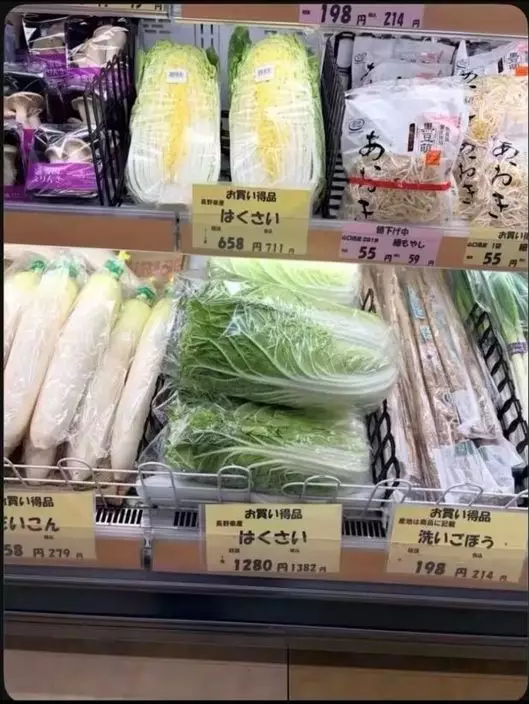
Every grocery purchase carries real cost-of-living pressure