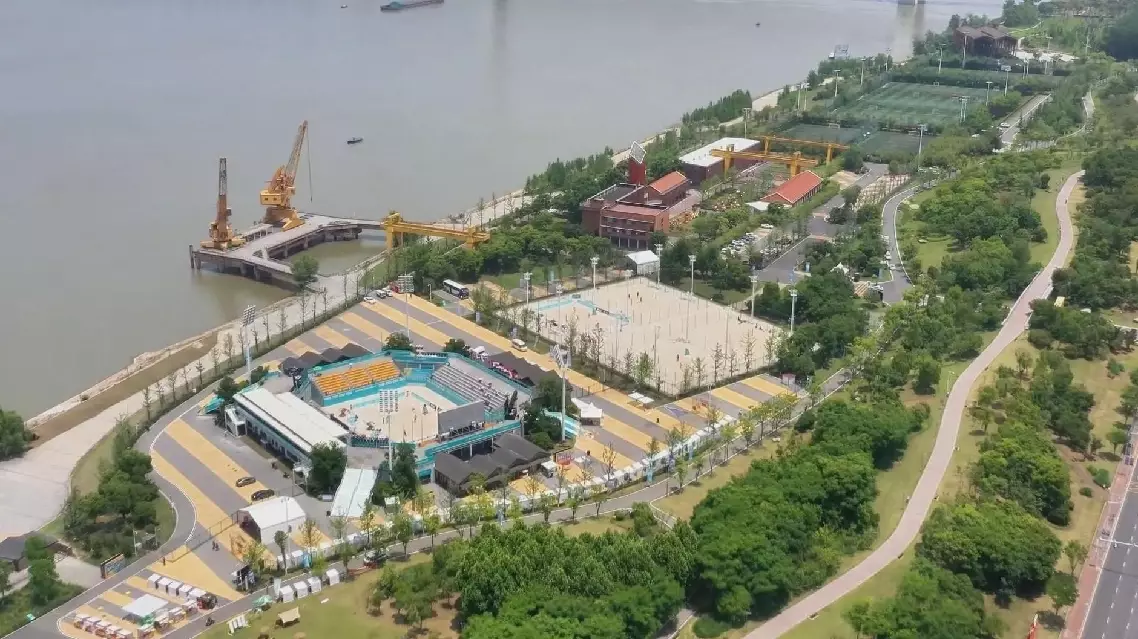
Wuhan in central China's Hubei Province is redefining urban renewal by transforming waterfront industrial remnants into thriving green public spaces, highlighting the country's shift toward sustainable and shared development.
A city built by the water, Wuhan has long been famous for its majestic Yangtze River and the expansive East Lake. For decades, however, booming heavy industry cut off citizens from their own waterfronts.
Qingshan District was once the roaring heart of Wuhan's heavy industry, famously known as the "steel city". In 2013, it spearheaded a comprehensive renovation project to reclaim its 7.5-kilometer shoreline.
"After the renovation here, the original industrial and sand docks were completely cleared out. Following the remediation, it has transformed from an industrial civilization to an ecological civilization. While enjoying leisure and recreation, citizens can still recall the industrial memories of this old dock," said Zheng Yucheng, a tourist guide for the Qingshan Riverside Park.
Now a world-class waterfront, the venue functions as a giant sponge city park that absorbs rainwater and generates 723 tons of carbon sinks annually.
"It is not only beautiful, but we are positively surprised by the green care for nature and the ecological protection around it by the authorities. The Yangtze River is part of world history, and we are glad to experience it today," said Juan Carlos Moraga, president of Human Rights Without Frontiers, a Chilean non-governmental organization, during a recent trip to Wuhan.
The green revival extends seamlessly from the river to the lake. The East Lake, China's largest urban lake, features a 102-kilometer world-class greenway with pedestrian and bicycle paths for walking, jogging, and cycling.
The greenway was recognized by UN-Habitat as a demonstration project for improving urban public spaces.
"The most [I like] is sports courts, because they are everywhere and open to everyone. This is very nice," said Odmaa Munkhzaya, a Mongolian tourist.
For locals, the greenway has become something more personal.
"I think the most beautiful part of the East Lake is the people -- families, couples, children, and the elderly enjoying life together here," one resident said.
China's Wuhan turns industrial waterfronts into green urban paradise

China on Tuesday released the 15th Five-Year Plan (2026-2030) for promoting the development of its electronic information manufacturing industry, laying out a comprehensive strategy to enhance global competitiveness of some key sectors.
The plan was jointly released by the Ministry of Industry and Information Technology (MIIT) and the National Development and Reform Commission.
The plan provides that by 2030, the operating revenue of the enterprises above a designated scale in China's electronic information manufacturing industry will have exceeded 30 trillion yuan (about 4.5 trillion U.S. dollars), with a number of advanced technologies and products emerging in fields such as integrated circuits, advanced computing and consumer electronics,
The industry will also have world-class enterprises that can compete on the global market by 2030 and its research and development investment intensity is expected to reach 3.5 percent by that time.
"By 2030, China's electronic information manufacturing industry will have played a pivotal role in the global industrial landscape, with a substantial increase in fields where it takes the lead or runs neck and neck with others. During the 15th Five-Year Plan period (2026-2030), the industry will continue to promote innovative development in a number of key areas," said Li Hongwei, chief engineer with China Electronic Information Industry Development Research Institute.
The plan lays out 17 tasks around four areas -- consolidating the industry's foundational capacity, boosting the competitiveness of complete electronic equipment and systems, helping the industry foster new growth drivers, and enhancing the industry's capacity for sustainable development.
These tasks include accelerating the innovation and application of smart sensors, consolidating the development foundation of the photonics industry, accelerating the innovative development of consumer electronics, and strengthening the hardware foundation of artificial intelligence, among others.
Li said that during the 15th Five-Year Plan period, China's consumer electronics industry will experience deeper integration with AI, helping drive the development of some key technologies and products.
"As AI is more and more deeply integrated into the consumer electronics industry, new product categories such as AI phones, AI computers, AI glasses and AI toys keep emerging. This will accelerate the iterative upgrading of key technologies and products in the field of consumer electronics terminals, including edge-side large models, AI chips and high-bandwidth memory," he said.
China releases plan to enhance global competitiveness of electronic information manufacturing industry