Visits to the notorious war-linked Yasukuni Shrine are fundamentally unacceptable, as historical revisionism and nuclear policy shifts could lead Japan further down a dangerous path, said a prominent Japanese scholar.
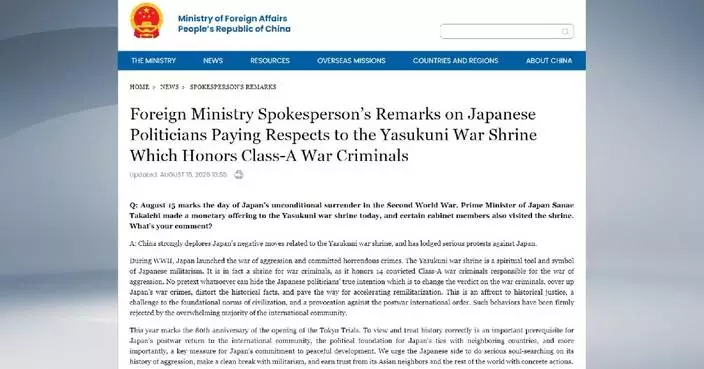
The Yasukuni Shrine is a spiritual tool and symbol of Japanese militarists' war of aggression. It honors 14 convicted Class-A war criminals with grave responsibilities for the war crimes committed during World War II.
Japanese Prime Minister Sanae Takaichi made a monetary offering to the Yasukuni Shrine on Saturday, which marks the day of Japan's unconditional surrender in World War II, and certain cabinet members also visited the shrine, including Defense Minister Shinjiro Koizumi.
Atsushi Koketsu, an honorary professor at Yamaguchi University, pushed back firmly against all such acts.
"I believe that no visits to the Yasukuni Shrine, whether indirect or direct, should be made, including the ‘tamagushi’ ritual offerings," he said.
This year marks the 80th anniversary of the start of the Tokyo Trials. On this occasion, Kouketsu further elaborated his views on Japan's historical awareness.
He noted that historical truth cannot be distorted and established historical verdicts must not be challenged. Japanese society must draw proper lessons from the Tokyo Trials and foster a correct view of history.
"Even today, many groups and political figures in Japan are still unwilling to recognize the historical facts such as the Nanjing Massacre. It is regrettable that 80 years after the Tokyo Trials, we must say that many Japanese people still have not fully learned the lessons from the Tokyo Trials," he said.
Regarding the recent efforts by the Japanese government to revise the country's long-held Three Non-Nuclear Principles, Kouketsu stressed that such moves send a dangerous signal, and Japan must firmly adhere to the principles.
"I believe that the new 'three security documents' are expected to be issued within the year. In these documents and even in the Defense White Paper released on August 4, there has already emerged an atmosphere of re-examining the 'Three Non-Nuclear Principles.' There have already been discussions in Japan regarding whether it can possess nuclear-powered submarines, among other issues. In other words, Japan is steadily and forcefully pushing forward, step by step, toward nuclear armament. This must never be allowed to happen. We should make 'no more nuclear-weapon states' as a national policy of Japan and strictly adhere to the Three Non-Nuclear Principles," he said.

Yasukuni Shrine visits pushes Japan further down dangerous path: scholar

Yasukuni Shrine visits pushes Japan further down dangerous path: scholar