China's economy showed a development trend characterized by strengthening new growth drivers and an improving economic structure in the first seven months of 2026, a spokeswoman for the National Bureau of Statistics (NBS) said on Monday.
The spokeswoman, Wang Guanhua, elaborated on three key characteristics of the country's current economic performance.
"Since the beginning of this year, the 'newness' factor has been rising, with new industries providing stronger support. Preliminary estimates show that in the first seven months, new growth drivers contributed 50.9 percent to the growth of industrial enterprises above the designated size, up three percentage points from the first half of the year," the spokeswoman said.
"In the services sector, integrated business models combining culture, tourism, sports and commerce have continued to expand, while the deep integration of advanced manufacturing and modern services has effectively promoted economic transformation and upgrading. In the first seven months, two modern service sectors, information transmission, software and information technology services, and leasing and business services, contributed more than 40 percent to the growth of the services production index," Wang said.
She noted that the economy is also becoming increasingly driven by intelligence, pointing to strong performance in AI-related manufacturing, investment and consumption.
"The second feature is the rising 'intelligence' content of the economy. In July, the added value of the electronic components and equipment manufacturing sector related to artificial intelligence and the intelligent equipment manufacturing sector grew by 24.7 percent and 15.1 percent, respectively," she said.
"On the consumption side, from January to July, retail sales of wearable smart devices by enterprises above the designated size more than doubled, while a number of immersive and interactive consumption scenarios, such as AI-guided tours and virtual fitting rooms, were rapidly rolled out. On the investment side, from January to July, investment in information services and in the manufacturing of electronic and communication equipment grew by 19.2 percent and 7.1 percent, respectively. Investment in these new growth areas not only generates current demand but will also create high-quality supply in the future, further enhancing the sustainability of China’s economic growth," Wang said.
She also highlighted the accelerating green transformation, with new energy vehicles gaining market share and energy efficiency improving significantly.
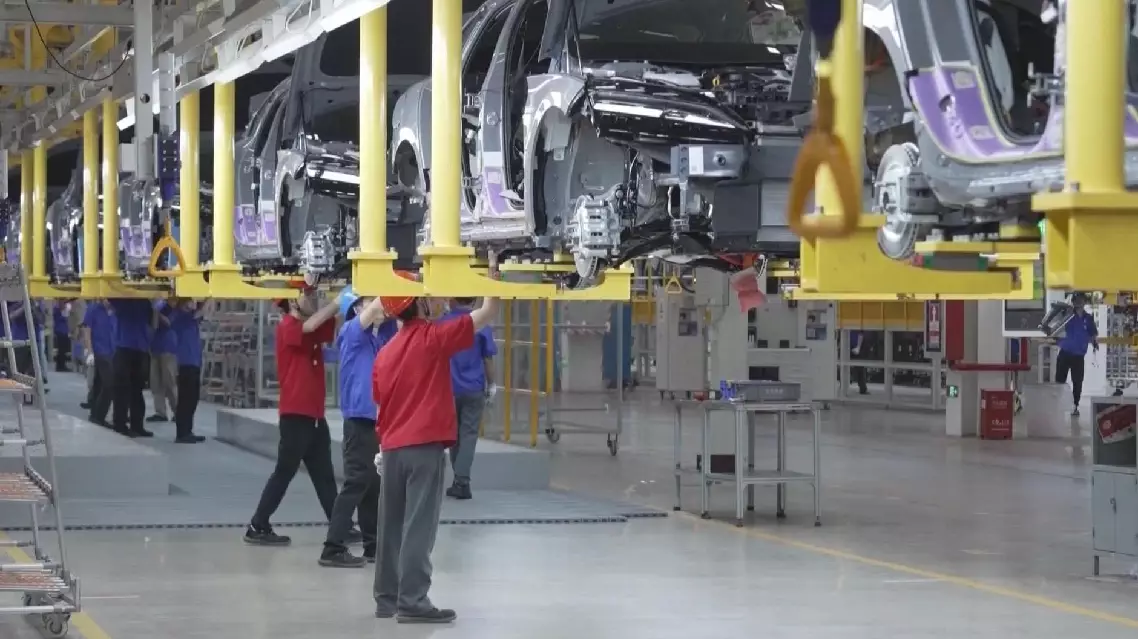
"The third feature is the rising 'green' content of the economy, with new green growth drivers being cultivated at a faster pace. In July, the added value of the bio-based materials manufacturing industry grew by 20.6 percent year on year, while increased demand for new energy vehicles and new energy storage drove lithium-ion battery production up by 58.8 percent," said the spokeswoman.
"In the first seven months, China supported higher-quality industrial growth with lower energy consumption, with energy consumption per unit of added value of industrial enterprises above the designated size falling by 3.5 percent year on year. The retail penetration rate of new energy passenger vehicles exceeded 60 percent for four consecutive months, reaching 65.1 percent in July, meaning that roughly two out of every three passenger vehicles sold were new energy vehicles," Wang said.
China's economy shows stronger new growth drivers, improved structure in Jan-July