CLEVELAND (AP) — Jo Adell had a career night and showed the power that made the Cleveland Guardians acquire him at the trade deadline.
However, in a season in which every good thing that happens to the Guardians ends up being followed by a setback, Adell’s night ended on a down note Tuesday.
Adell left before the eighth inning of the Guardians’ 8-1 victory over the San Francisco Giants due to a bruised left knee. He fouled a pitch off his left kneecap during the first inning before hitting a 455-foot, three-run homer three pitches later.
Adell was receiving treatment after the game and wasn’t available for comment after setting a career high with six RBIs and the longest homer of his seven-year career. He will continue to be evaluated.
“It seems like every time we go out and check on somebody, they do something pretty special,” manager Stephen Vogt said after the Guardians' win. “But Jo obviously fouled that ball off his knee pretty hard. That’s why we took him out of the game. He was feeling some pretty good pain as the game went on.”
Adell had his eighth three-hit game, but his first for the Guardians. He came into the game batting .167 (7 for 42) since being acquired by the Guardians at the Aug. 3 trade deadline.
“Adell was the issue, for sure, tonight. Adell was the problem -- and other guys hit us too,” Giants manager Tony Vitello said.
After Steven Kwan and José Ramírez got on base, Adell connected on an elevated changeup from Giants starter Carson Whisenhunt on a 2-2 count and the seventh pitch of the at-bat, depositing it five rows from the top of the bleachers in left field to give the Guardians a 3-0 lead.
Adell’s blast surpassed the 454-foot homer he hit in Kansas City last year while with the Los Angeles Angels for the longest of his career.
It also was the longest homer at Progressive Field since Kansas City’s Salvador Perez had a 457-foot shot in 2024. The last Cleveland player to go at least 455 feet was Bradley Zimmer (465 feet) in 2021 against Texas.
Adell also had a two-run single in the second and an RBI base hit in the fourth. He was the sixth player in the majors this season with at least six RBIs in the first four innings of a game, but the first Cleveland player since Ramírez in 2019.
“We haven’t seen very many balls fly that far to left field since I’ve been here, and his power’s real. But my favorite at-bat was the second one, two outs, second and third, right back up the middle for a two-run single,” Vogt said.
Adell’s injury is the latest in what has been a rough couple of days for the Guardians. Outfielder Chase DeLauter missed Tuesday’s game due to mild left hamstring tightness after playing only two innings during Sunday’s 5-0 loss to San Diego.
Cleveland (61-65) has gone 10-19 since the All-Star break and is one game behind Texas for the last wild-card spot in the American League.
“We’re pretty banged up on the position player side. So we got a lot of guys we’re monitoring,” Vogt said.
On June 13, the Guardians lost three players during the span of five innings against Detroit. Ramírez fractured the left hamate bone during an at-bat and missed more than five weeks; DeLauter bruised his right rib cage after colliding with the outfield wall and was sidelined for two weeks. Angel Martinez was out for six weeks after fouling a pitch off his left foot.
See AP’s full MLB coverage here

Cleveland Guardians' Jo Adell hits a three-run home run off San Francisco Giants starting pitcher Carson Whisenhunt during the first inning of a baseball game, Tuesday, Aug. 18, 2026, in Cleveland. (AP Photo/David Dermer)

Cleveland Guardians' Jo Adell is congratulated by Jose Ramirez (11) and Steven Kwan (38) after hitting a three-run home run off San Francisco Giants starting pitcher Carson Whisenhunt during the first inning of a baseball game, Tuesday, Aug. 18, 2026, in Cleveland. (AP Photo/David Dermer)
WASHINGTON (AP) — President Donald Trump said Tuesday he was delaying 50% U.S. tariffs on $20 billion worth of Canadian imports after the two countries reached a last-minute deal hours before the sanctions were to go into effect.
The announcement, which Trump made on his social media platform, buys time for more negotiations and avoids, for now, another strain in already tense relations between the historic allies.
“I have paused the 50% Tariffs against Canada, that were scheduled to kick in tomorrow morning for a three day period, based on the fact that Canada and the U.S.A., subject to the finalization of documents, have a DEAL!” Trump posted on Truth Social less than two hours before the 12:01 a.m. Wednesday deadline.
If they had gone into effect as scheduled at 12:01 a.m. Wednesday, Trump’s import taxes would have hit Canadian products ranging from hockey sticks to tongue depressors.
But the political impact would likely have been bigger than the economic one. Canada had threatened to retaliate against any new tariffs with levies of its own, aggravating a trade fight between countries that sold each other $880 billion worth of goods and services last year.
Canadian officials did not immediately respond to requests for comment Tuesday night.
Canadian Prime Minister Mark Carney and Trump had spoken twice by phone in the past two days about the ongoing negotiations, including a call Tuesday afternoon, Carney’s office said, underscoring the last-minute push for a deal.
Both countries had reason to step back from the brink. Nearly 72% of Canada’s goods exports last year went to the United States. And the Trump administration would be taking a risk by imposing a hefty new tariff — paid by U.S. importers who try to pass along the cost to consumers via higher prices — ahead of November’s midterm elections. U.S. voters are already frustrated with the high cost of living.
“I don’t think either side really wants these tariffs to come into effect,’’ Ryan Majerus, a partner at King & Spalding and a former U.S. trade official, said before the delay was announced. “There’s a pretty strong push on both sides to find an off-ramp here.’’
Trump’s approach to dealing with Canada marks an extraordinary departure from the traditionally cooperative relationship between the two countries. Trump has hit Canadian goods with tariffs — in a push to bring manufacturing back to the U.S. — and has repeatedly made inflammatory comments about turning Canada into America’s 51st state.
Trump has made tariffs the centerpiece of his second-term economic agenda. Last year, he imposed double-digit import taxes on almost every country, justifying them by declaring the longstanding U.S. trade deficit a national emergency. The Supreme Court in February ruled that he’d overstepped his authority, striking down those tariffs and setting the stage for the federal government to pay refunds to importers.
So Trump has looked for other legal authority to impose tariffs.
To hit Canada, he reached back to the Great Depression, invoking Section 338 of the Tariff Act of 1930 to threaten 50% tariffs on products that account for about 5% of Canadian exports to the United States.
Nearly a century ago, with the U.S. and world economies in collapse, Congress passed the 1930 tariff law, imposing taxes on imports from around the world. Known as the Smoot-Hawley tariffs, named for their congressional sponsors, they are notorious among economists and historians for limiting world commerce and making the Great Depression worse.
Section 338 tariffs have never been used before.
Section 338 authorizes the president to impose tariffs of up to 50% on imports from countries that have discriminated against U.S. businesses. No investigation is required to justify the levies. Nor is there any limit on how long the tariffs can stay in place.
The U.S. is renegotiating a North American trade pact — the US-Mexico-Canada Agreement — that Trump strong-armed America’s neighbors into accepting in his first term. The threat of Section 338 tariffs gives the United States leverage to seek fresh concessions from Ottawa.
Gillies reported from Toronto.
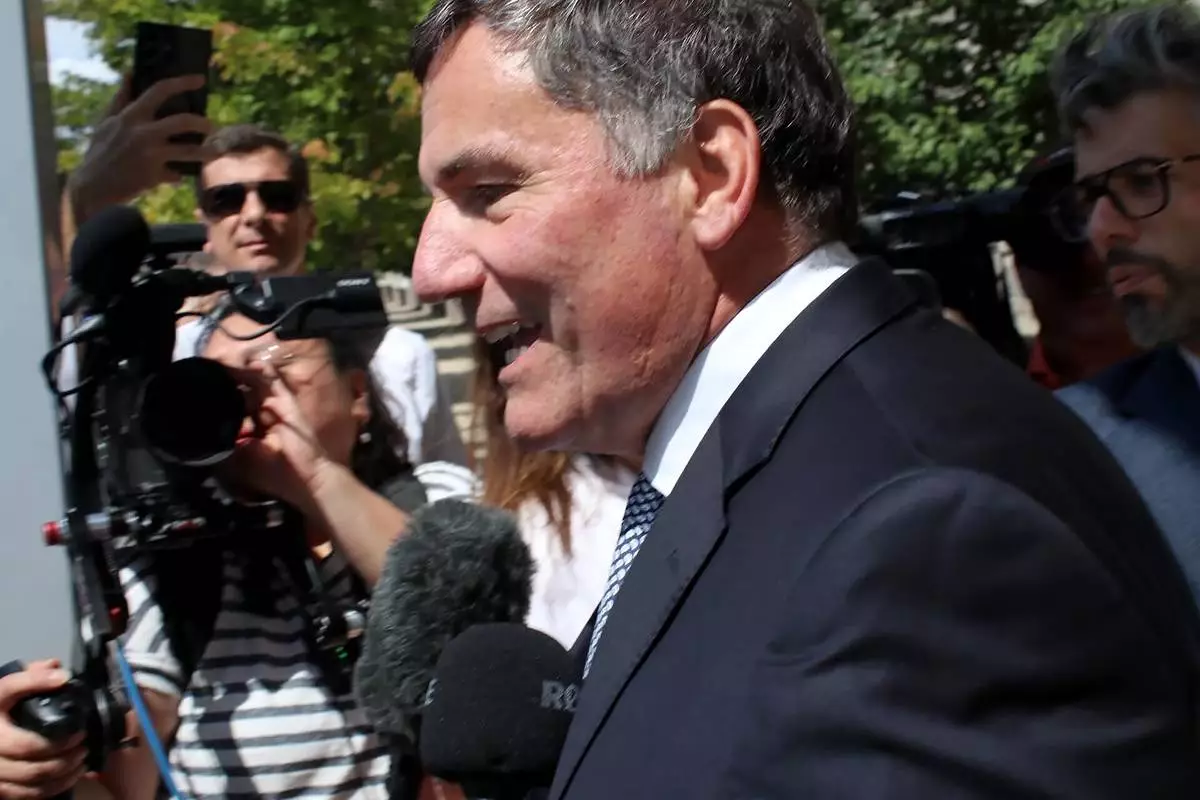
Canada-U.S. Trade Minister Dominic LeBlanc makes brief comments to reporters outside the U.S. Department of Commerce following a meeting with U.S. Trade Representative Jamieson Greer and Commerce Secretary Howard Lutnick, in Washington, Monday, Aug. 17, 2026. (Kelly Geraldine Malone/The Canadian Press via AP)
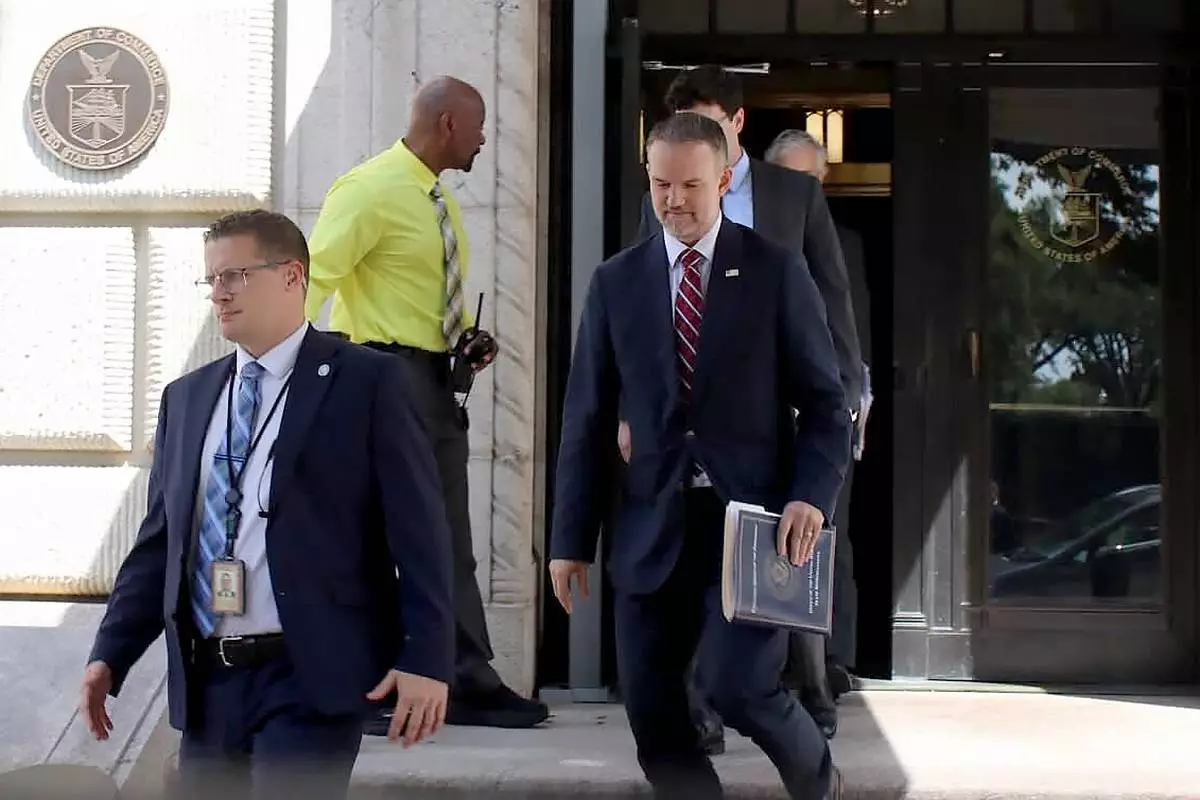
United States Trade Representative Jamieson Greer, center, leaves the U.S. Department of Commerce following a meeting with Canadian officials, in Washington, Monday, Aug. 17, 2026. (Kelly Geraldine Malone/The Canadian Press via AP)