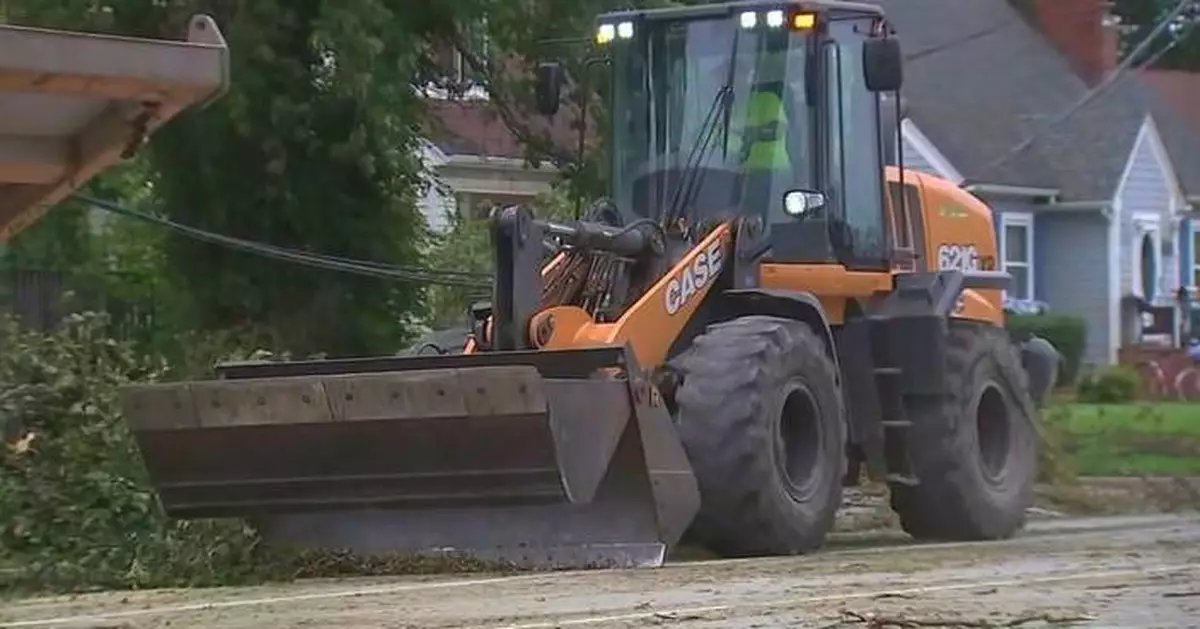
Tens of thousands of people in northwest Indiana remained without power Wednesday, more than a week after deadly storms leveled trees and knocked down power lines across the region.
Northern Indiana Public Service Co. said crews were working nonstop to fix the outages, but 75,000 customers still lacked electricity by late afternoon, mostly in Lake County next to the Illinois border.
They included more than 20,000 customers in Gary, where residents lined up again at community centers for hot meals and a place to charge phones.
The latest news for Gary wasn't good: Full restoration is not expected there until Aug. 25, NIPSCO said.
Roughly 300 poles and 44 power transmission poles need to be repaired or replaced in Gary as a result of the storm, which carried winds of 99 mph (159 kilometers per hour), said Melody Birmingham, an executive at NIPSCO's parent company.
Birmingham acknowledged the “real burden” of losing perishable food and people living for days without air conditioning after a “historic storm” that initially left 300,000 customers in the dark.
“These aren't simple repairs,” Birmingham said at a news conference. “These are systems that are being rebuilt.”
Jeremy Spurrier, 51, said he's fortunate to have a generator at his Portage home, about 40 miles (64 kilometers) southwest of Chicago. But the generator is expensive — it goes through about $75 of gas a day — and Spurrier said his family is relying on nonperishable food like soup. He drives to Illinois to get ice to chill his insulin.
"If I run out of ice, that’s several hundred dollars of insulin just ruined,” he said.
Gary, a majority-Black city, has been especially hit hard, with some residents voicing frustration that they're being ignored. Birmingham denied that low-income residents were being overlooked and blamed posts on social media.
“We have areas that are probably affluent where we still have customers out as well. ... This has nothing to do with race or any type of division,” said Birmingham, who is Black. “It's really a matter of where the storm hit.”
Gary Mayor Eddie Melton acknowledged that locals were “frustrated and exhausted” but said more than 600 linemen were working to restore power in the city.
"I want to reiterate this is clearly not just a Gary situation. It is a northwest Indiana situation,” Melton said.
A 4-year-old boy, three men and three women were among those who had died since the storms began Aug. 11, said Liz Woods, a spokesperson for the state Department of Homeland Security.
In Whiting, Myra Carden, 74, said her home wasn’t damaged by the storm — “not even a chair was blown over in the yard.” But she was in her second blackout Wednesday.
Carden, her son and three dogs lost power for more than two days last week. Then the electricity went out again Tuesday.
“More than once I have put in an outage report,” she said. ”All I get back is, ‘You already put in a report.’ Well, what do you want me to do? ... This doesn’t make sense. Of course I’m not a lineman; I’m a paralegal.”
Carden uses a generator to keep the refrigerator humming but only when someone’s home to monitor it.
“We have a deep freeze in the garage packed full with beef and chicken. I’m sure everything will be thrown away,” she said.
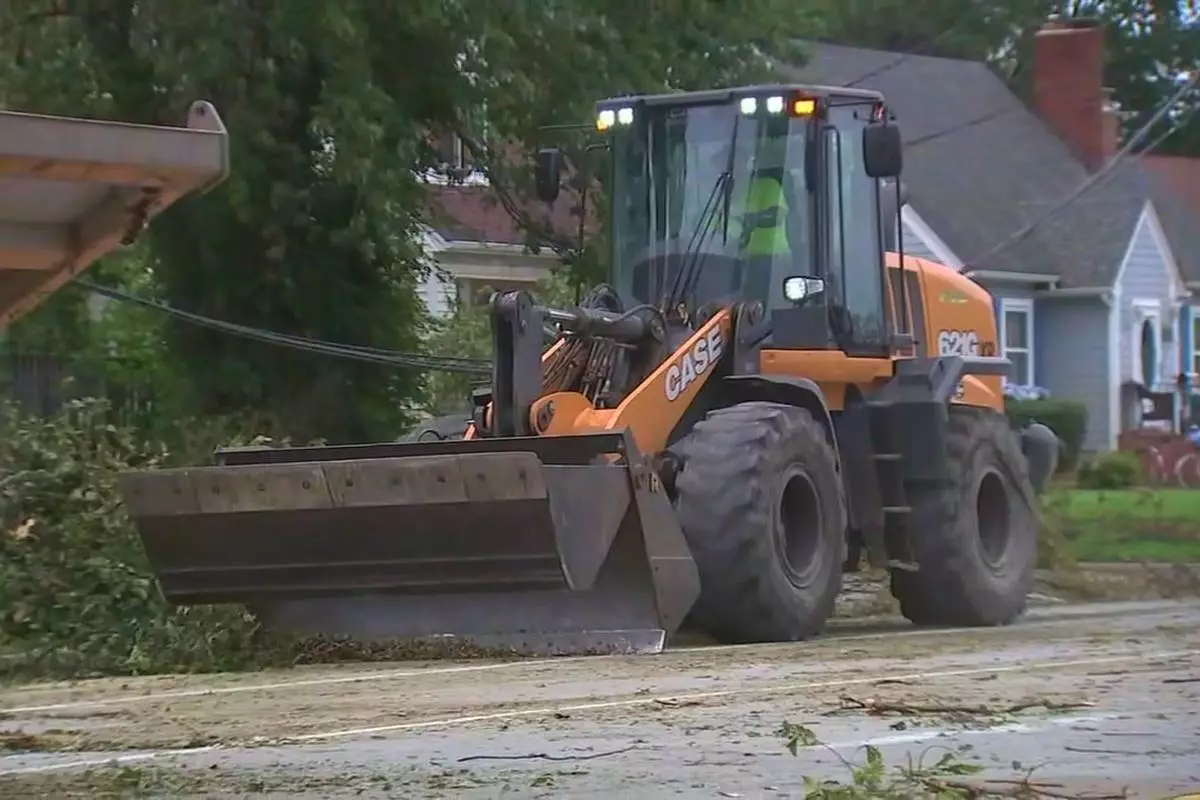
This image made from a video provided by ABC 7 Chicago shows crews working to restore power on Tuesday, Aug. 18, 2026, in Griffith, Ind., more than a week after storms leveled trees and knocked down power lines across the region. (ABC 7 Chicago via AP)
WASHINGTON (AP) — Canada and the United States moved closer Wednesday to finalizing a trade agreement that would avert threatened 50% U.S. tariffs, with a senior Canadian official calling the emerging terms “a very good deal for Canada” while cautioning that negotiations were not complete.
President Donald Trump said the agreement was “very fair” to both sides and predicted U.S. farmers and manufacturers would benefit. The tariffs on about $20 billion worth of Canadian imports have been postponed until 12:01 a.m. Saturday.
The senior Canadian official said the emerging agreement would provide greater certainty, protect Canada’s dairy sector and jobs threatened by the new tariffs, and preserve what Ottawa considers favorable trade terms with the United States.
Prime Minister Mark Carney asked provincial premiers during a briefing to return U.S. alcohol to store shelves, Nova Scotia Premier Tim Houston said, a step aimed at addressing one of the Trump administration’s key trade complaints. Houston and two other premiers voiced support for the direction of the talks, though Houston said whether Canadians would actually buy U.S. alcohol again “is a whole other discussion.”
The senior official spoke on condition of anonymity because they were not authorized to discuss the negotiations publicly before an agreement is finalized.
Here's what to know:
Last month, Trump invoked a never-before-used legal authority, dating back to the Great Depression, to announce that the United States would slap 50% tariffs on $20 billion, or about 5%, of Canadian exports to the United States, ranging from hockey sticks to tongue depressors.
Trump claimed that Canada discriminates against American exports of autos, alcohol and cheese. The U.S. president is also furious that Canada and China were the only countries that punched back with retaliatory tariffs of their own when he slapped levies on their products.
While details of the agreement emerging Wednesday remain vague, Trump claimed Canada had agreed to end tariffs on U.S. agricultural products. “The tariffs will be non-existent for our farmers. Our farmers were paying tremendous tariffs into Canada, and those tariffs are going to be totally eviscerated. Down to zero,” he said.
Canada currently allows a set amount of dairy imports at low tariffs. Once imports exceed that limit, much higher tariffs apply. The U.S. says Canada’s “supply management″ system makes it harder for American dairy producers to get full access to the Canadian market.
Dominic LeBlanc, the minister responsible for Canada-U.S. trade, told reporters in Washington that Canada’s “agriculture sector will be well protected and we have maintained our tough line.”
The senior Canadian official was even more explicit, saying supply management was “not on the table" and Canada’s dairy system would remain protected.
That leaves another key question unresolved: how Canada can preserve supply management while giving U.S. farmers the additional access Trump says they will get.
Canada has not publicly detailed what tariff relief Washington has offered.
But the senior Canadian official said the emerging agreement would avert the new 50% tariffs, protect a significant number of jobs and preserve Canada’s favorable access to the U.S. market.
The official also said the agreement would allow Canada to focus more on its domestic economic agenda, including infrastructure projects, attracting foreign investment and diversifying exports beyond the United States.
Provincial leaders also signaled that a trade agreement would not mean returning to the previous Canada-U.S. economic relationship. Saskatchewan Premier Scott Moe said “the old status quo is not possible,” while British Columbia Premier David Eby said, agreement or not, “we will not go back to the way things were before.”
In announcing the tariff pause, Trump said the long-canceled Keystone XL pipeline “may be awoken from the grave,” though he did not say it was part of the agreement. The project, designed to carry Canadian crude to U.S. refineries, was rejected by Barack Obama, revived by Trump and canceled again by Joe Biden.
Carney had already raised reviving Keystone XL with Trump at the White House in October 2025, and Trump was receptive, according to a Canadian government official familiar with the discussion. A revival would align with a longstanding Canadian goal rather than amount to a new U.S. concession.
Eight of Canada’s 10 provinces restrict or ban U.S. alcohol — measures imposed in retaliation for Trump’s previous tariffs on a number of Canadian goods last year and amid anger over his repeated talk of making Canada the 51st U.S. state. The Distilled Spirits Council says U.S. spirits exports to Canada have fallen more than 70%.
Ontario, Canada’s most populous province, is especially important. Its government-run LCBO, one of the world’s largest alcohol purchasers, sold nearly $1 billion Canadian dollars ($723 million) in U.S. products annually before pulling them from shelves.
The White House says the emerging deal includes a Canadian commitment to address the restrictions. But Carney cannot order provinces to restore sales.
The backlash extends beyond liquor stores, with Canadian travel to the United States falling sharply. Even if U.S. alcohol returns, sales could take time to recover.
The U.S. is renegotiating a North American trade pact — the US-Mexico-Canada Agreement — that Trump strong-armed America’s neighbors into accepting in his first term. The U.S. has begun formal USMCA negotiations with Mexico but not with Canada.
The senior Canadian official said resolving the immediate tariff dispute would provide a path toward broader USMCA negotiations.
If the threat of 50% tariffs is cleared, it "should help pave the way for formal U.S.-Canada negotiations,'' said Wendy Cutler, a former U.S. trade negotiator who is now senior vice president at the Asia Society Policy Institute.
Both countries had incentives to head off an escalation in trade tensions.
Nearly 72% of Canada’s goods exports last year went to the United States. And the Trump administration might be wary of imposing a hefty new tariff — paid by U.S. importers who try to pass along the cost to consumers via higher prices — ahead of November’s midterm elections. American voters are already frustrated with the high cost of living.
Gillies reported from Toronto.
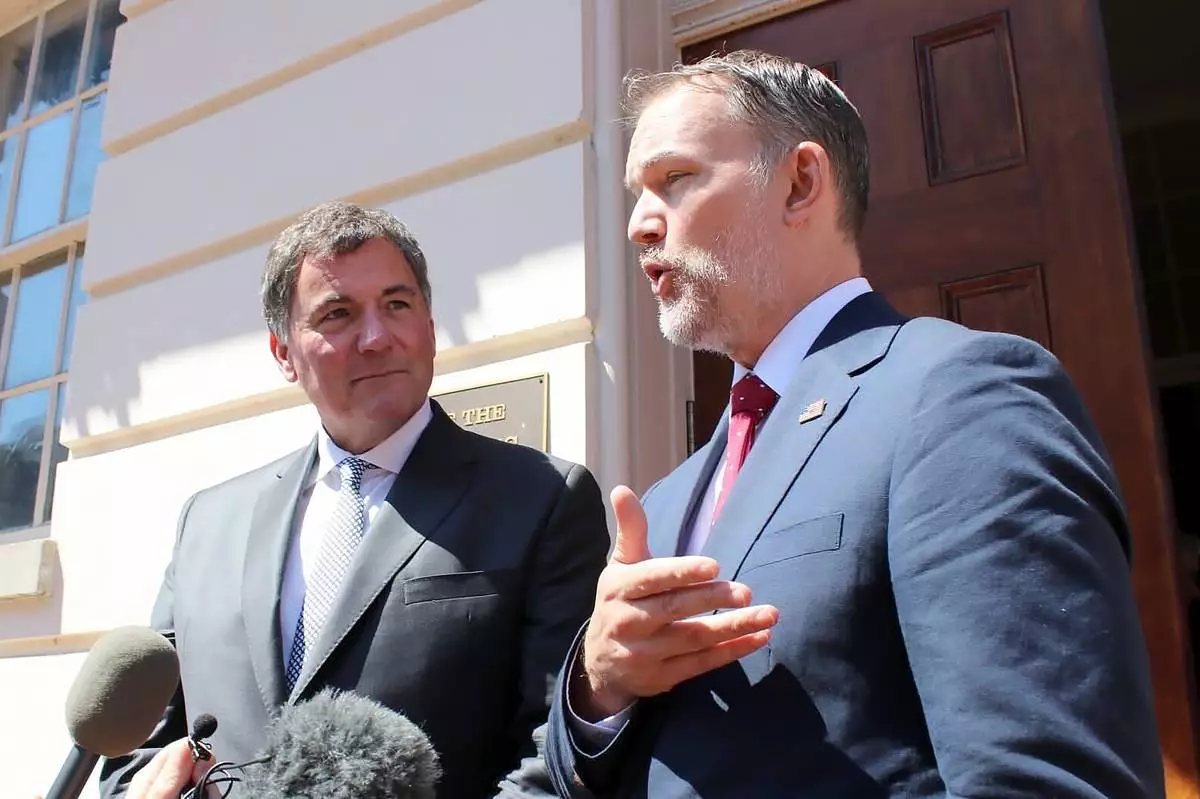
Canada-U.S. Trade Minister Dominic LeBlanc, left, and United States Trade Representative Jamieson Greer, speak to reporters in Washington, D.C., on Wednesday, Aug. 19, 2026, the day after the Trump administration temporarily delayed tariffs on Canada. (Kelly Geraldine Malone/The Canadian Press via AP)
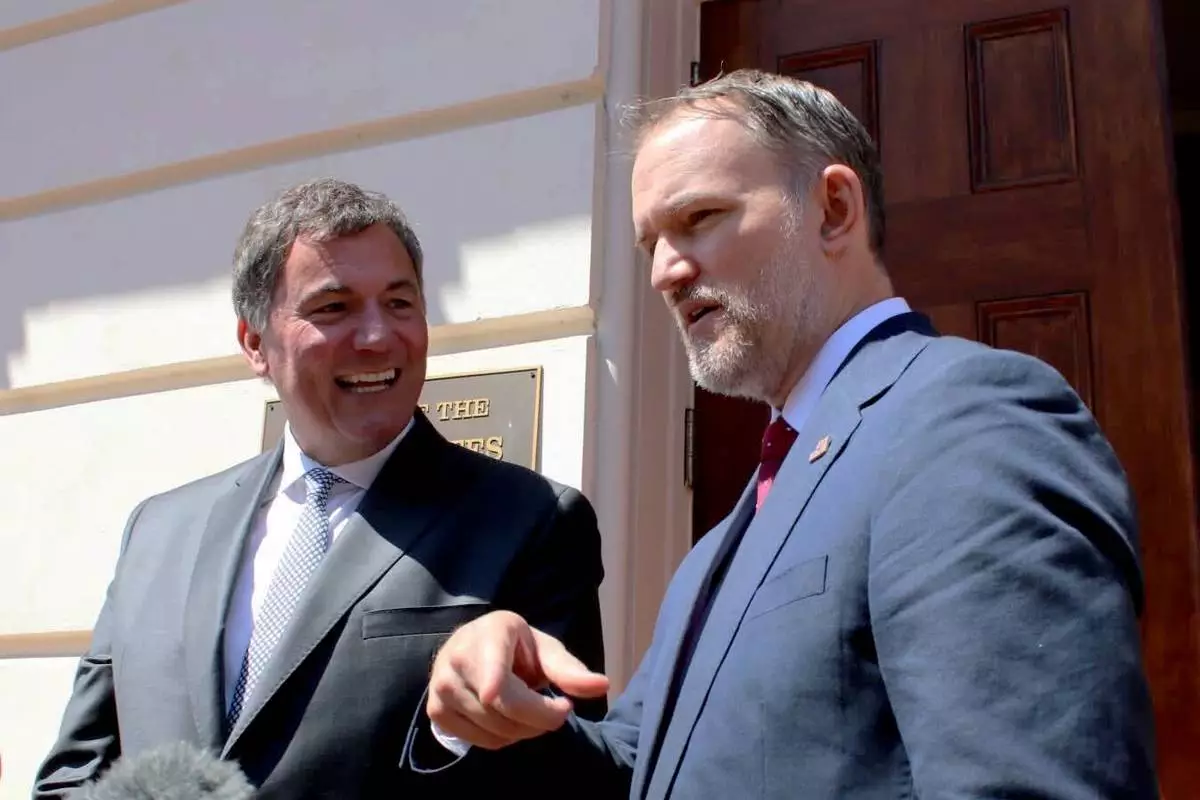
Canada-U.S. Trade Minister Dominic LeBlanc, left, and United States Trade Representative Jamieson Greer, speak to reporters in Washington, D.C., on Wednesday, Aug. 19, 2026, the day after the Trump administration temporarily delayed tariffs on Canada. (Kelly Geraldine Malone/The Canadian Press via AP)
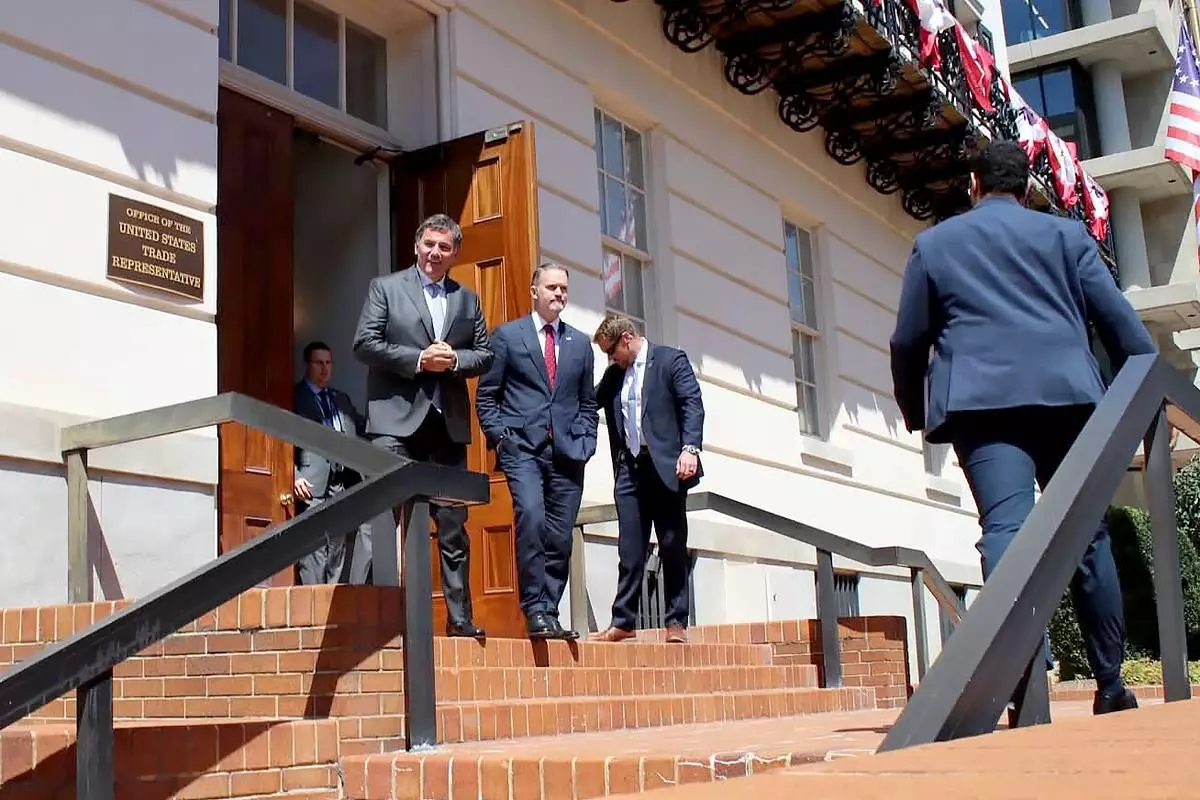
Canada-U.S. Trade Minister Dominic LeBlanc, centre left, and United States Trade Representative Jamieson Greer, leave a meeting in Washington, D.C., on Wednesday, Aug. 19, 2026, the day after the Trump administration temporarily delayed tariffs on Canada. (Kelly Geraldine Malone/The Canadian Press via AP)
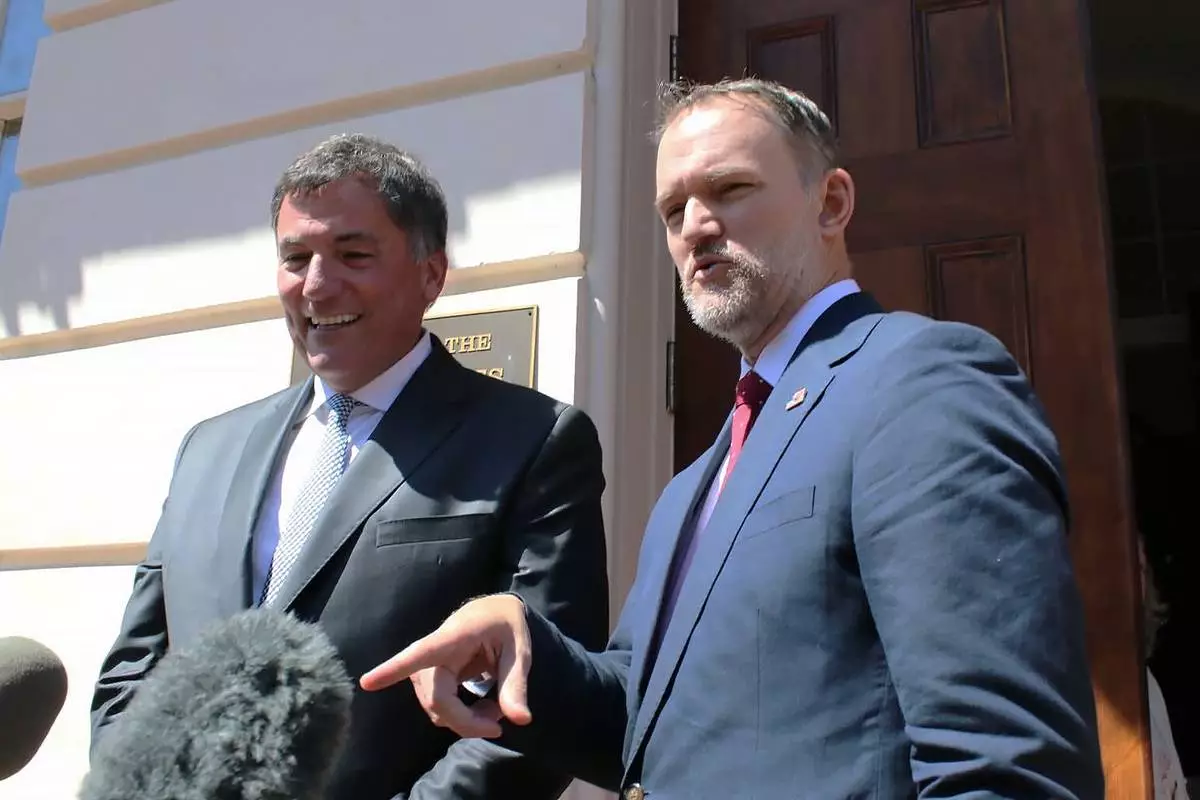
Canada-U.S. Trade Minister Dominic LeBlanc, left, and United States Trade Representative Jamieson Greer speak to reporters in Washington, D.C., on Wednesday, Aug. 19, 2026, the day after the Trump administration temporarily delayed tariffs on Canada. (Kelly Geraldine Malone/The Canadian Press via AP)