CHICAGO (AP) — Meta insists it has a long history of protecting its youngest customers as it defends itself against a swath of lawsuits alleging its social media empire harms children.
In the latest such instance, the social media giant is fighting allegations in a California federal court that it contributes to the youth mental health crisis by deliberately and stealthily designing features to get children hooked on its platforms Instagram and Facebook. Four states are seeking billions of dollars in damages as well as fundamental changes to how Meta runs those apps.
Children’s mental health, and what they do and see on social media, are all issues “Meta takes seriously and tries to act on,” Paul Schmidt, a lawyer for the tech giant, said in opening statements this week.
Critics say the company's safety record falls short and that many of its protections simply don’t work.
They include Marc Berkman, executive director at the Organization for Social Media Safety, who said Meta introduced safeguards promising to protect children in response to public pressure rather than out of concern.
There’s been a “lack of real institutional willingness to act here,” Berkman said.
Here’s a look at some of the changes Meta has introduced, along with the work advocates say could still be done.
Most of the changes Meta has introduced focus on addressing harassment and offensive content.
Instagram users have always been able to block others — and, along with Meta’s oldest crown jewel, Facebook — the app has gradually added features for reporting problematic accounts and inappropriate content.
In 2016, Instagram users were given the option to delete or filter comments they found offensive, and later added warnings that prompted users to reconsider posting potentially harmful content, as well as options to limit comments and tags on their posts.
Meta also says it prevents adults from starting private chats with teens if they are not already connected, and has increased checks to make sure users under 13 — the minimum age for holding a Facebook or Instagram account — aren't online. Schmidt said in his opening remarks that Meta recognizes some users still sign up using incorrect birthdays but that the company takes enforcement of age limits seriously.
The company says it also posts warnings and resources at the top of Instagram search results related to suicide, self-harm and eating disorders, and touts its “Teen Accounts,” launched in 2024, as a safe space for teenagers online. It aligns photo and video restrictions for teen accounts with those for a PG-13 movie, unless there’s parental permission otherwise.
Critics complain these changes amount to little more than corporate posturing.
A September 2025 report from former employee and whistleblower Arturo Béjar and four online safety advocacy nonprofits accused Meta of not taking “real steps” to address youth safety, instead opting for “splashy headlines about new tools for parents and Instagram Teen Accounts for underage users.”
“We really found that overall what Meta was marketing under Teen Accounts was very lacking in actual protections,” said Haley Hinkle, policy counsel at Fairplay, which co-authored the report. They evaluated 47 of Meta’s 53 safety features for teens on Instagram and found 60% of them were either not available or didn't work as advertised, Hinkle said.
Meta called the report's findings “misleading” and “dangerously speculative.”
Researchers say Meta's efforts to reduce the risk of children becoming addicted to the scrolling features of social media platforms have been largely unsuccessful.
Ashley Shea, a Ph.D. candidate specializing in social media and online spaces at Cornell University, points to what academics call “attention-capture deceptive designs” that are not exclusive to Meta's platforms. They include infinite scrolling, “casino style” pulls to refresh content, push notifications and algorithmic recommendations. Those features “prey on the cognitive vulnerabilities” of young people with developing brains, in particular the need to feel rewarded.
Meta has taken important steps to address problematic content, cyberbullies and sexual predators, Shea said, but she has not seen the same level of effort to offset the addictive impact of attention-capture deceptive designs.
“There’s no question that some teens struggle to manage their time with social media,” Schmidt said Tuesday, adding that Meta’s time management tools prove its evolution on the issue. Those tools include parental supervision controls and in-app “nudges” for teen users who repeatedly look at the same type of content or spend too long on Instagram or Facebook late at night.
Hinkle notes the “entirely voluntary” time management tools are not easy to set up, and amount to “far too little too late.”
Béjar, the former Meta employee and whistleblower, agrees. In testimony Wednesday, he said a tool called “Take a Break” is “designed to fail.” Users have to turn the feature on themselves and, he said, very few do.
Across the board, tech companies exist to maximize revenue, said Berkman, and for almost every social media platform today, that means “maximizing children using their features for as long as they can.”
Legal challenges focused on “the fact that these are defective products by design because of their features, not the content per se” is something new, Shea added. And beyond the courtroom, mounting pressure on lawmakers could bring more industrywide changes.
“The momentum only continues to grow,” she said. “Ultimately, these are for-profit companies that respond to economic pressures. And so I think that the more economic pressure they’re confronted with through these litigations, the quicker they will have to adapt.”

Erin Popolo holds a picture of daughter Emily Murilla, who died at age 17, during a protest against social media platforms outside the Ronald V. Dellums Federal Building and U.S. Courthouse on Tuesday, Aug. 18, 2026, in Oakland, Calif. (AP Photo/Noah Berger)

California Attorney General Rob Bonta discusses a lawsuit against Meta during a press conference on Tuesday, Aug. 18, 2026, in Oakland, Calif. Joining him are Colorado Attorney General Philip Weiser, and New Jersey Attorney General Jennifer Davenport. (AP Photo/Noah Berger)
NEW YORK (AP) — A rise in oil prices on Thursday is sending worries about inflation and yields in the bond market higher, erasing some of the relief the U.S. Treasury Department created the day before. A drop for Walmart following its latest profit report helped drag the U.S. stock market lower.
The S&P 500 slipped 0.4% and is on track for a fourth loss in the five days since setting its all-time high last week. The Dow Jones Industrial Average was down 430 points, or 0.8%, as of 10:15 a.m. Eastern time, and the Nasdaq composite was 0.7% lower.
The bond market remains the center of action after yields charged higher through the summer on worries about high inflation, gargantuan government debts and other factors. Treasury Secretary Scott Bessent made a move Wednesday that jolted financial markets to at least double the size of his department’s planned purchases of longer-term Treasurys from Sept. 9 through Nov. 4.
That helped push yields down after the 10-year Treasury’s yield had hit its highest level in more than a year and the 30-year yield got back to where it was in 2007, before the Great Recession sent yields toward zero worldwide. It’s a big deal because high yields slow the economy by raising interest payments for people, companies and the government, and they can undercut prices for stocks and other investments.
But analysts had cautioned the effect may be short lived, given how small the purchases are relative to the overall size of the Treasury market and how they don't fix the fundamental concerns of investors that had driven up yields. Plus, more signals arrived quickly to push worries higher.
The U.S. government’s debt topped $40 trillion on Wednesday, a staggering record that arrived just months after the national debt first blew past the $39 trillion mark in April, because Washington continues to spend far more money than it brings in.
And on Thursday, the price for a barrel of Brent crude climbed 2.5% to $93.90 as uncertainty continues about when the war with Iran will allow oil tankers to freely exit the Persian Gulf again. President Donald Trump threatened Iran with “the MOST CRUSHING ECONOMIC OPERATION EVER TAKEN AGAINST ANY COUNTRY” late Wednesday but provided few details.
That helped push the 10-year Treasury yield up to 4.69% from 4.65% late Wednesday. It’s almost back to its 4.71% level from late Tuesday, before the Treasury Department made its announcement.
A couple encouraging reports on the U.S. economy also helped push up longer-term Treasury yields, which move with expectations for the economy and inflation in coming years. One said fewer U.S. workers applied for unemployment benefits last week than economists expected, while another said manufacturing in the mid-Atlantic region appears to be much stronger than expected.
On Wall Street, Walmart was the heaviest weight on the S&P 500 and fell 8.7% even though it reported stronger profit and revenue for the latest quarter than analysts expected. Investors focused instead on how an important underlying measure of revenue growth at its stores slowed again. Its forecast for profit in the current quarter also fell short of analysts’ expectations.
Given its massive size, Walmart offers a look at how shoppers are doing across the United States. A surprisingly weak update on sales at U.S. retailers overall last month had raised worries that shoppers may be succumbing to pressure from high inflation and a job market that may be looking less solid.
Advance Auto Parts tumbled 22.2% after the retailer reported weaker revenue for the latest quarter, even though its profit topped expectations. CEO Shane O’Kelly said that “tighter household budgets constrained spending more than we anticipated, especially during the last four weeks of the quarter.”
Spending by U.S. consumers is the main engine of the economy, and a pullback by them could exacerbate what's already a slowdown in growth for the economy.
A pullback could also mean a double-whammy for travel companies, which would see fewer bookings when they have to pay higher prices for fuel. Norwegian Cruise Line Holdings fell 4.2%, while United Airlines sank 2.6% and American Airlines lost 2.5%.
Helping to keep Wall Street’s losses in check was Deere, which reported stronger profit and revenue for the latest quarter than analysts expected. It rose 4.1% as the company said order trends indicate the agriculture equipment business looks set to accelerate after this year.
Oil companies also rose with gains for crude prices. Exxon Mobil added 1.8%, and ConocoPhillips climbed 3%.
In stock markets abroad, indexes dipped in Europe following a stronger finish in Asia.
South Korea’s Kospi soared 5.9% for one of the world’s biggest moves after the two tech titans that dominate its market, Samsung Electronics and SK Hynix, jumped. Such swings have become more common for Seoul's market, which has borne the brunt of rising and falling worries that winning stocks in the artificial-intelligence boom may have shot too high.
AP Business Writers Chan Ho-him and Michelle Chapman contributed to this report.
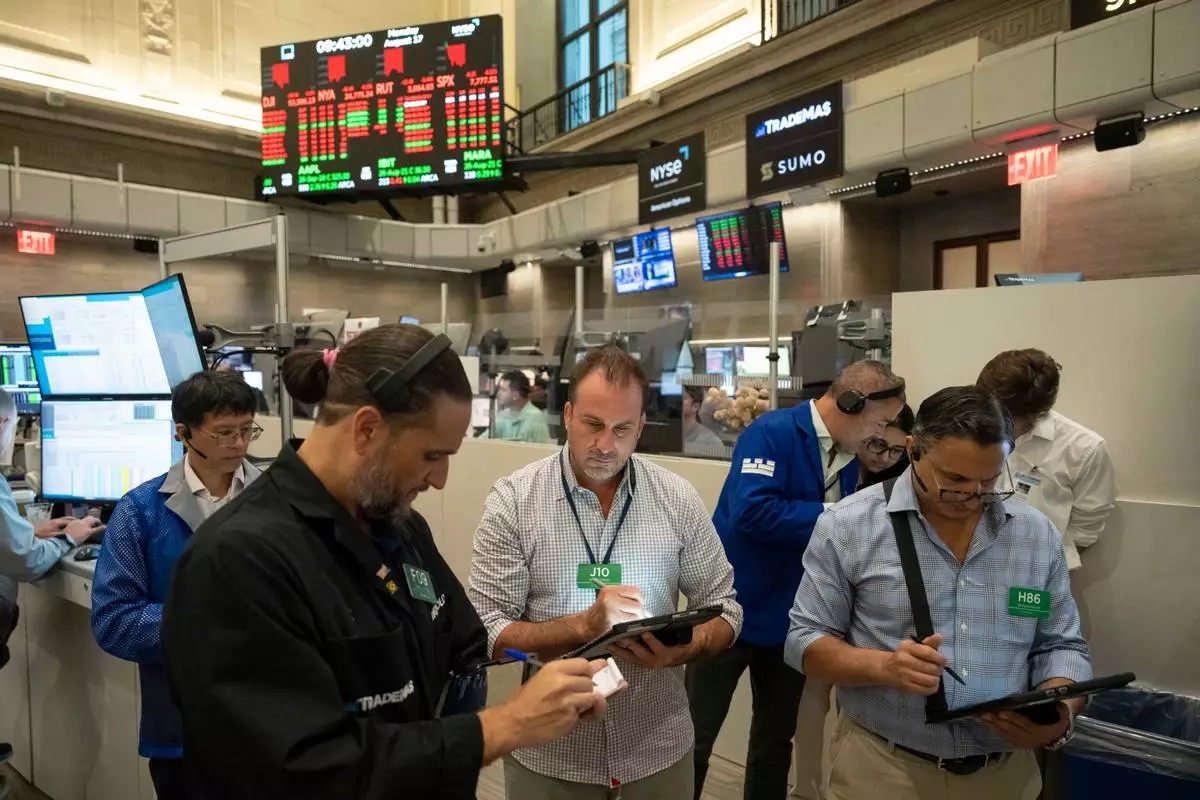
Options traders Chris Dattolo, Scott Frinzi, and Ravi Bhandari, left to right, work on the floor of the New York Stock Exchange, Monday, Aug. 17, 2026, in New York. (AP Photo/Yuki Iwamura)
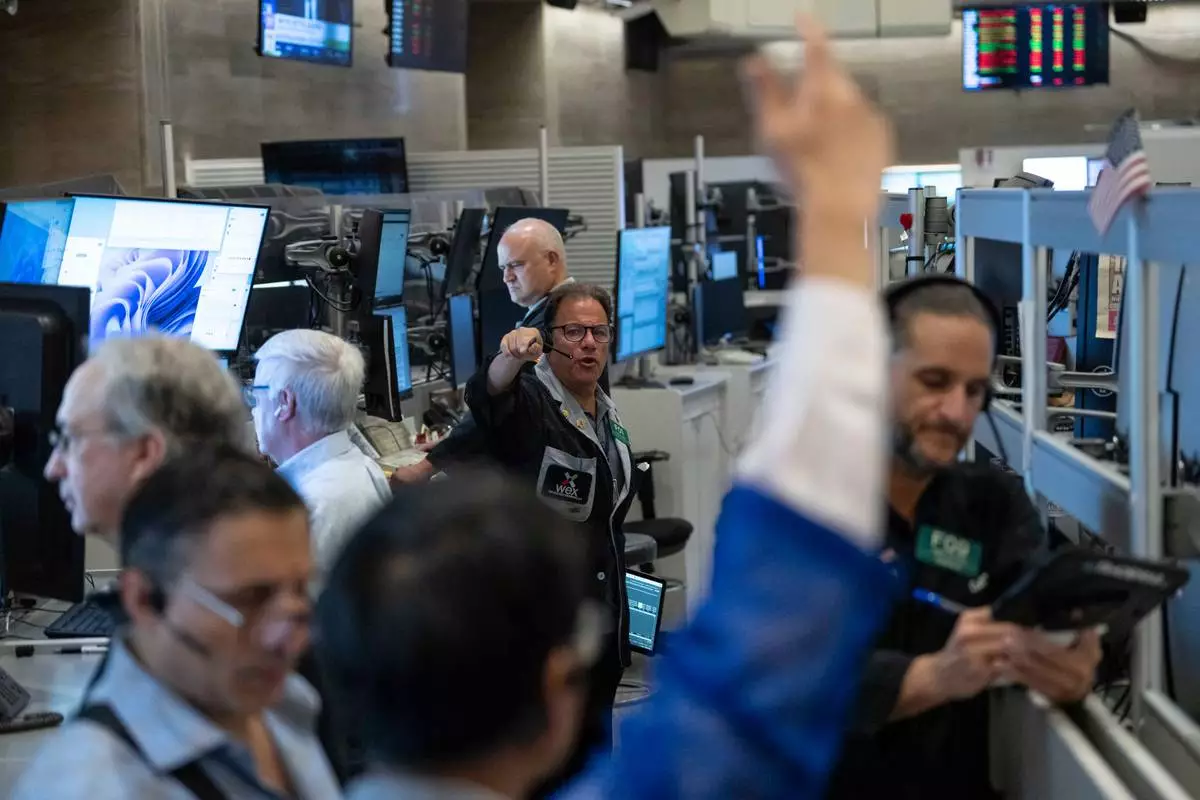
Options trader Anthony Spina works on the floor of the New York Stock Exchange, Monday, Aug. 17, 2026, in New York. (AP Photo/Yuki Iwamura)
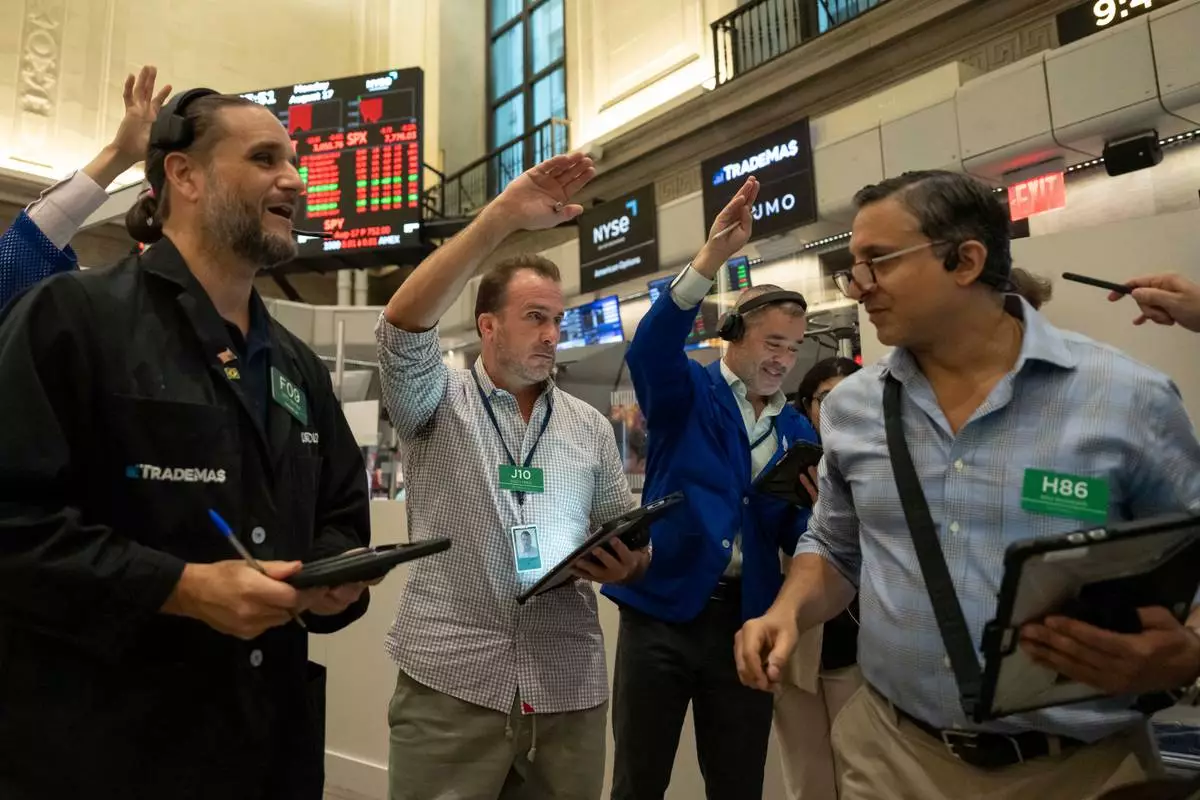
Options traders Chris Dattolo, Scott Frinzi, Justin Kanda, and Ravi Bhandari, left to right, work on the floor of the New York Stock Exchange, Monday, Aug. 17, 2026, in New York. (AP Photo/Yuki Iwamura)

People walk in front of an electronic stock board showing Japan's Nikkei index at a securities firm Thursday, Aug. 20, 2026, in Tokyo. (AP Photo/Eugene Hoshiko)
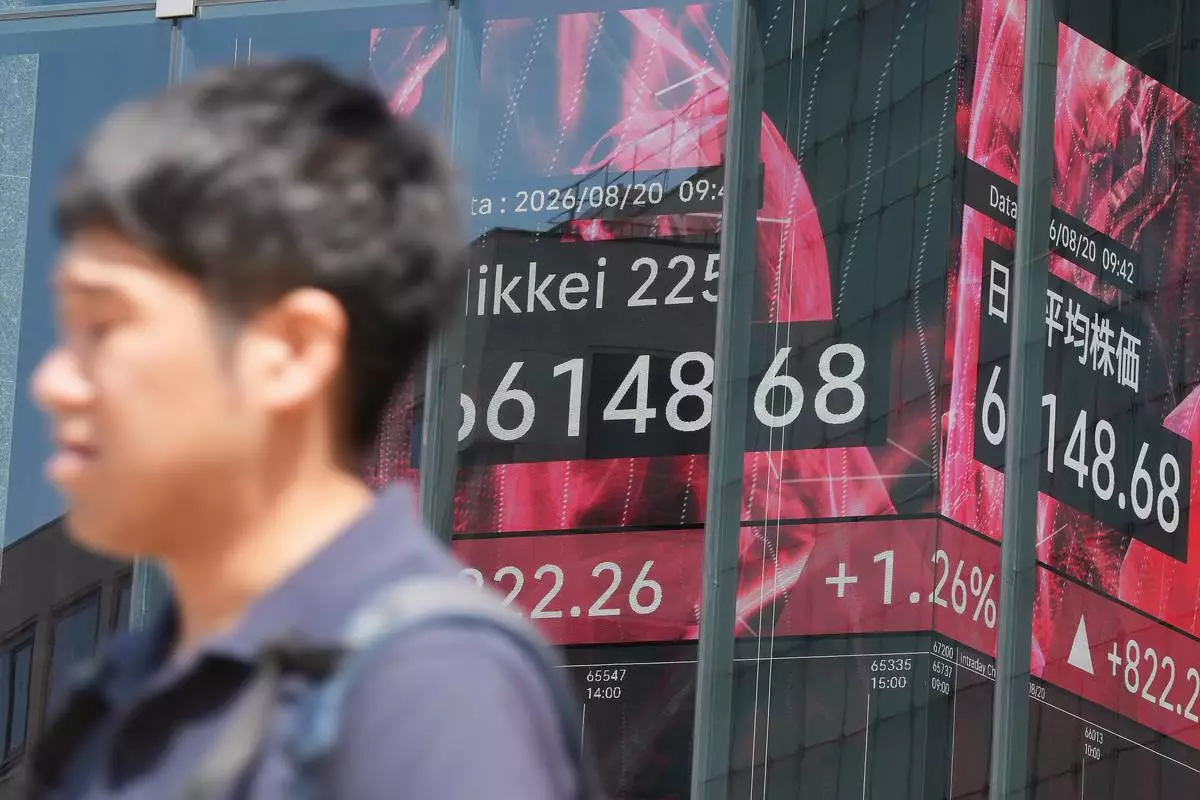
A person walks in front of an electronic stock board showing Japan's Nikkei index at a securities firm Thursday, Aug. 20, 2026, in Tokyo. (AP Photo/Eugene Hoshiko)
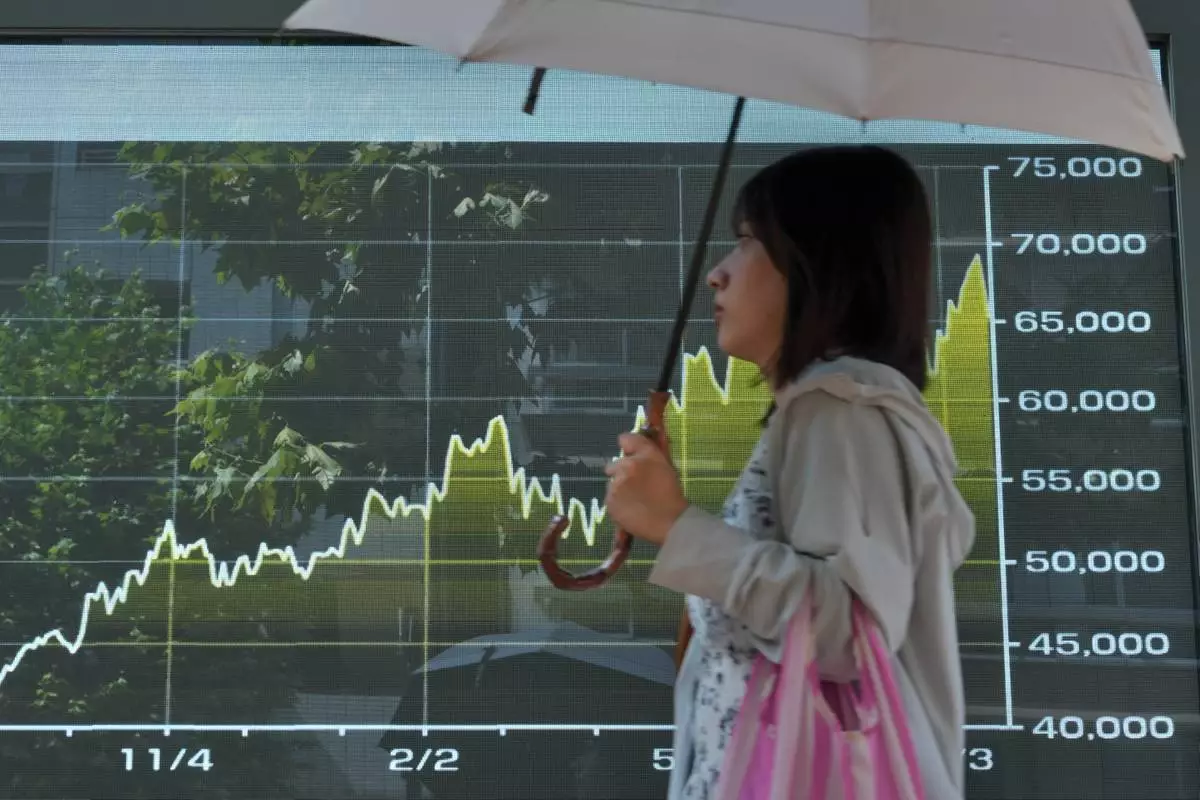
A person walks in front of an electronic stock board showing Japan's Nikkei index at a securities firm Thursday, Aug. 20, 2026, in Tokyo. (AP Photo/Eugene Hoshiko)
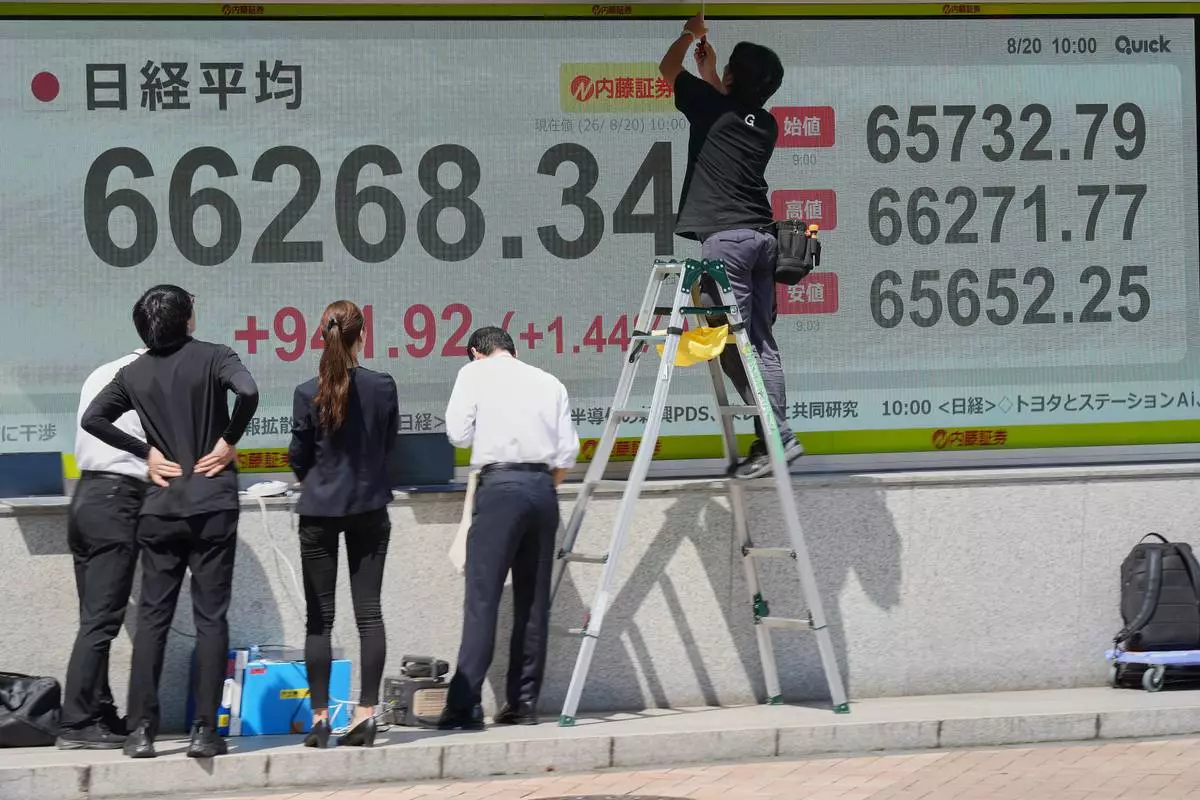
Staff arrange an electronic stock board showing Japan's Nikkei index at a securities firm Thursday, Aug. 20, 2026, in Tokyo. (AP Photo/Eugene Hoshiko)

A person walks in front of an electronic stock board showing Japan's Nikkei index at a securities firm Thursday, Aug. 20, 2026, in Tokyo. (AP Photo/Eugene Hoshiko)