PHOENIX (AP) — Enrollment in the biggest federally funded food aid program in the U.S. dropped by more than 13% in a 12-month span — a decline far steeper than the government estimated as work requirements and other provisions of President Donald Trump's “big beautiful bill” take hold.
Those losing coverage in the Supplemental Nutrition Assistance Program, or SNAP, include people who don't meet the tightening requirements to participate, and, advocates say, some who qualify for the help but are rejected because they miss deadlines or don't have the needed documentation handy. It's too early to tell exactly how many fall into each group.
It's also unclear how many have lost coverage because some state agencies that run the programs are overwhelmed trying to keep up with changes. That was the case in Arizona, which saw the nation's largest enrollment drop.
Tia Fields, who analyzes social safety net policies at the advocacy group Invest in Louisiana, said a the main reason she's seeing people lose coverage is not failure to meet work requirements. “A lot of it is administrative paperwork,” she said.
Proponents of welfare reform hope the roll reductions are driven by people earning too much to keep qualifying — a sign that policy changes are behaving as intended for a program they assert is riddled with fraud.
“If there are people that are leaving the welfare rolls because they're working and they're moving forward,” said Rachel Sheffield, a research fellow at the conservative Heritage Foundation, which pushed for stricter requirements for SNAP, “that would be a step forward.”
Arizona has had the steepest decline so far, with a 12-month drop over more than 50%, according to data compiled by the U.S. Department of Agriculture, which runs SNAP. The decline was more than 20% in Georgia, Louisiana and Nevada — and in Florida, where the Department of Children and Families said in a statement that the decreasing number “is reflective of the state's strong focus on advancing opportunities for Floridians and their families to achieve economic self-sufficiency.”
SNAP helps more than 1 in 10 people in the U.S. buy food. Most of the beneficiaries have incomes below the poverty line. The monthly benefit, which is delivered on debit cards that can be used only for groceries, is $344 per household on average.
Newly released federal data found SNAP enrollment fell from 42.2 million in May 2025 to 36.6 million in May, a drop of more than 13% in a year. The May data are preliminary and could be revised.
Since 2010, the average number of monthly beneficiaries has been below 40 million for only two years — 2019 and 2020. The rolls started dropping after a recent peak of 43.3 million in October 2024. It’s fallen much faster since implementation began last year for Trump’s “one big beautiful bill,” which cut taxes and overhauled social safety net programs.
The expanded SNAP work requirement has now kicked in for most of the country, but it won’t begin in some places until next year.
Many adults 54 and younger without minor children have long been required to work to get SNAP benefits. The new law requires most people who previously had been exempt from requirements to either work, volunteer or go to school to get benefits. It now includes those ages 55 to 64, and those with children ages 14 to 17. Those 65 and older or with children younger than 14 remain exempt, as do those with health limitations. Some other groups that had been exempted from the requirement — including homeless people — no longer are.
In February, the Congressional Budget Office projected that the new requirements and other factors would push SNAP enrollment down over the next decade, falling below 34 million by 2036. But the nonpartisan office did not expect the drop to be as fast as it's been. By May, the number of people receiving the benefits was about as low as it was forecast to go in 2030.
Experts expect another impact when states are required to pay part of the cost of benefits if their rate of payment errors — when recipients receive more or less than they should — is above 6%. Advocates for recipients say states may deny benefits to some people entirely rather than risk errors.
The cost-sharing is scheduled to start in October 2027, though Congress has considered a delay.
In Arizona, enrollment plummeted by 55% from April 2025 to April 2026 — the biggest drop in the country, with more than 400,000 fewer people getting benefits now.
The state said the drop was driven largely by the state's own struggles putting new federal requirements in place.
“Implementing the federally mandated changes triggered unprecedented call volumes and administrative hurdles, including additional verification requirements, creating real barriers for applicants,” said Brett Bezio, a spokesman for the Arizona Department of Economic Security.
Bezio said that hiring more staff members and introducing ways for people to submit their documents online have stemmed the enrollment drop in recent months as the state has reduced the chance for people who qualify to lose benefits.
In Phoenix, LaDiamond Lopez lost her benefits in January, with officials telling her she needed more documentation about her income and household — something that's needed for officials to determine whether enrollees meet work requirements.
She’s been skipping meals and some bill payments to ensure her children have enough to eat.
In her quest to be reinstated, she had previous employers sign forms confirming she no longer worked for them and added her children — ages 3 and 9 — to her apartment lease. She expected payments to resume in August, but she doesn’t know if they’ll last.
“I was approved at the end of May, but now they’re asking me for more documents,” she said. “It’s a panic.”
The Heritage Foundation's Sheffield says that some of the drop in SNAP use is likely a natural decline after peaks in the coronavirus pandemic era.
Paco Velez, the president and CEO of Feeding South Florida, said the 22% one-year enrollment drop in Florida is driven partly by immigrants who are in the U.S. legally but fear being targeted by Trump's immigration crackdown if they're seeking government benefits.
Invest in Louisiana's Fields said SNAP enrollment declines have broader consequences. For instance, children in households that receive the benefit can be automatically enrolled in free school lunch programs or in the SNAP for Women, Infants and Children program for low-income mothers, young children and expectant parents if they meet the other criteria.
“What happens when that child can’t pay for lunch?” she asked.
Some food banks have ramped up donations to try to meet a demand that they say has risen as SNAP rolls have declined. But that isn't expected to bridge the gap fully.
“We’re very worried about it because we know that no other organization or program can replicate the scale and success of SNAP, ” said Carolyn Vega, a policy analyst at the advocacy group Share Our Strength. “We know that schools can’t fill this gap. We know that food banks can’t fill this gap.”
Schuettler is a corps member for The Associated Press/Report for America Statehouse News Initiative. Report for America is a nonprofit national service program that places journalists in local newsrooms to report on undercovered issues.
Mulvihill reported from Haddonfield, New Jersey.
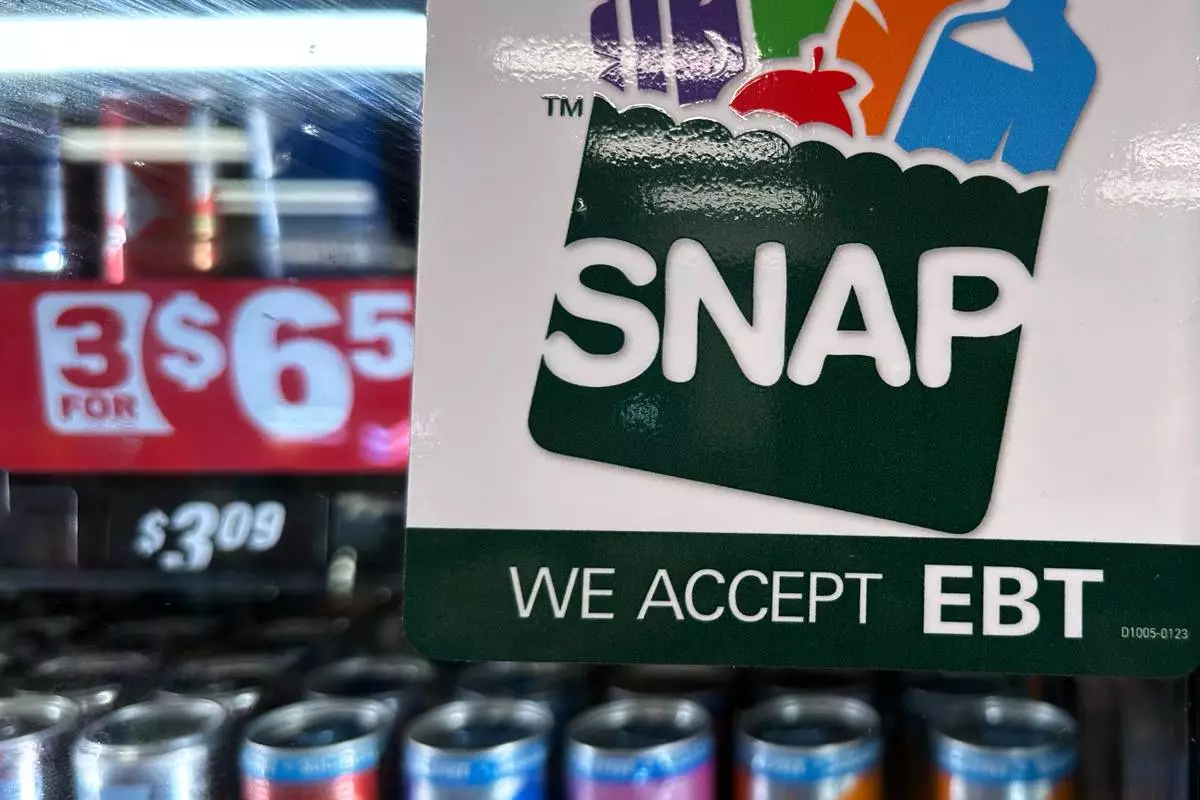
FILE - A SNAP EBT information sign is displayed at a gas station in Riverwoods, Ill., Nov. 1, 2025. (AP Photo/Nam Y. Huh, File)
Nearing the six-month mark of the Iran war and facing diminishing stockpiles of key weapons, the Trump administration is touting a crushing financial campaign against Tehran, promising an “economic D-Day” against a country that has so far withstood nearly five decades of punishing American sanctions.
With sparse details, President Donald Trump announced this week that the U.S. would be imposing an “unprecedented” level of economic warfare and isolation on Iran, aiming to force its leadership to cave to demands to end its nuclear program and fully reopen the crucial Strait of Hormuz to oil and natural gas tankers.
The Latest:
The U.S. Capitol Police briefly evacuated the agency’s Washington headquarters Friday morning and blocked off neighborhood roads when officers spotted what they called a “suspicious” vehicle in the same block as the headquarters.
The evacuation ended and roads reopened quickly after authorities checked out the vehicle without incident. The agency did not immediately respond to a question about the vehicle.
Roads are closed and a swath of the National Mall is fenced and blocked off and the security level is heightened throughout D.C. because of the weekend’s Freedom 250 Grand Prix. The FBI did not immediately respond to a question about the current threat level in the city.
The U.S. and South Korean militaries ended their annual drill six days earlier than initially scheduled Friday in a conciliatory gesture toward North Korea.
Trump had earlier abruptly ordered the Pentagon to “substantially reduce” the Ulchi Freedom Shield exercise just before it began Monday. Trump cited what he described as a good relationship with North Korean leader Kim Jong Un and South Korea’s refusal to support him over the war in Iran.
The end of the drill comes after North Korea said such a step isn’t enough to persuade it to return to talks.
On Thursday, North Korea fired about 10 short-range ballistic missiles toward the sea, apparently following through with its previous threat to respond to the drills that it views as an invasion rehearsal.
In a social media post Friday, the president said his administration will allow more beef to be imported into the U.S. without triggering a higher tariff rate that would otherwise go into effect.
The agreement, Trump said, allows up to 300,000 metric tons of ground beef to be brought into the U.S. for the next 90 days without activating an “out of quota” tariff.
The president said he had a commitment that the beef would be sold at 25% below current market rates, making beef cheaper for American consumers.
Trump did not say who the deal was with or what countries the beef will be imported from. The White House did not immediately respond to a request for more details.
An out-of-quota tariff is a higher tax that goes into effect once a certain quantity of that product enters the U.S.
Trump said the agreement would help rebuild the U.S. beef herd and ultimately help American ranchers. But the American cattle industry has in the past balked at Trump’s plans to import more foreign beef, such as his effort last year to bring in more beef from Argentina.
Trump is scheduled to travel to South Carolina on Friday to make a last-minute appeal for Sen. Darline Graham, his chosen candidate to replace her brother, the late Sen. Lindsey Graham, ahead of a Republican runoff next week.
Voters will decide Tuesday whether Graham or Rep. Ralph Norman will be Republicans’ nominee on the November ballot.
The Myrtle Beach rally is the sort of campaign trail occasion that Trump hasn’t done as much of this year, compared with past midterms, making it a signal of the importance Trump is placing on a win for his pick.
It’s also an opportunity for the president to wade into friendly territory ahead of the midterm elections that leave his party’s control of Congress hanging in the balance. South Carolina hasn’t elected a Democrat statewide in decades, its House delegation has only one Democrat and Trump’s own victory in the 2016 presidential primary here helped propel him toward the nomination and ultimately the White House.
▶ Read more
Justice Department investigators have sought to interview law enforcement officials related to the FBI search of Donald Trump’s Mar-a-Lago estate as part of a Florida-based inquiry aiming to establish a conspiracy against the Republican president, multiple people familiar with the matter said Thursday.
The requests for interviews, made in recent weeks, suggest a conspiracy investigation that had mostly appeared focused on the decade-old question of Russian interference in the 2016 presidential election is also examining a more contemporary event — the 2022 search of Mar-a-Lago that resulted in the FBI seizing top secret documents from the president’s Palm Beach estate.
The requests for voluntary interviews were not made through subpoenas, said the people, who spoke on condition of anonymity to discuss an ongoing investigation with The Associated Press.
It is not clear when or if prosecutors might seek to bring charges, or for what, but investigating conduct that occurred in Florida might give the Justice Department the legal hook it needs to try to anchor a prosecution in the state.
— Eric Tucker and Alanna Durkin Richer
▶ Read more
World shares were mixed Friday after a retreat on Wall Street as a U.S. Treasury Department plan to boost its government debt buybacks appeared to have only limited capacity to calm markets.
The futures for the S&P 500 and the Dow Jones Industrial Average were up 0.3%.
The Treasury Department announced Wednesday that it will at least double the size of its planned purchases of longer-term government debt, while Treasury Secretary Scott Bessent signaled Thursday that the repurchase program could be larger.
The announcement temporarily brought down government bond yields, which have been elevated under concerns about high inflation partly caused by the war in Iran and rising U.S. government debt. Higher yields tend to slow the broader economy because of increased borrowing costs across the financial system and can undercut stock prices.
▶ Read more
Nearing the six-month mark of the Iran war and facing diminishing stockpiles of key weapons, the Trump administration is touting a crushing financial campaign against Tehran, promising an “economic D-Day” against a country that has so far withstood nearly five decades of punishing American sanctions.
With sparse details, President Donald Trump announced this week that the U.S. would be imposing an “unprecedented” level of economic warfare and isolation on Iran, aiming to force its leadership to cave to demands to end its nuclear program and fully reopen the crucial Strait of Hormuz to oil and natural gas tankers.
It reflects the dire reality Trump faces with an increasingly unpopular war he can’t seem to end just months before pivotal midterm elections that will decide whether his Republican Party keeps control of Congress. Whether out of desperation or strategy, the president is refocusing America’s might on bringing Iran to its knees through an accelerated sanctions campaign against one of the most economically penalized countries in the world.
▶ Read more
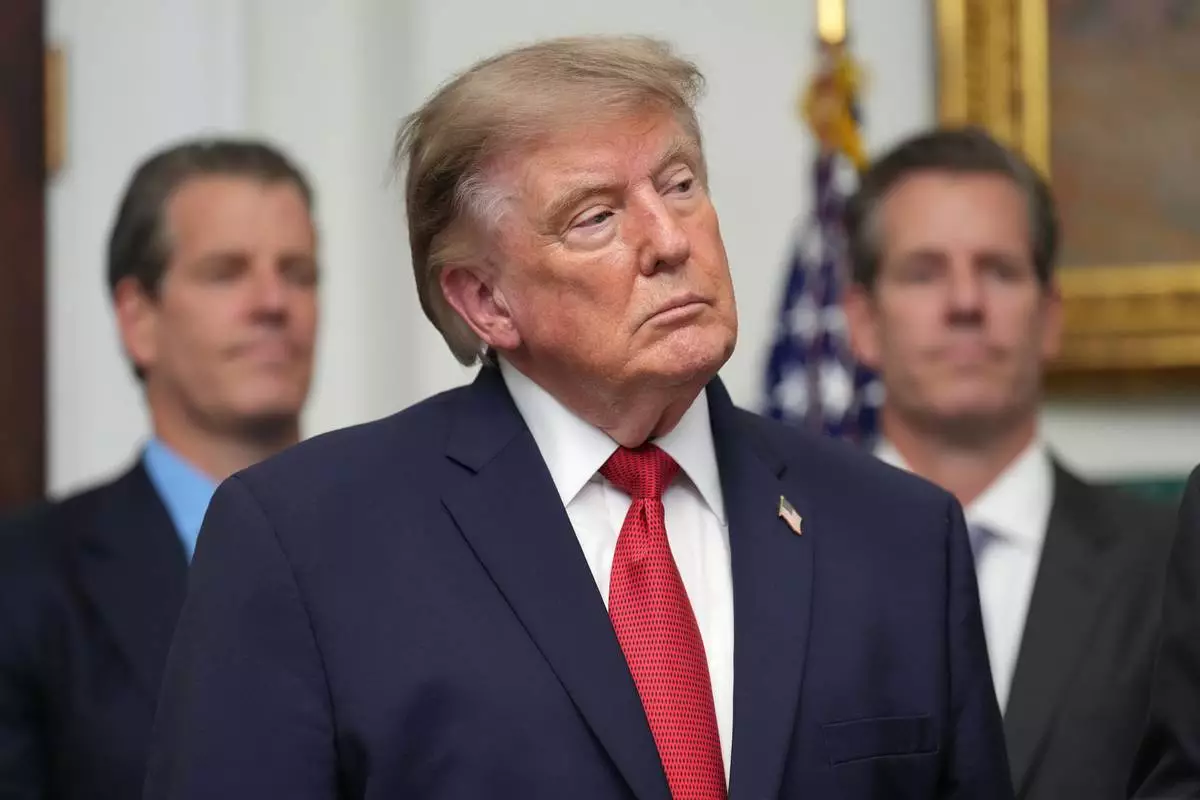
President Donald Trump listens as Gemini co-founder and president Cameron Winklevoss, left, and Gemini co-founder and CEO Tyler Winklevoss, right, watch, during a meeting with technology leaders in the Roosevelt Room of the White House, Wednesday, Aug. 19, 2026, in Washington. (AP Photo/Jacquelyn Martin)

President Donald Trump, right, and first lady Melania Trump walk to attend an event in the Rose Garden of the White House, Thursday, Aug. 20, 2026, in Washington. (AP Photo/Jacquelyn Martin)