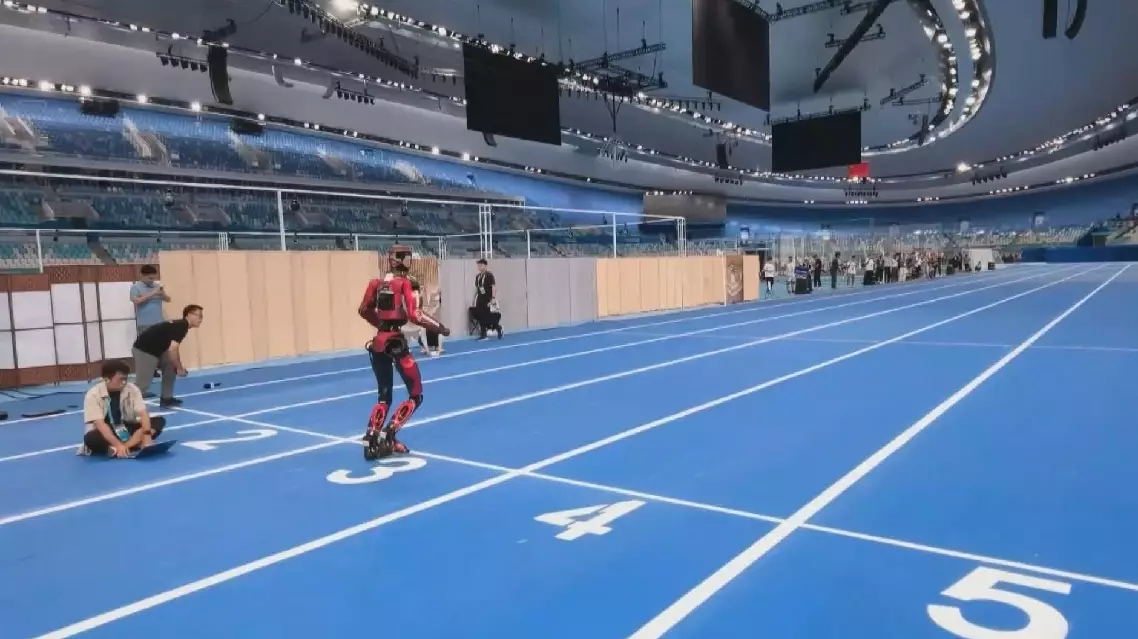
The second World Humanoid Robot Games will open Saturday at Beijing's National Speed Skating Oval, where autonomous humanoid robots, including a 175cm, 75kg sprinter named "Bolt" capable of reaching 11 meters per second, prepare to push the boundaries of embodied AI and engineering limits.
While many competition robots are being designed to be as lightweight as possible, the developers of "Bolt" intentionally modeled this machine after the proportions of an adult male.
The research and development team named the robot after the Jamaican sprint legend Usain Bolt after it achieved a peak laboratory test speed of over 11 meters per second in April, surpassing Bolt's average speed of 10.44 meters per second during his 100-meter world record run.
The goal of enabling high-speed running is to rigorously test mechanical performance and motion control, and aligning the robot's dimensions with human proportions allows engineers to better apply biological motion principles to embodied artificial intelligence.
"Speed is not just about velocity; it is actually a synthesis of a series of engineering limits: intensity, toughness, strength, density, fluidity, and more. More importantly, achieving speed is about breaking the limits of existing cognition - examining the biological motion mechanisms behind it, understanding what the dynamic mechanisms look like, and determining whether we can harness these mechanisms," said Jin Yongbin, chief technology officer at MirrorMe Technology, a Shanghai-based robotics startup that designed "Bolt".
The MirrorMe research and development team analyzed the relationship between foot force generation, tendon movement, and energy storage in human running. Utilizing motion bionics technology, they designed the robot's ankles and arches to make better ground contact with the forefoot during a sprint, decoupling impact energy upon landing. This allows the robot to distribute force more evenly and significantly reduce battery energy consumption.
While bionic technology minimizes energy loss during high-speed sprints, parts wear and material upgrades are always required.
Jin noted that a crucial foundation for the rapid development of robotics in China is the country's comprehensive manufacturing ecosystem, where the integration of multiple industries is helping the embodied intelligence sector gradually achieve industrial scale.
"In my view, China's supply chain is exceptionally complete. For the entire robot system, its motors, batteries, electric drives, and transmission systems are perfectly aligned with the existing automotive industry's supply chain. We are essentially transferring our established automotive supply chain to robotics. Moreover, we need to rely on events like this to continuously exchange ideas, evaluate the strengths and weaknesses of different technologies, and rapidly refine the robotic supply chain," he said.
The second World Humanoid Robot Games, which will run from Aug 22 to 26, will move beyond standardized arenas into real-life urban operating environments, and test the robots' ability to adapt to different environments and perform operations with their hands.
2nd World Humanoid Robot Games to open in Beijing as autonomous "sprinters" push engineering limits