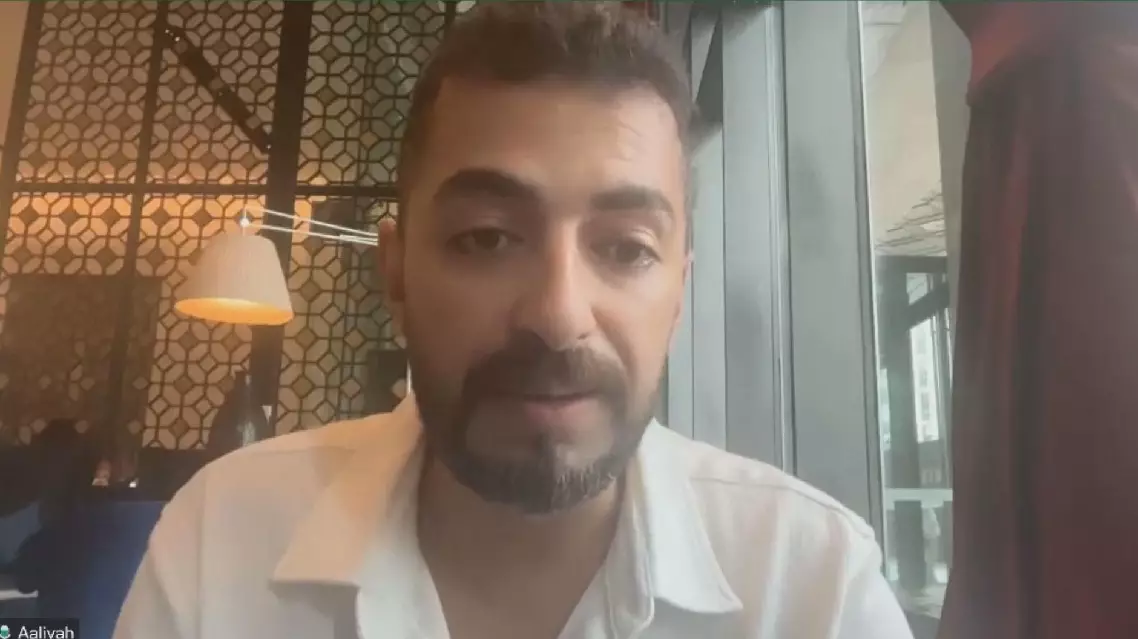
The anti war film "Once Upon a Time in the Middle East" has struck a chord across cultures by telling a story of ordinary humanity in conflict, rather than the conventional Western hero narrative, said Egyptian producer Mohamed Osama.
Set largely in a small Chinese restaurant in a war torn Middle Eastern country in the 2000s, the film is helmed by Wen Muye, acclaimed for "Dying to Survive". It follows Xu Fu, a down on his luck Chinese chef played by comedian Shen Teng, who travels abroad to settle debts and joins a local manager to run a restaurant. Through his humble viewpoint, the film portrays everyday struggles and compassion amid war, using food as a thread to explore survival and peace.
Rejecting Western hero tropes, the film adopts the humble viewpoint of Xu Fu, an ordinary cook. Through his eyes, it portrays the struggles of civilians caught in conflict, using food and daily life to explore survival, compassion and peace.
Osama, founder of Dragon Bridge Media, recalled joining the production and his first impression of the story.
"Finally, I feel like success after that whole thing. It was like difficult at the beginning because we started to find good actors first. One thing I want to mention is regarding to the movie, actually when we got the script at the beginning, I was like quite afraid because most of the movies coming from Western [world], they are all focusing on a hero movie, a hero coming from the West, coming to save the world. But this movie, no, it's like a Chinese chef, he's a normal person, sometimes he do mistakes, sometimes he do good things and he just not coming to save the world. But during the story, he's a good person in his heart. So it's like when the situation puts him there, he just did the right thing and saved the kids," he said.
The producer stressed that the film’s appeal lies not only in its unconventional protagonist but also in its commitment to authentic storytelling, at a time when commercial blockbusters dominate the market.
"I think because first of all, people need good movies. It's hard to find good movies now. Like most of the movies are very commercial, not focusing on the good story. So I think the main thing is the story touched many people's hearts, whether you are Chinese or Arab or from anywhere, it's like at the end there is a really strong message about not using the kids in the war," he said.
He believes one of the film’s most powerful devices is its juxtaposition of food and war, a contrast carrying deep cultural weight. Having lived in China for years, he added that food embodies the Chinese philosophy of life.
"I like the comparison between war and food because like 'eating well'. I lived in China for a long time, so I know how food can represent life in China. It's like food represents life. At the same time, war represents death. So like when we did this comparison, it's like at the end, it's like we choose food, we choose 'eating well', we choose a good life. That's a very strong message," Osama said.
Egyptian producer hails Chinese anti‑war film’s authentic storytelling