Chinese robot makers are pushing AI-powered machines beyond laboratory prototypes and into factory work, using models designed to help robots recognize changing environments, correct their movements and perform precision tasks.
At the 2026 World Robot Conference in Beijing, which opened Wednesday, robots sorted parcels, picked products from shelves in a simulated store and carried out industrial tasks such as assembling components and tightening screws.
More than 300 exhibitors displayed over 2,000 products at the event, underscoring a push to shift the industry’s focus from crowd-pleasing demonstrations to robots that can perform useful work in factories, warehouses and retail settings.
At Galaxea AI, an industrial robotic arm can identify an object placed at random on a table and put it in a designated area, even if the object or its surrounding environment changes.
The capability comes from an embodied AI foundation model, which links perception with physical action and allows the machine to adapt in real time rather than simply follow pre-programmed instructions.
"Tasks such as screwdriving require sub-millimeter precision. As the capabilities of our foundation model continue to evolve, it can unlock improvements across the robot, including speed, accuracy and generalization, allowing it to be deployed across a range of industries," said Zhao Hang, chief scientist at Galaxea AI.
The move toward practical deployment is also extending to demanding industrial processes such as welding, where Chinese manufacturers are seeking to replace imported equipment.
"Our robots have achieved accuracy of 0.06 millimeters, and each weld point is completed within 2.2 seconds. More than 100 units have already been deployed in automotive manufacturing, marking a breakthrough for Chinese-made robots in automotive production," said Cheng Hufeng, senior director for the automotive industry at Siasun Robot and Automation's industrial robotics division.
The advances reflect broader growth in China's robotics sector. Combined revenue at robotics companies above the designated size exceeded 300 billion yuan, or near 45 billion U.S. dollars, in 2025, after growing by more than 20 percent a year on average over the previous five years.
Speaking at the conference's opening ceremony, Vice Minister of Industry and Information Technology Xin Guobin said the sector generated about 25 billion U.S. dollars in revenue in the first half of the year, as robots found wider use across China’s economy and society.
"In the first half of this year, the sector's revenue reached 165.5 billion yuan, up 24.5 percent year on year. Robot technologies and products are now widely used across the economy and society, becoming an important force driving high-quality development," Xin said.

China's AI-powered robots move from prototypes to factory floors
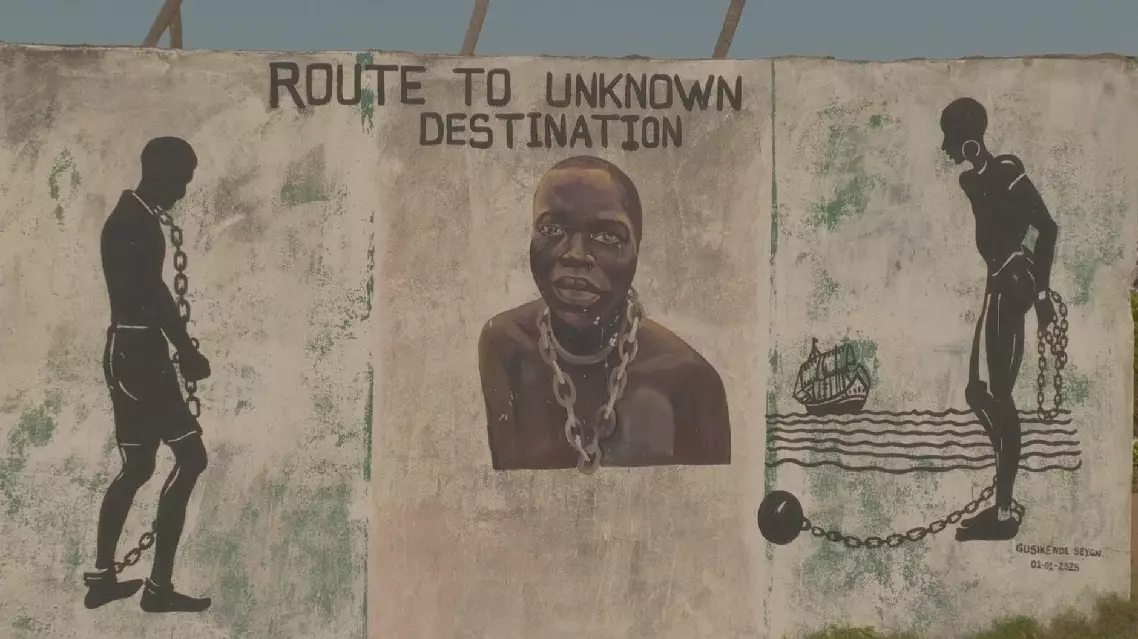
Badagry, once a major slave port on Nigeria's coast, still holds the physical relics of a brutal trade that shipped millions of enslaved Africans across the Atlantic, making it a silent witness to one of history's darkest chapters.
Sunday marks the International Day for the Remembrance of the Slave Trade and Its Abolition. Established by UNESCO in 1997, the day is observed to honor the victims of the transatlantic slave trade and encourage reflection on its legacy.
At the height of this inhuman commerce, Badagry emerged as one of West Africa's busiest slave hubs. Local historians estimate that more than three million enslaved Africans were forcibly transported from this small coastal town to America and Europe. Centuries later, its museums, marketplaces, and historic sites still bear witness to the atrocities committed in the city.
At the Mobee Royal Family Slave Relics Museum, guide Simon Eyonam walks visitors through a haunting collection of shackles, restraints, and instruments of punishment. He demonstrates how some of these tools were used to seal the mouths of captives.
"They also use it to perforate because communication is not allowed. They put this inside the fire. They draw the upper lip and put a hole. They put another hole here. Now, after the clipping of the upper and lower lips, they have to draw the lip through this mouth clip or mouth guard," Eyonam said.
The displays leave few visitors unmoved. Hassana Babasnaya, a Nigerian visitor, said the experience was particularly unsettling because it brought her ancestors' possible suffering to mind.
"It is very sad to see how all the slaves were treated. And seeing all the instruments the ones they used to tie to their neck, the ones they used to perforate their mouths. It's just very emotional to see, knowing that some of my ancestors might have had to pass through this," she said.
Not far from the museum stands the last remaining slave market in Badagry. It is now a quiet, empty space, but local accounts describe how enslaved people were once displayed and bargained over like commodities.
The cruelty was not only physical. One of the most chilling sites in Badagry is the so-called "Slave's Spirit Attenuation Well." According to local tradition, enslaved people were forced to drink from this well before their final march to the ships. It was believed that the water had been treated with herbs and incantations to suppress resistance and erase memory. Many residents still avoid drinking from it today, a sign of how deeply the history remains embedded in local consciousness.
According to historical records, the slave trade in Badagry began in 1473 and was legally abolished in 1852, though illicit operations continued until 1888, spanning more than four centuries. This prolonged exploitation not only inflicted immense suffering on African populations but also dismantled local agricultural and craft industries, contributing to the economic and social challenges that many parts of Africa continue to face today.
Peter Olaide, the curator of Badagry Heritage Museum, said that a debt is owed to Africa for these historic wrongdoings.
"Several millions of Africans died. European countries, all those participating countries should come, apologize to Africa, and see how Africa can be compensated after the transatlantic slave trade," Olaide said.
Slave relics in Nigeria's Badagry offer glimpse into tragic past