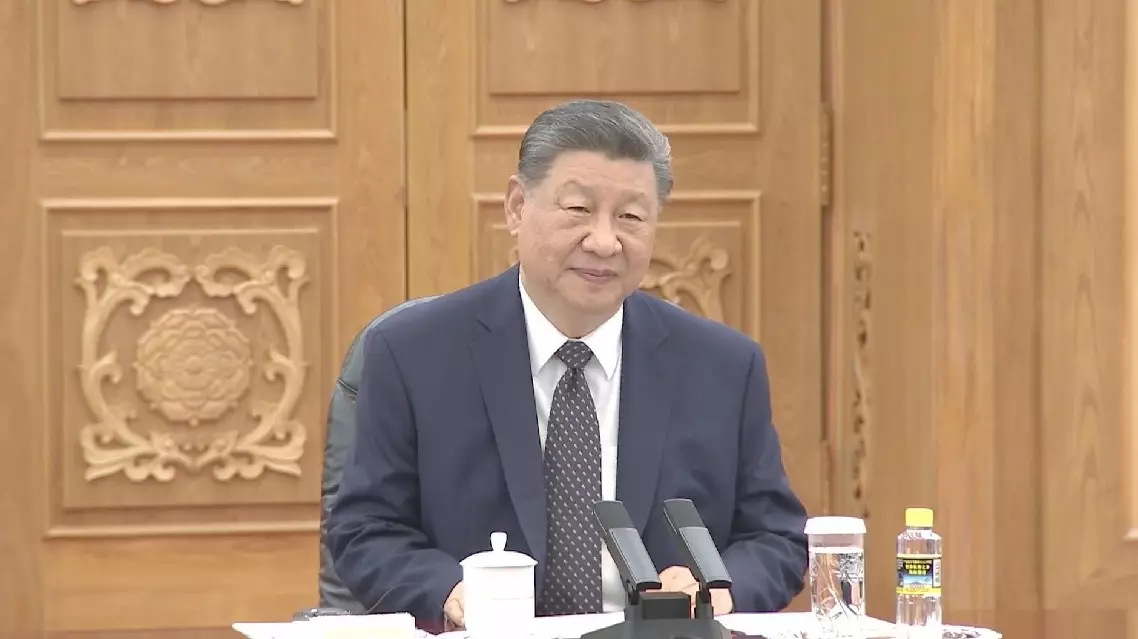
Chinese President Xi Jinping held talks with visiting King of the Hashemite Kingdom of Jordan Abdullah II ibn Al Hussein in Beijing on Monday, calling for deeper synergy in development strategies between the two countries.
Xi said that since the establishment of diplomatic relations between China and Jordan, the two countries have always treated each other with mutual respect and on an equal footing, and pursued mutually beneficial cooperation, setting an example of win-win cooperation and mutual learning between countries with different social systems and of different sizes.
Xi recalled that he and King Abdullah II jointly announced the establishment of the China-Jordan strategic partnership in 2015, which opened a new chapter in bilateral relations.
In the face of a complex and volatile international and regional situation, building a more substantive and dynamic China-Jordan relationship meets the common expectations of the two peoples and conforms to the prevailing trend of Global South countries working together for strength, Xi said.
He urged efforts from both sides to carry forward their traditional friendship, enhance strategic mutual trust, deepen mutually beneficial cooperation and strengthen multilateral coordination, so as to advance the China-Jordan strategic partnership and make greater contributions to regional peace, stability and prosperity.
China attaches importance to Jordan's unique and important role in the region and firmly supports Jordan in safeguarding its national sovereignty, security and development interests, Xi said, voicing the country's willingness to maintain close exchanges with Jordan at all levels between governments, political parties, legislative bodies, and at subnational levels, and to enhance exchanges of experience in governance.
Pointing out that bilateral cooperation lies in mutual benefit and win-win outcome in nature, Xi urged efforts from both sides to further align their development strategies and deepen cooperation in traditional areas such as the economy and trade, infrastructure, transportation and minerals, while fostering new growth areas in the digital economy, artificial intelligence and green energy.
Xi also called for bilateral efforts to deepen exchanges in education, culture, science and technology and tourism, expand people-to-people exchanges and build closer bond between the two peoples.
China stands ready to work with Jordan to implement the four global initiatives, strengthen coordination and cooperation in multilateral institutions including the United Nations, jointly uphold the international system with the U.N. at its core and the international order based on international law, thus promoting the building of a community with a shared future for humanity, Xi said.
King Abdullah II said that China is a great country and that its remarkable development achievements under the leadership of Xi are admirable.
With a strong bilateral strategic partnership, the two sides have consistently respected each other and maintained close cooperation, yielding fruitful results in various fields, he said.
Jordan firmly adheres to the one-China principle and believes that Taiwan is part of China's territory, King Abdullah II said.
Jordan attaches great importance to its relations with China and stays committed to deepening exchanges and cooperation with China in areas including the economy and trade, manufacturing, agriculture, science and technology, medicine, culture, and education, the King of Jordan said, extending welcome to more Chinese enterprises to invest in his country for common development and prosperity.
Jordan highly appreciates the four global initiatives proposed by Xi and hopes that China can play a greater leadership role on the world stage, he added.
The two heads of state exchanged views on the situation in the Middle East.
Xi said China has consistently called for a comprehensive ceasefire, an end to fighting, and the resolution of disputes through political and diplomatic means. The sovereignty and security of regional countries, including Jordan, should be respected, he said.
The Palestinian question lies at the heart of the Middle East issue, Xi said, calling for four principles to guide efforts to resolve it.
First, a political settlement should be upheld. The two-state solution is the right direction, and efforts should be made to restart peace talks between Palestine and Israel, with a view to establishing an independent Palestinian state at an early date, Xi said.
Second, the principle of "Palestinians governing Palestine" should be followed in advancing the governance of the West Bank and the post-war reconstruction of Gaza, he said.
Third, humanitarian principles must be upheld. The international community, and the UN Security Council in particular, should shoulder its responsibility effectively to protect civilian safety, ensure the flow of humanitarian assistance, and put an end to humanitarian disasters, Xi said.
Fourth, fairness and justice must be upheld. This means following international law, addressing both symptoms and root causes, and taking practical actions so that the Palestinian question can be resolved in a comprehensive, just and lasting way at an early date, he said.
King Abdullah II said Jordan highly appreciates China's consistently just position on Middle East affairs and its support for the just cause of Arab countries, stressing that China's just position is of great importance to countries in the region.
Jordan stands ready to maintain close communication with China and continue making positive efforts to ease the current situation, so that the people of Middle East countries can enjoy peace and prosperity, he said.
After the talks, the two heads of state witnessed the signing of multiple cooperation documents in areas including diplomacy, the economy and trade, industrial and supply chains, and judicial affairs.
The two sides also issued a joint statement on deepening the strategic partnership between the two countries.
Before the talks, Xi held a welcome ceremony for King Abdullah II at the Great Hall of the People.
In the evening, Xi held a banquet to welcome King Abdullah II.
At the invitation of Xi, King Abdullah II is on a state visit to China from Aug 18 to 24.
This visit marks King Abdullah II's ninth visit to China since his accession to the throne.
Xi calls for deeper China-Jordan synergy in development strategies
Xi calls for deeper China-Jordan synergy in development strategies