Iran's currency plunged to a record low on the open market Monday, hours before the U.S. announcement of a new wave of sanctions aimed at further isolating Tehran.
The rial fell to 2.02 million against the U.S. dollar as trading opened on currency markets, while the official exchange rate set by Iran's Central Bank stood at around 1.5 million rials per dollar.
The currency, which was already under pressure before the joint U.S.-Israeli attacks on Feb. 28, has continued to hit new lows as nearly six months of conflict have placed further strain on Iran's economy.
U.S. Treasury Secretary Scott Bessent on Monday warned of an "economic D-Day" for Iran, announcing what he described as "an economic onslaught against Iran's financial connections around the globe."
The new sanctions target five key sectors -- digital assets, technology, gold, aviation and shipping, according to the Treasury Department.

Iran's currency hits record low
The Pinglu Canal, a major new waterway in south China, has successfully concluded its first trial navigation for passenger vessels, marking another step forward its official opening in September.
Measuring 32 meters long and 5.4 meters wide with a certified capacity of 100 passengers, the test vessel docked smoothly at an integrated service area in Qinzhou City, south China's Guangxi Zhuang Autonomous Region, at midday on Monday, marking the successful completion of the inaugural passenger service trial along the canal. According to the local maritime authorities, the trial was conducted without passengers on board and served as a comprehensive first-phase evaluation of the canal's navigability for passenger ships, the operational efficiency of its lock system, and the service capabilities of its waterside support facilities.
Monday's successful trail navigation came less than two weeks after the canal officially launched vessel trials on Aug 12, paving the way for future commercial passenger services on the waterway.
"Based on the entire navigation process this time, the channel dimensions of the Pinglu Canal, the operational efficiency of its locks, and the support capabilities of the waterside service areas all met the navigational requirements for tourist passenger vessels," said He Changhai, a law enforcement officer from the Qinzhou Maritime Safety Administration.
Designed to accommodate vessels of up to 5,000 tons, the 134.2-km Pinglu Canal is China's first major river-to-sea canal project planned and coordinated at the national level since 1949.
Stretching from the Pingtang River in Guangxi's Hengzhou City to the Beibu Gulf in the South China Sea, the canal is the backbone of the country's New International Land-Sea Trade Corridor, which has evolved into a strategic route linking China's inland regions with countries of the Association of Souchteast Asian Nations and other global markets.
The corridor's rail service handled a record 1.425 million 20-foot equivalent units of cargo in 2025, up 47.6 percent year on year. As of early July 2026, its network has reached 593 ports in 128 countries and regions.
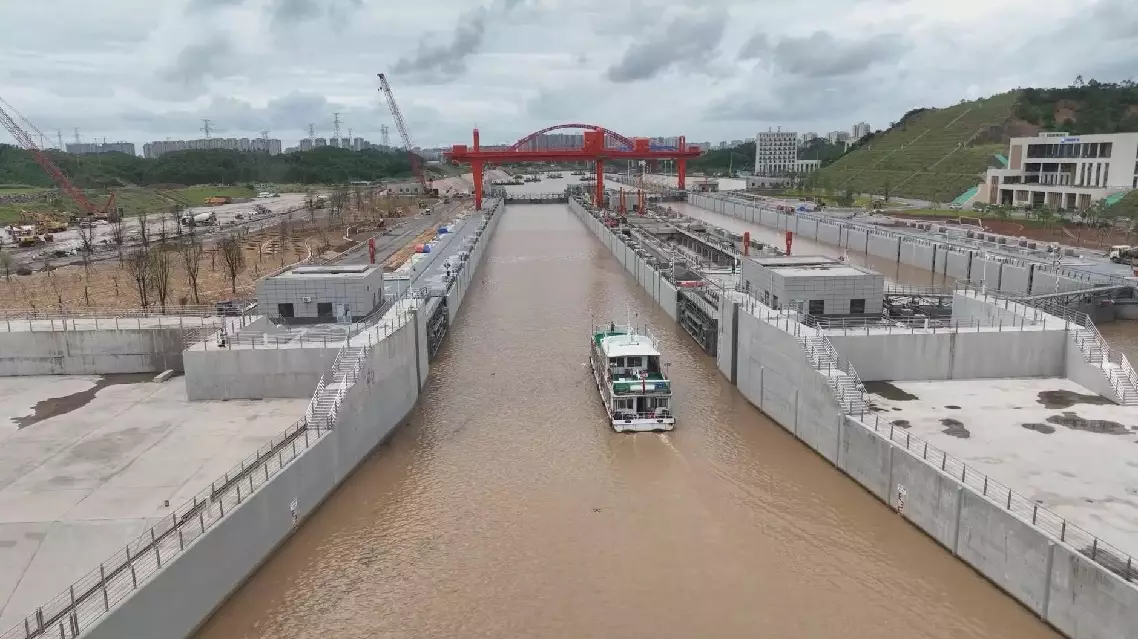
China's major river-to-sea canal completes first passenger vessel trial run ahead of official opening