The World Health Organization (WHO) said in a statement on Monday that its director-general has released updated temporary recommendations to member states on the Ebola outbreak, with the in the Democratic Republic of the Congo (DR Congo) assessed as the only country at "very high" risk.
The statement noted that WHO has put forward more detailed recommendations than before for the Ebola situation in the DR Congo, covering disease surveillance, case detection and investigation, infection prevention and control, clinical care, risk communication and community engagement. New sections on social measures, mass gatherings and domestic movement have also been added.
According to the statement, as of August 14, the WHO Secretariat assessed the risk level in the DR Congo as "very high," and currently only the DR Congo falls into this category. Nine neighboring countries, including Angola, Burundi, the Central African Republic, the Republic of the Congo, Rwanda and South Sudan, are assessed as "high" risk, while other countries are at "low" risk.
The current outbreak is caused by the Bundibugyo ebolavirus, for which there is no approved vaccine or specific treatment. The WHO Regional Office for Africa said clinical trials of potential treatments and evaluations of candidate vaccines are continuing.
WHO Director-General Tedros Adhanom Ghebreyesus announced on August 18 that the outbreak remained a public health emergency of international concern, based on the recommendation of the emergency committee. He said the outbreak had become the second-largest Ebola outbreak on record and was spreading faster than any previous one.
According to the latest epidemic report released by the health ministry of the DR Congo on Monday, as of Saturday, the country had recorded 5,514 confirmed cases, including 2,642 deaths and 1,200 recoveries, with a case fatality rate of 47.9 percent.
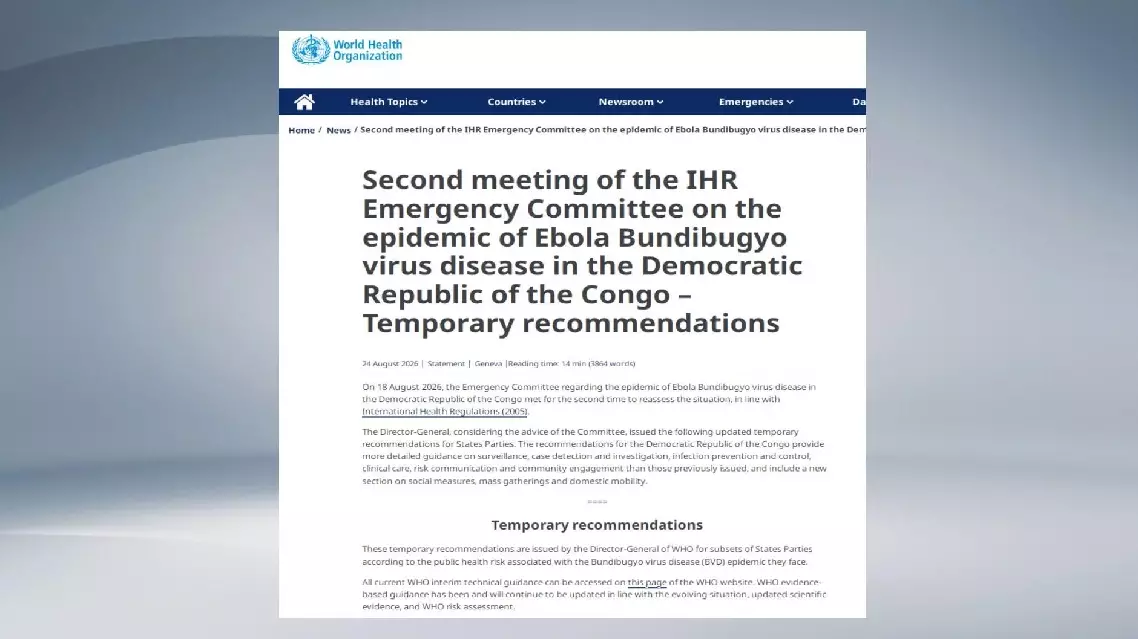
WHO issues updated temporary recommendations for Ebola outbreak in DR Congo
The Pinglu Canal, a major new waterway in south China, has successfully concluded its first trial navigation for passenger vessels, marking another step forward its official opening in September.
Measuring 32 meters long and 5.4 meters wide with a certified capacity of 100 passengers, the test vessel docked smoothly at an integrated service area in Qinzhou City, south China's Guangxi Zhuang Autonomous Region, at midday on Monday, marking the successful completion of the inaugural passenger service trial along the canal. According to the local maritime authorities, the trial was conducted without passengers on board and served as a comprehensive first-phase evaluation of the canal's navigability for passenger ships, the operational efficiency of its lock system, and the service capabilities of its waterside support facilities.
Monday's successful trail navigation came less than two weeks after the canal officially launched vessel trials on Aug 12, paving the way for future commercial passenger services on the waterway.
"Based on the entire navigation process this time, the channel dimensions of the Pinglu Canal, the operational efficiency of its locks, and the support capabilities of the waterside service areas all met the navigational requirements for tourist passenger vessels," said He Changhai, a law enforcement officer from the Qinzhou Maritime Safety Administration.
Designed to accommodate vessels of up to 5,000 tons, the 134.2-km Pinglu Canal is China's first major river-to-sea canal project planned and coordinated at the national level since 1949.
Stretching from the Pingtang River in Guangxi's Hengzhou City to the Beibu Gulf in the South China Sea, the canal is the backbone of the country's New International Land-Sea Trade Corridor, which has evolved into a strategic route linking China's inland regions with countries of the Association of Souchteast Asian Nations and other global markets.
The corridor's rail service handled a record 1.425 million 20-foot equivalent units of cargo in 2025, up 47.6 percent year on year. As of early July 2026, its network has reached 593 ports in 128 countries and regions.
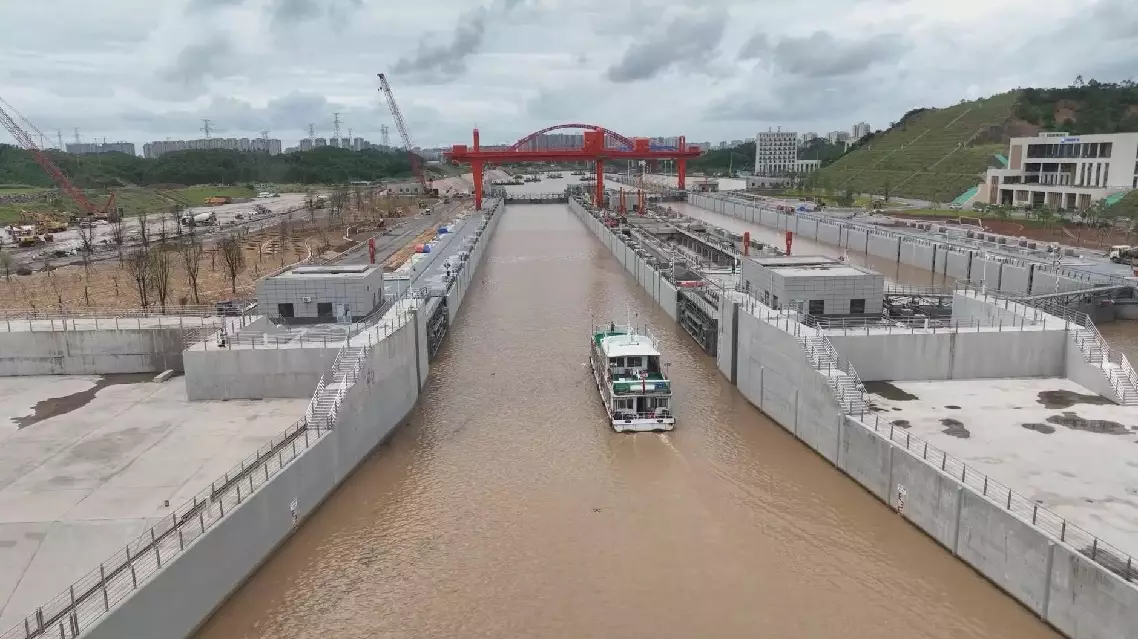
China's major river-to-sea canal completes first passenger vessel trial run ahead of official opening