OAKLAND, Calif.--(BUSINESS WIRE)--Aug 25, 2026--
Everlaw, the AI-powered litigation and investigations platform, today announced strategic partnerships with Thomson Reuters CoCounsel Legal and Harvey, along with MCP connectors for Google Cloud’s Gemini Enterprise for Legal and Microsoft 365 Copilot. The integrations expand the ways legal teams can use the AI tools they choose while keeping Everlaw as their trusted, governed evidence foundation.
This press release features multimedia. View the full release here: https://www.businesswire.com/news/home/20260825416331/en/
As legal professionals turn to a growing range of general-purpose and legal-specific AI tools, many still lack a defensible way to connect those tools to evidence when managing litigation or conducting internal investigations. Evidence is too sensitive, complex, and consequential to move casually into disconnected systems, where teams risk losing critical permissions, matter context, and auditability.
These new integrations allow users of Everlaw to securely access their documents, data, and advanced Everlaw capabilities while conducting work in partner platforms. For example, a Harvey and Everlaw user can instantly search millions of documents and metadata to extract insights and uncover case-critical details, a Copilot and Everlaw user can draft deposition questions using facts organized in Everlaw, and users of the other integrated platforms can do the same in their respective environments.
Everlaw’s expanding AI ecosystem gives legal teams more choice. Across the integrations, lawyers can ask natural language prompts to understand their case, analyze evidence and metadata, generate early case insights, and plan multi-step research—all while Everlaw remains the governed system of record for the underlying evidence, permissions, and audit trail.
“As legal teams adopt more AI tools for litigations and investigations, that intelligence needs to be informed by a matter's context and evidence," said AJ Shankar, Founder and CEO of Everlaw. "Litigation data is too complex for a single silver bullet. Our growing integration ecosystem gives customers the freedom to connect their AI tools to powerful Everlaw capabilities and the underlying evidentiary record. Everlaw's search, analytics, entity extraction, clustering, and communication analysis help narrow vast document collections to the evidence that matters, giving AI agents the context they need to deliver useful results."
The newly announced partnerships and integrations include:
Everlaw provides the platform and advanced analytic capabilities that help legal teams turn vast amounts of litigation and investigation data into effective case strategy. Its partners provide additional AI environments for synthesis, research, analysis, and work-product creation. Connecting the two layers helps teams move from raw data to insight and action more quickly, without compromising the governance framework high-stakes legal work requires.
“As our team expands its use of AI tools, we’re excited about the opportunity to connect the platforms we use directly to Everlaw,” said Julie Brown, Director of Practice Technology at Vorys. “Giving teams the flexibility to work with the AI tools that best fit their needs—while keeping those tools grounded in Everlaw—can help us get oriented to matters faster, surface important facts earlier, and generate insights with confidence in the underlying record.”
This announcement advances Everlaw’s broader approach to AI interoperability: legal teams should be able to work with the tools they prefer without moving sensitive evidence into disconnected systems or compromising the controls legal work demands. It builds on Everlaw’s previously announced work with Claude for Legal and its strategic partnership with Legora.
The integrations mark another step in bringing the power of Everlaw everywhere legal work gets done, while keeping the evidence itself in the platform built to manage it. More information about these partnerships and integrations is available here.
About Everlaw
Everlaw, the leading AI litigation and investigation platform, transforms raw evidence into insight and insight into strategy. Operating as the evidence layer for legal AI, our platform delivers the system of record that keeps workflows organized, highly secure, and defensible, whether work happens in Everlaw or with our extensive network of AI partners. Trusted by Fortune 100 corporate counsel, 93 of the Am Law 200, leading federal agencies, and all 50 state attorneys general, Everlaw is based in Oakland, California and is funded by top-tier investors, including Andreessen Horowitz, CapitalG, HIG Growth Partners, K9 Ventures, Menlo Ventures, and TPG Growth.
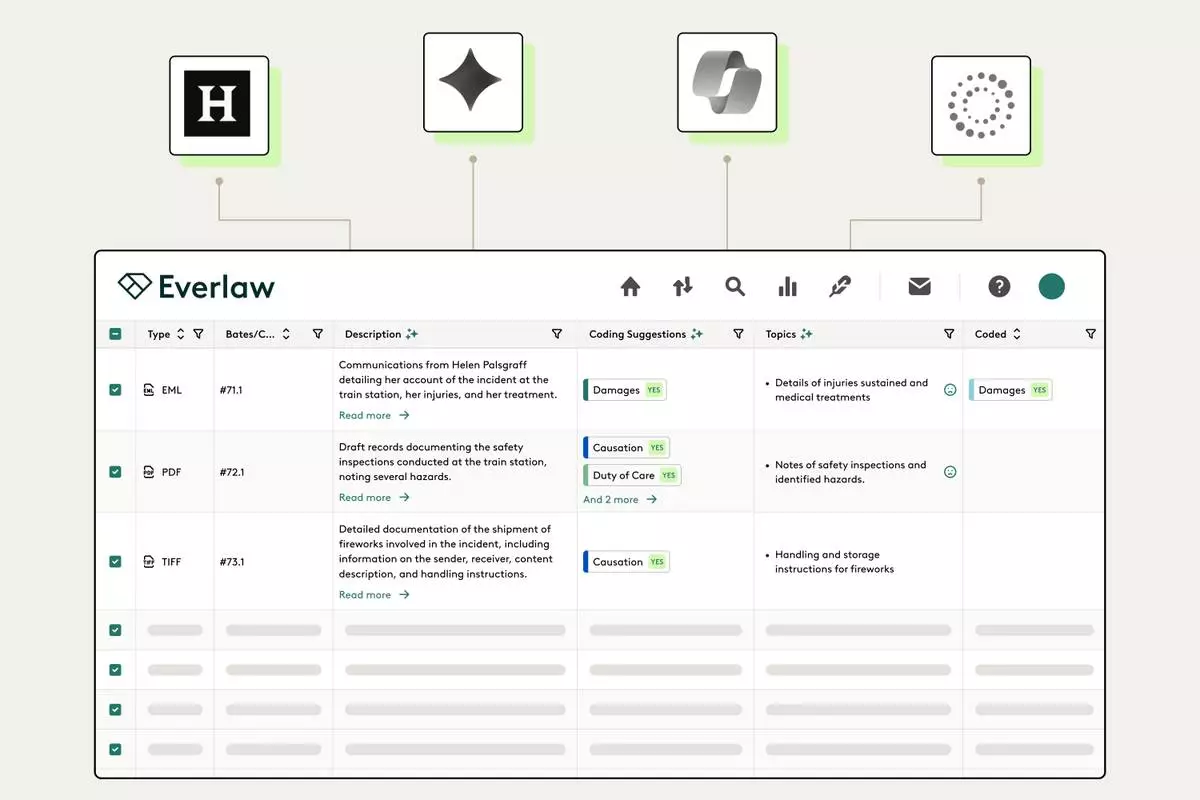
Everlaw announces integrations with Thomson Reuters CoCounsel Legal, Harvey, Google Gemini Enterprise for Legal, and Microsoft 365 Copilot.