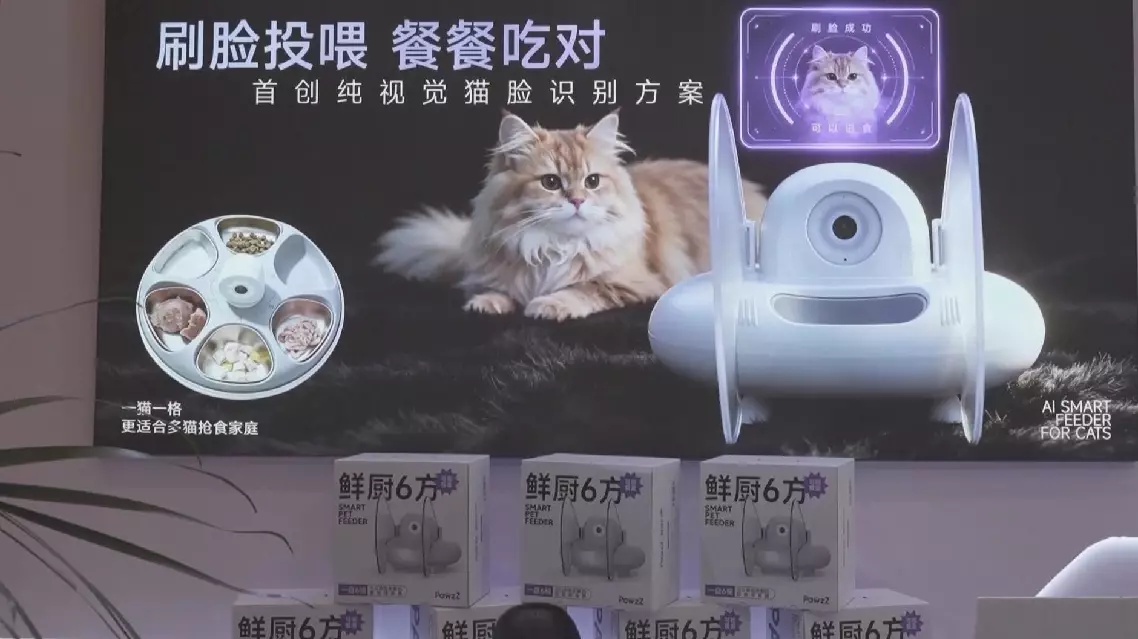
Chinese smart pet products are gaining significant traction in the global market, with local manufacturers reporting a surge in overseas orders as buyers at the recent Asia Pet Expo in Shanghai turn their attention to China's technological innovations.
So far, the urban dog and cat consumer market in China has surpassed 310 billion yuan (about 46.11 billion U.S. dollars).
The 28th Pet Fair Asia, which concluded in Shanghai recently, attracted over 530,000 visitors and more than 2,600 domestic and international exhibitors.
Many overseas buyers turned their attention to China's smart pet products.
"Pet technology, maybe we will need to update every year. We already received many good feedbacks from the customer to the China product in Vietnam market," said a Vietnamese buyer at the expo.
"Chinese products are very good in terms of the AI technologies there. Now, I feel in AI, the Chinese are leading the world. We hope that we'll get a lot of products," said an Indian purchaser at the expo.
"Chinese people are very creative. Every year we come to see new products so that is why we are attending the exhibition," said another Indian buyer.
At a smart pet washing and drying equipment manufacturer in Cixi City, east China's Zhejiang Province, workers are kicking into high gear to assemble pet dryers.
Once packaged, the products will be shipped to the United States.
The company owner said that overseas orders have been steadily increasing recently, prompting the production line to work overtime to meet the demand.
"We basically have to produce several thousand units every day. Our main markets are Europe, Australia, North America, and some Southeast Asian markets. Based on this year's figures, (overseas orders) may total around 10 million yuan to 20 million yuan," said Wei Naijian, co-founder of JirPet Technology Co., Ltd.
Wei said that when the company started in 2017, it focused primarily on the domestic market, but shifted its focus to overseas markets beginning in 2024. In the first half of this year, the company's overseas sales volume surged by more than 55 percent year on year.
In the first half of this year, Ningbo Customs processed export declarations for pet-related products valued at 2.24 billion yuan, up 21.7 percent year on year.
Experts say that Chinese companies are expanding their presence in overseas pet markets not only through supply chain advantages but also through their pricing power when dealing directly with overseas consumers.
They say the pet product market boasts a broad potential going forward.
"Currently, the global market for smart pet products is estimated to be between 8 billion U.S. dollars and 18 billion U.S. dollars. By around 2030, it is expected to reach between 15 billion U.S. dollars and 30 billion U.S. dollars and the broader pet tech ecosystem could hit between 30 billion U.S. dollars and 50 billion U.S. dollars," said Cui Lili, deputy director of the Institute of Digital Economy at Shanghai University of Finance and Economics.
Chinese smart pet products capture global market amid surging overseas orders
Twenty-five years after its founding, the Shanghai Cooperation Organization (SCO) has evolved into an economic grouping with tangible global influence, international experts have said.
The organization, spanning critical energy corridors, manufacturing hubs, and consumer markets, represents nearly a quarter of global GDP and over 15 percent of world trade.
Ahead of the upcoming SCO summit 2026 in Bishkek, Kyrgyzstan, Mohammed Saqib, Secretary-general of India-China Economic and Cultural Council hailed the organization's dual role in empowering member states and ensuring regional stability.
"SCO does two things. One is that it gives empowerment and also stability. It gives stability by creating cooperation between the countries. It empowers them by giving them infrastructure, by giving them opportunities to grow, and stability by having cooperation, working together," Saqib said. Against the backdrop of rising protectionist sentiments, SCO is believed to have turned shared needs into shared opportunities for all countries. In 2023 alone, SCO economies accounted for more GDP than the European Union.
"I think for rising protectionism, which now the West has been trying for a long time to do, SCO has substantially reduced the protectionism, fear, or implications for the Global South. Western countries are trying to essentially create a bloc confrontation. They want to continue with the hegemony, which they have been enjoying for the last 80-plus years. And now SCO has given an opportunity to get out of that dependence on the West," Saqib said.
"SCO is not involved in this so-called de-risking approach. This is an ideological agenda of some countries in the West who are scared of China. This approach is outdated and this mindset won't work in the 21st century. So they are going against the tide of history while SCO is on the right side of history," said Mushahid Hussain Sayed, a Pakistani Senator.
SCO's pursuit of multilateralism offers a platform for countries long marginalized in global economic cooperation, especially those in the Global South.
"In the past, Global South countries were always under pressure, under Western pressure. And Western governments would give them very unfair agreements to sign. And the West had a monopoly over industry and business to a large degree. And so they would put forward one-sided trade deals, and trade deals that benefited the West and gave very little benefit to countries across the Global South. Now, with the rise of Asian powers, the West no longer has that monopoly. And therefore, countries across the Global South have a choice. They can work with the rising Asian countries that offer much better deals, that offer much more beneficial collaboration, collaboration with much better results," said Mohammad Marandi, a Professor at the University of Tehran.
"I think the Global South now is seeing a focus on economic connectivity, economic relationships. It is tired of the militarization of international relations. But the SCO framework is somewhat different. SCO is trying to be the bridge between different countries in trade, economy, investment, road transport," Sayed said.
As Western sanctions reshape trade flows, how to leverage the SCO platform to enhance their independent development capabilities is a key focus for many Global South countries.
"They should cooperate more. They should have more South-South cooperation. They should have more trade among themselves. They should break these border tariffs and trades," said Sayed.
"Asia needs greater infrastructure projects in order to protect the trade routes from disruption on the seas. That, I think, creates an incentive for greater land-based infrastructure to be developed among SCO member states to protect the trade and business between these countries from external factors," Marandi said.
Twenty-five years on, the SCO is no longer just a security group. It is becoming an engine of shared prosperity.
By deepening connectivity, expanding South-South cooperation, and offering an open, rules-based alternative to bloc politics, the SCO is helping Global South countries turn interdependence into opportunity. In an age of fragmentation, its message is clear: The future belongs not to walls or sanctions, but to bridges, trade routes, and joint development.
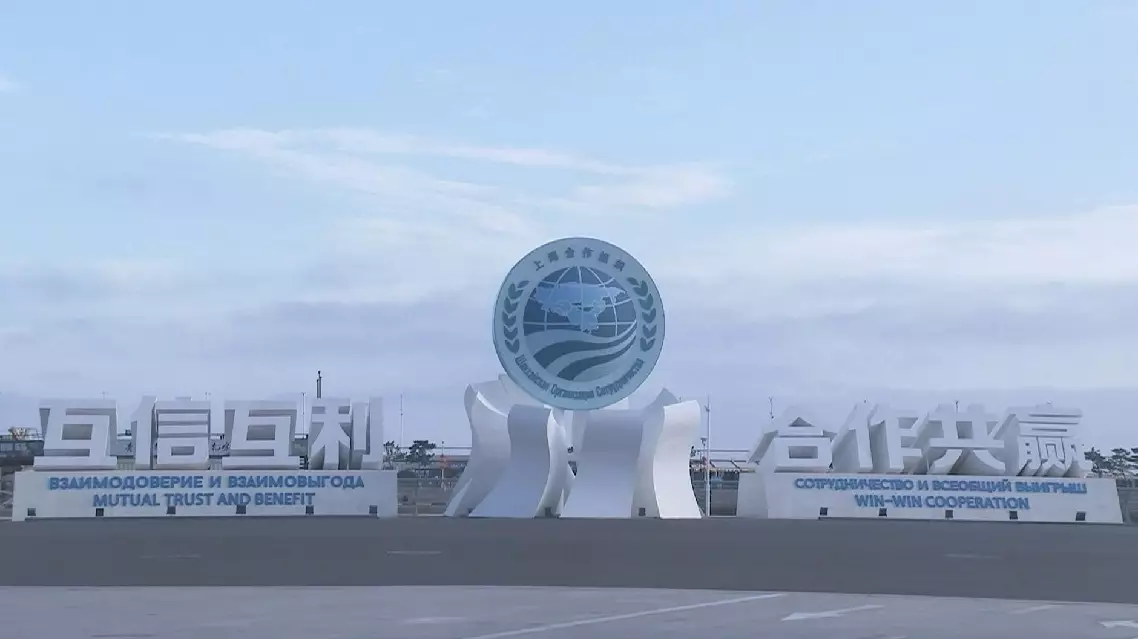
SCO serves as economic engine in era of fragmentation: experts