Rescue operations intensified Thursday at the mudslide-stricken border port of Gyirong in southwest China's Xizang Autonomous Region, as rescue teams and helicopters were dispatched to the disaster area.
The mudslide struck Gyirong Port in Gyirong County, Xizang, on Wednesday morning. As of 08:00 on Thursday, three people had been killed, 558 others remained missing, while two local villagers had been rescued.
The first team of 141 rescuers arrived at the port on Thursday morning, according to the Ministry of Emergency Management.
Also on Thursday morning, four helicopters from a unit of the Xizang Military Command's Army Aviation took off from an airport at Xigaze City to explore rescue routes and assess disaster conditions.
At 13:02, the first two helicopters arrived over the Gyirong Port and completed their mission.
A directing group from the Western Theater Command of the Chinese People's Liberation Army (PLA) was dispatched to Xizang on Thursday morning to coordinate joint rescue operations by military personnel in Gyirong County.
Carried by the Y-20 transport aircraft of the western theater command, the group will organize military forces to assist in disaster relief efforts.
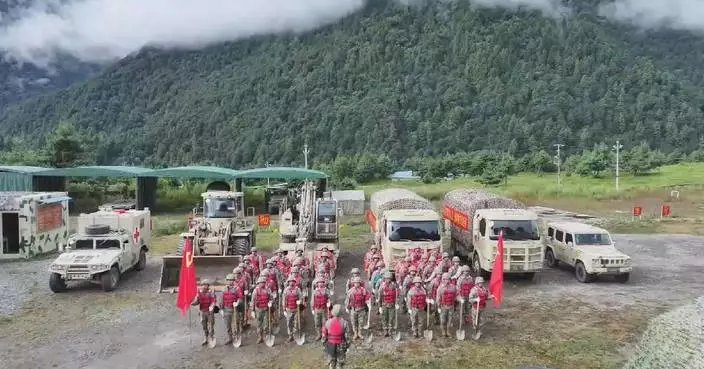
The command responded immediately following the disaster, mobilizing multiple rescue forces to the affected area to assist in road clearance, disaster assessment, search and rescue operations, and relocation of affected residents.
As of Wednesday noon, rescue forces from the PLA and the Armed Police Force had deployed a total of 500 personnel, four helicopters, and multiple drone sorties.
The Sichuan Provincial Emergency Management Department also urgently sent a Wing Loong emergency communication drone to carry out cross-regional reinforcement mission.
The drone took off at 18:18 Wednesday and arrived in the mission airspace at 02:00 Thursday.
Upon arrival, it quickly began disaster assessment and emergency communication support operations, providing aerial technical support for ground search and rescue efforts and emergency communications.
Fifty rescue team members from the Chongqing base of China Aneng, a state-owned engineering and rescue enterprise, arrived at Xigaze Airport at 09:00 Thursday and are currently en route to the disaster site in Gyirong County.
The 50-member team consists primarily of technical experts and is equipped with specialized rescue gear, including drones and life detectors.
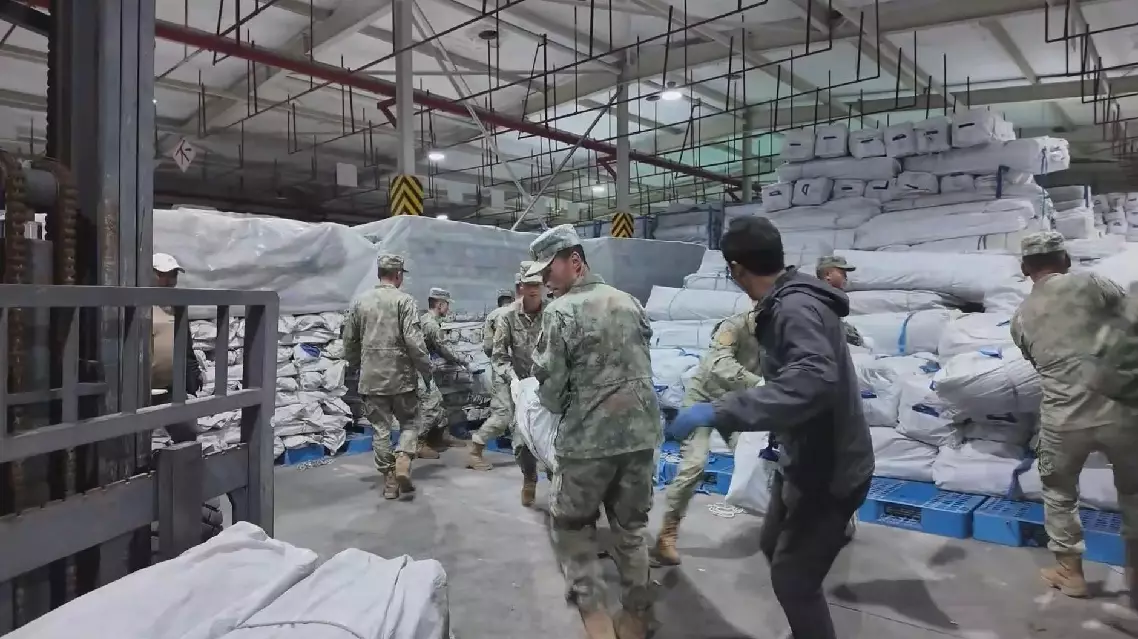
The Red Cross Society of China has dispatched a working team to disaster-hit areas to assist with relief efforts. It has also allocated 2,500 sets of supplies, including tents, family emergency kits, hygiene kits, quilts, folding beds and jackets.
The Chinese Red Cross Foundation has provided more than 5,500 boxes and packages of drinking water, instant noodles, ham sausages and milk.
Intensified rescue underway at mudslide-hit border port of Gyirong
Twenty-five years after its founding, the Shanghai Cooperation Organization (SCO) has evolved into an economic grouping with tangible global influence, international experts have said.
The organization, spanning critical energy corridors, manufacturing hubs, and consumer markets, represents nearly a quarter of global GDP and over 15 percent of world trade.
Ahead of the upcoming SCO summit 2026 in Bishkek, Kyrgyzstan, Mohammed Saqib, Secretary-general of India-China Economic and Cultural Council hailed the organization's dual role in empowering member states and ensuring regional stability.
"SCO does two things. One is that it gives empowerment and also stability. It gives stability by creating cooperation between the countries. It empowers them by giving them infrastructure, by giving them opportunities to grow, and stability by having cooperation, working together," Saqib said. Against the backdrop of rising protectionist sentiments, SCO is believed to have turned shared needs into shared opportunities for all countries. In 2023 alone, SCO economies accounted for more GDP than the European Union.
"I think for rising protectionism, which now the West has been trying for a long time to do, SCO has substantially reduced the protectionism, fear, or implications for the Global South. Western countries are trying to essentially create a bloc confrontation. They want to continue with the hegemony, which they have been enjoying for the last 80-plus years. And now SCO has given an opportunity to get out of that dependence on the West," Saqib said.
"SCO is not involved in this so-called de-risking approach. This is an ideological agenda of some countries in the West who are scared of China. This approach is outdated and this mindset won't work in the 21st century. So they are going against the tide of history while SCO is on the right side of history," said Mushahid Hussain Sayed, a Pakistani Senator.
SCO's pursuit of multilateralism offers a platform for countries long marginalized in global economic cooperation, especially those in the Global South.
"In the past, Global South countries were always under pressure, under Western pressure. And Western governments would give them very unfair agreements to sign. And the West had a monopoly over industry and business to a large degree. And so they would put forward one-sided trade deals, and trade deals that benefited the West and gave very little benefit to countries across the Global South. Now, with the rise of Asian powers, the West no longer has that monopoly. And therefore, countries across the Global South have a choice. They can work with the rising Asian countries that offer much better deals, that offer much more beneficial collaboration, collaboration with much better results," said Mohammad Marandi, a Professor at the University of Tehran.
"I think the Global South now is seeing a focus on economic connectivity, economic relationships. It is tired of the militarization of international relations. But the SCO framework is somewhat different. SCO is trying to be the bridge between different countries in trade, economy, investment, road transport," Sayed said.
As Western sanctions reshape trade flows, how to leverage the SCO platform to enhance their independent development capabilities is a key focus for many Global South countries.
"They should cooperate more. They should have more South-South cooperation. They should have more trade among themselves. They should break these border tariffs and trades," said Sayed.
"Asia needs greater infrastructure projects in order to protect the trade routes from disruption on the seas. That, I think, creates an incentive for greater land-based infrastructure to be developed among SCO member states to protect the trade and business between these countries from external factors," Marandi said.
Twenty-five years on, the SCO is no longer just a security group. It is becoming an engine of shared prosperity.
By deepening connectivity, expanding South-South cooperation, and offering an open, rules-based alternative to bloc politics, the SCO is helping Global South countries turn interdependence into opportunity. In an age of fragmentation, its message is clear: The future belongs not to walls or sanctions, but to bridges, trade routes, and joint development.
SCO serves as economic engine in era of fragmentation: experts