The Tanzania-Zambia Railway (TAZARA), which recently marked its 50th anniversary of commercial operation, has been serving as a vital transport corridor for regional trade, local officials said.
Built between 1970 and 1975 using an interest-free Chinese loan, the 1,860-kilometer railway connects Dar es Salaam on the Tanzanian coast to Kapiri Mposhi in Zambia.
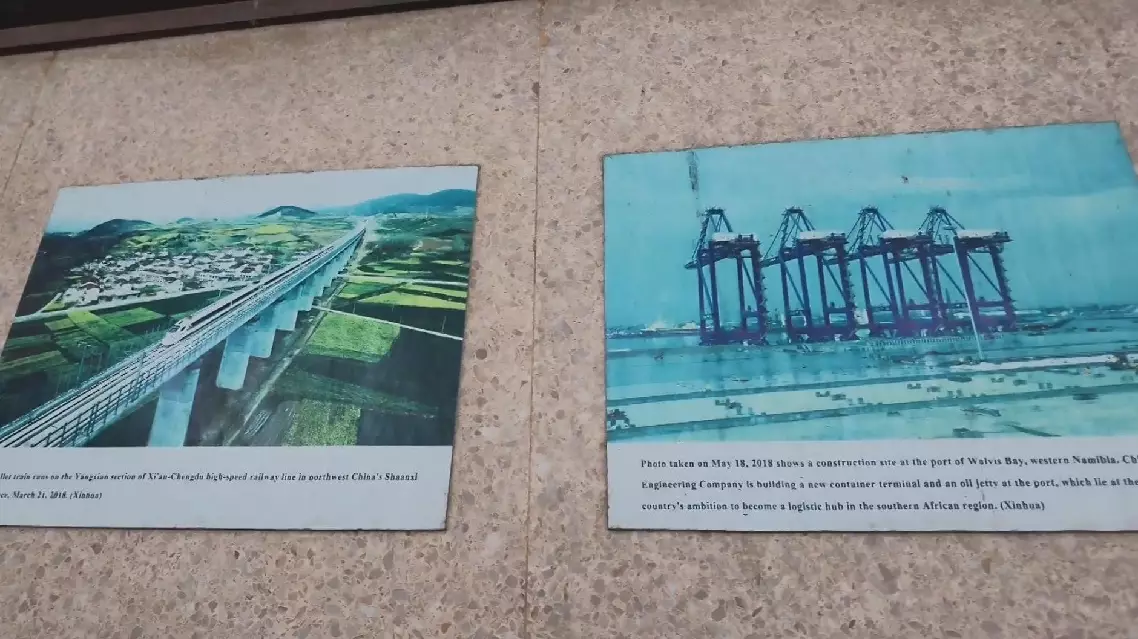
The railway station in Dar es Salaam has set up a photo exhibition showcasing the memories of Chinese and African constructors working side by side more than half a century ago, paying tribute to the Chinese friends who came from afar.
"This rail line, which started operation in 1976, contributed a lot in development of various towns and cities in Tanzania. It passes through the areas where there is no other means of transport. It helped to move, beside the domestic traffic, the traffic from neighboring countries like Zambia, the DRC, and there was time we moved cargo from South Africa and Zimbabwe," said Fuad Abdallah, director of the Tanzania Division of TAZARA.
While boosting economic development in Africa, the project has also helped training local talents through vocational workshops, higher education partnerships, and hands-on technical programs.
Adili Rajab Mohammed, a transport and logistics student at the Dar es Salaam Institute of Technology, said his studies are driven by a desire to master the mechanics of rail‑sea intermodal systems.
"I'm here for learning about this to increase my knowledge, skills about this operation found in rail transportation. And my future ambition is, I want to be someone with the biggest knowledge about this movement of transportation to the world. These sectors are [more common since] the old days," he said.
The China Railway Construction Corporation (CRCC) and its subsidiary, the China Civil Engineering Construction Corporation (CCECC), launched a revitalization project for the railway in November last year, aiming to transform it into a new corridor of economic prosperity through smart upgrades using Chinese solutions, technologies and standards.
"It is an important logistical link, which will be used to transport the materials and commodities. Currently, TAZARA is under concession. And the Chinese company CCECC is going to operate this railway. New wagons are coming, new locomotives are coming, the efficiency is going to be improved. So, the cooperation between China and Tanzania -- and to be precise, for TAZARA -- is beneficial and something which we need to uphold and praise," said Sadiki Anthony Minja, deputy director of TAZARA.
Since May 1 this year, China has fully implemented a zero-tariff policy for the 53 African countries with which it has diplomatic relations, opening new pathways for African specialty products to enter the Chinese market.
Tanzania-Zambia railway serves as vital regional trade corridor for half a century
The Japanese government is walking a tightrope between stimulating economic growth, expanding fiscal spending, and containing debt risks, a Japanese expert said on Wednesday.
Japan's real gross domestic product (GDP) grew 0.3 percent quarter-on-quarter in the second quarter of 2026, the Cabinet Office said in a preliminary report on Aug 17. Meanwhile, yields on Japanese long-term government bonds have continued to climb. The rise in long-term interest rates signals further increases in the government's future interest payments. Japan's Ministry of Finance has already raised the assumed interest rate for the fiscal 2027 budget to 3.8 percent, up from the previous 3 percent.
Kodama Yuichi, chief economist fellow at the Meiji Yasuda Research Institute, noted that as high interest rates gradually feed through to government bonds due for refinancing, Japan's fiscal space may come under further pressure.
"If this high interest rate continues, the interest expense will continue to increase every year in the future. The interest expense in the new annual budget is about 16 trillion yen (about 100 billion U.S. dollars). At present, as the budgetary estimate of the new annual budget requires, it seems that the figure may exceed 130 trillion yen (about 820 billion U.S. dollars). Thus, as indicated by this figure, interest expenditure accounts for nearly 10 percent. If this proportion continues to expand, other expenditures are likely to be squeezed, and it is necessary to be wary that it may have fallen into an intractable situation by the time when problems emerge," Kodama said.
"In terms of financial operation, the [Sanae] Takaichi government regards the proportion of government debt to the GDP as an important goal, but the problem with this goal lies in the proportion of government debt balance to the GDP. The change period is very long. In the next two or three years, we can actually see the improvement trend of this indicator. However, if interest expenditure keeps increasing in this process, interest expenditure may expand greatly in five or six years, and the proportion of government debt balance to the GDP may deteriorate again," Kodama said.
He also warned that if Japan's defense spending continues to increase, it will also worsen Japan's overall financial management. "The increase in the defense expenditure is indeed one of the factors. Among all kinds of expenditure items, the defense expenditure represents one of the biggest increases. The market is not only worried about the defense expenditure itself, but I think what the market is really worried about is that the overall financial situation of Japan, including the defense expenditure, is deteriorating. Therefore, it has become very difficult to manage the overall financial situation in the future," he said.
"In addition, rising prices may continue in the second half of this year, due to the impact of the previous increase in crude oil prices. At present, it is still in the process of transmitting the price to the final consumer, so I think personal consumption is likely to remain weak in the second half of this year," he added.

Japan's economic growth slows as fiscal expansion weighed by debt pressure: expert