Irkeshtam, an inland port on the border between northwest China's Xinjiang Uygur Autonomous Region and neighboring Kyrgyzstan, has emerged as a key gateway for Chinese electric vehicle (EV) exports to Central Asia.
With cross-border port upgrades high on the agenda for the upcoming 2026 Shanghai Cooperation Organization (SCO) Summit in Kyrgyzstan's capital Bishkek, the port is actively leveraging smart technology to streamline customs clearance and deepen regional interconnectivity.
"The customs authorities have rolled out a 'highway port plus local direct clearance' model. By means of advance declarations and centralized inspections, and with the application of smart, digital technologies such as automated data extraction, intelligent license plate recognition and automated checkpoint verification, this direct clearance model can boost the transit efficiency of export by 80 percent," said Mukhamat Shahaba, inspection section chief of the Irkeshtam Customs Department.
Once goods clear the port, they can reach Bishkek in as little as a single day. This combination of geographic advantage and continuously optimized customs procedures has helped establish Irkeshtam as a "golden passage" into Central Asia.
"We have implemented 24/7 cargo clearance, streamlined inspection procedures, and introduced a range of facilitation measures. By focusing on the practical needs of businesses and refining emergency response and assistance mechanisms, we are making every effort to enhance port clearance efficiency and support local opening-up and development," said Zuo Qi, head of the first duty squadron at the Irkeshtam border inspection station.
The numbers speak for themselves. In the first half of 2026, Irkeshtam processed the border exit of nearly 10,000 new energy vehicles (NEVs) for export. While this figure is modest compared to Xinjiang's mega-hub of Khorgos, size is only part of the story. Irkeshtam's true advantage lies in its proximity with Central Asian countries.
On the ground, a dedicated fleet of truck drivers has provided the agility and flexibility required to manage high-volume trade efficiently.
"As a truck driver hauling cross-border freight at the Irkeshtam Port for years, I have truly felt the tangible improvements in customs clearance. Inspections are now much more streamlined, we no longer have to wait in long queues, clearance is significantly faster, and as a result, I am earning more," said Guo Hongbo, one of the drivers.
Irkeshtam is just one node in a much larger picture. Across Xinjiang, a network of border ports is transforming the region from the status of northwest China's frontier zone into a gateway for green mobility to Central Asia. The ancient Silk Road once carried silk and spices. Today, it carries speed, innovation and sustainable power.
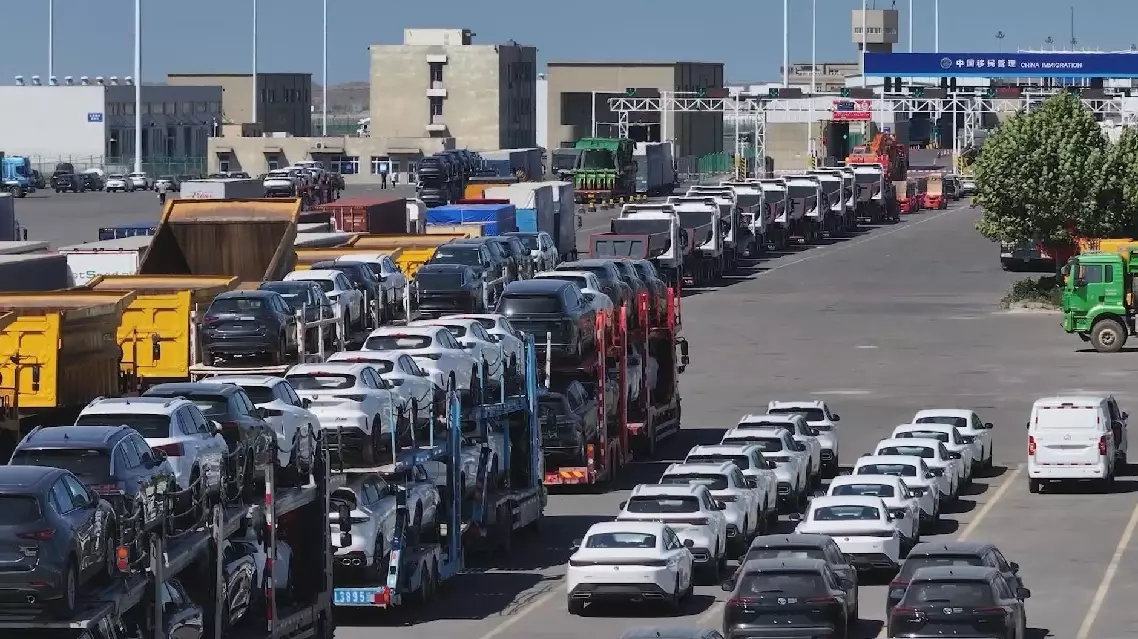
China-Kyrgyzstan border port emerges as key gateway for Chinese EV exports