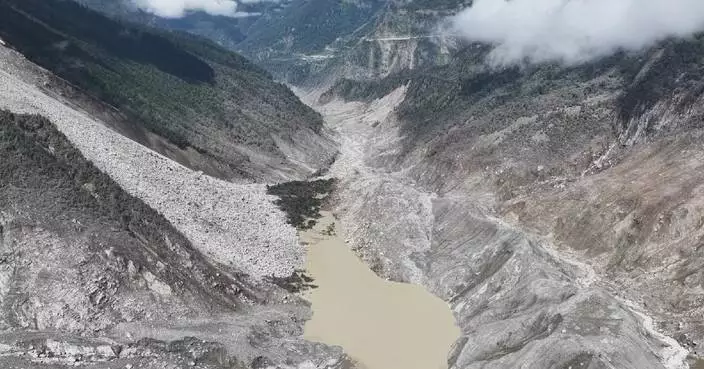
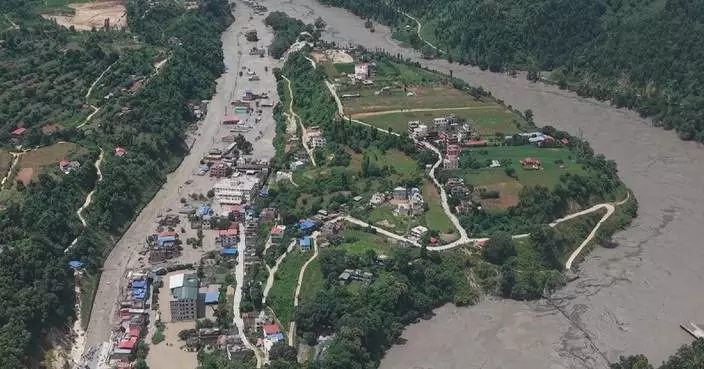
Search and rescue operations continue in full swing in southwest China's Xizang Autonomous Region after a catastrophic glacier collapse sent a torrent of ice, rock, mud and water across the China-Nepal border region, killing at least seven people and leaving more than 550 others missing in Gyirong County alone.
Rescue teams are advancing by land, water and air as communications and road access are gradually restored, but difficult terrain and unstable conditions remain major obstacles to the operation.
Experts say the disaster originated on the Nepalese side of the border, where part of a high-altitude glacier gave way. The falling ice and rock raced downhill, gathering loose debris at tremendous speed. Within minutes, the massive flow had swept into Gyirong Port, a key land border crossing in Xizang.
The scale and speed of the collapse were extraordinary. The ice source was located at an elevation of roughly 5,140 meters above sea level, while Gyirong Port lies at just 1,800 meters -- a vertical drop of nearly 3,300 meters over a distance of about 20 kilometers, according to Guo Zhaocheng, a senior engineer at the China Aero Geophysical Survey and Remote Sensing Center for Natural Resources.
"According to our records, the time from the start of the glacier collapse to its impact on the Gyirong Port was seven minutes, so the average speed was about 50 meters per second, which is extremely fast," he said.
China swiftly launched an emergency response. Entrusted by President Xi Jinping, Premier Li Qiang traveled to Gyirong County and called for all-out rescue and emergency response efforts.
More than 2,000 rescue personnel and specialists, along with over 570 pieces of equipment, have been deployed to the disaster zone so far but the operation is a race against time, and the challenges are immense, according to Chen Hongqi, a senior engineer at the Technical Guidance Center for Geological Disasters under the Ministry of Natural Resources.
"Mudslides like this occur under particular terrain and water conditions, and that creates several challenges for rescue teams. First, the flow of water from upstream keeps changing. Second, the valley is narrow, which limits access for rescuers. Third, the debris [left] by the mudslide contains both solid material and water, making it difficult for heavy machinery to move through the area. Fourth, the fast-moving water and debris can further damage slopes and roads," he said.
"Right now, multiple agencies are working together to assess the risk of secondary disasters. They are also closely monitoring the weather, water levels, and geological conditions," Chen said.
With the situation still unfolding, rescue teams are pushing forward, hoping to reach survivors before time runs out.
The disaster had killed 626 people and left 2,426 others missing in Nepal as of Saturday morning, according to Nepal's National Disaster Risk Reduction and Management Authority.
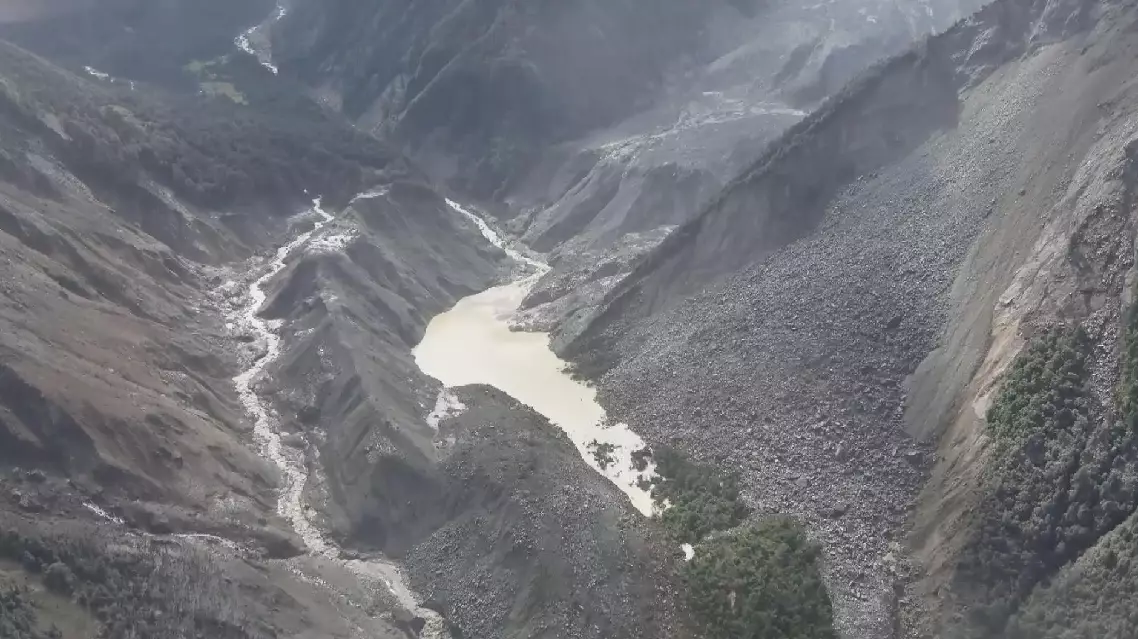
Search, rescue efforts continue after China-Nepal border glacier collapse as teams battle difficult terrain