TOKYO (AP) — Japanese automakers Nissan and Honda entered a deal to jointly develop computer parts and software for vehicles set to enter the market in fiscal 2029, both sides said Monday.
Under the deal, Nissan, based in the port city of Yokohama, and Tokyo-based Honda will share standardized parts in “core ECUs,” or electronic control units, as well as software.
Nissan and Honda started talks in 2024 to work together in developing electric vehicles and auto intelligence technology.
Nissan makes Leaf electric cars and Infiniti luxury models, while Honda makes the Accord sedan, Civic compact and Odyssey minivan.
Monday’s agreement did not specifically mention EVs, or any model names, and was focused on so-called software-defined vehicles, which could include EVs. These vehicles have functions and features that can be updated and controlled by software, rather than the mechanics of hardware.
The global competition in the auto industry is increasingly intensifying as it moves into various technologies, such as automated driving and zero emissions. Each vehicle is starting to be more like a computer packed with electronic parts and software rather than the old image of the gas-guzzling engines.
Sharing components and collaborating on research will help cut costs and speed up development, as well as add efficiency in economy of scale once the vehicles go into production.
European makers Volkswagen, BMW, Mercedes-Benz and Stellantis are working together in software development so they can share the same operating system.
Both Nissan and Honda are overshadowed by Toyota Motor Corp., the top Japanese automaker, and working together could be a plus in competing against Toyota.
However, Toyota has been mentioned in the past as engaging in the software talks with Nissan and Honda, although it was not part of Monday’s announcement.
Toyota is working on software with other companies like Subaru, which is part of the Toyota group, and U.S. autonomous driving technology company Waymo.
As part of their strategic partnership, Nissan and Honda will continue to explore other opportunities for collaboration across a range of areas, including zero-emissions and decreasing traffic fatalities.
Both sides stressed that the use of intelligence and electrification technology is an important focus for working together.
“Recognizing the need to strengthen competitiveness through faster development cycles and more efficient investment, the two companies have conducted extensive studies on potential collaboration in the software domain,” they said in a statement.
Yuri Kageyama is on Threads: https://www.threads.com/@yurikageyama

FILE - The Honda and Nissan dealerships are shown in Carmel, Ind., Wednesday, Aug. 6, 2025. (AP Photo/Michael Conroy, File)
DUBAI, United Arab Emirates (AP) — The United Arab Emirates’ air force intercepted an Iranian drone over its territorial waters Monday, the Defense Ministry said, an attack that comes after the United States and Iran exchanged fire on the weekend, the first significant military action in a month.
During the lull in fighting, the U.S. has been ratcheting up economic pressure on Iran with the hope of forcing concessions out of Tehran, including reopening the vital Strait of Hormuz to shipping.
After the U.S. and Israel attacked Iran on Feb. 28, Iran established a chokehold on the strait, though which a fifth of the world's traded oil passed in peacetime, slowing ship traffic to a trickle.
As the fighting resumed, the price of Brent crude oil, the international standard, climbed above $90, up about 25% from the start of the war, presenting a growing problem for U.S. President Donald Trump ahead of the midterm elections.
In a short statement, the UAE Defense Ministry said it “dealt with” an Iranian drone that was detected over its waters approaching from Iran. There were no reports of damage.
“This dangerous escalation constitutes a blatant violation of the UAE’s sovereignty, security, and stability, and a direct threat to the safety of its citizens and residents,” the Foreign Ministry said.
The Defense Ministry later issued a second statement denying a claim by the Iranian army that the Al Minhad Air Base in Dubai had been targeted, saying it was false.
The incident came after U.S. forces on Sunday struck Iranian rocket launchers on an Iranian island, breaking a lull in fighting in the war that has lasted more than six months.
Iran responded by launching missiles at U.S. sites in Jordan, which were intercepted.
Early Monday, Iran's Foreign Ministry said Iran would “not hesitate to exercise the inherent right of legitimate defense and will respond decisively to any military aggression.”
Before heading to attend the Shanghai Cooperation Organization's summit in Kyrgyzstan with Foreign Minister Abbas Araghchi, Iranian President Masoud Pezeshkian, who has favored a negotiated end to the conflict, stressed that Iran was not seeking war.
“But,” he said, “we will respond decisively to aggressors.”
The summit brings together a group billed as a counterweight to U.S. global influence, and includes Chinese President Xi Jinping, Russian President Vladimir Putin and Indian Prime Minister Narendra Modi. Pezeshkian was scheduled to meet with Putin on the sidelines on Tuesday.
Meantime, U.S. Treasury Secretary Scott Bessent was set to host meetings of the Group of 20 finance ministers in North Carolina on Monday and Tuesday, which come as Washington pressures other countries to help the U.S. economically isolate Iran.
The shifting strategy centers on threats to punish any country or entity that continues to conduct business with Tehran.
Two weeks ago, the UAE suspended all trade with Iran after saying it had come under renewed fire from Iran with two missiles fired at shipping traffic splashing down harmlessly in the Persian Gulf. Iran denied the attack.
Bessent later suggested it was pressure from Washington that led to the UAE decision.
Trump stressed last week that he is “not in a hurry” to get Iran back to the negotiating table, and he continues making the case that the Islamic Republic’s leadership is on the ropes.
Appointments to Iran’s senior security leadership in the past month, however, have signaled Tehran’s defiance after weathering decades of sanctions as well as a lack of tolerance for dissent at home.
On Sunday, U.S. Central Command said it had struck Iranian launchers after observing forces with Iran’s Revolutionary Guard Corps preparing to launch rockets with sea mines into the Strait of Hormuz. The U.S. military said last week it had completed clearing sea mines from the waterway’s international shipping routes.
Semiofficial news outlets in Iran reported sounds of explosions near Larak island on the strait and the Revolutionary Guard said there had been casualties.
U.S. military officials disputed Iran’s claim that the latest American strikes were an act of aggression, calling them a “limited, precise action” against what they said were minelaying forces.
Iranian state television later showed what it said were ballistic missiles being fired at American bases in Jordan, and Jordan’s military said it intercepted eight that had entered its airspace.
A return to open conflict would be dangerous for the region, where Iran has targeted U.S. military bases and infrastructure in Gulf countries since the war began on Feb. 28.
The last time the U.S. military confirmed targeting Iran was on July 29, when it announced a “heavy wave of strikes” on dozens of Revolutionary Guard targets including coastal surveillance and defense sites.
Trump said on Aug. 1 he would order the military to hold off on new strikes at the urging of Gulf allies Qatar, Saudi Arabia and the United Arab Emirates.
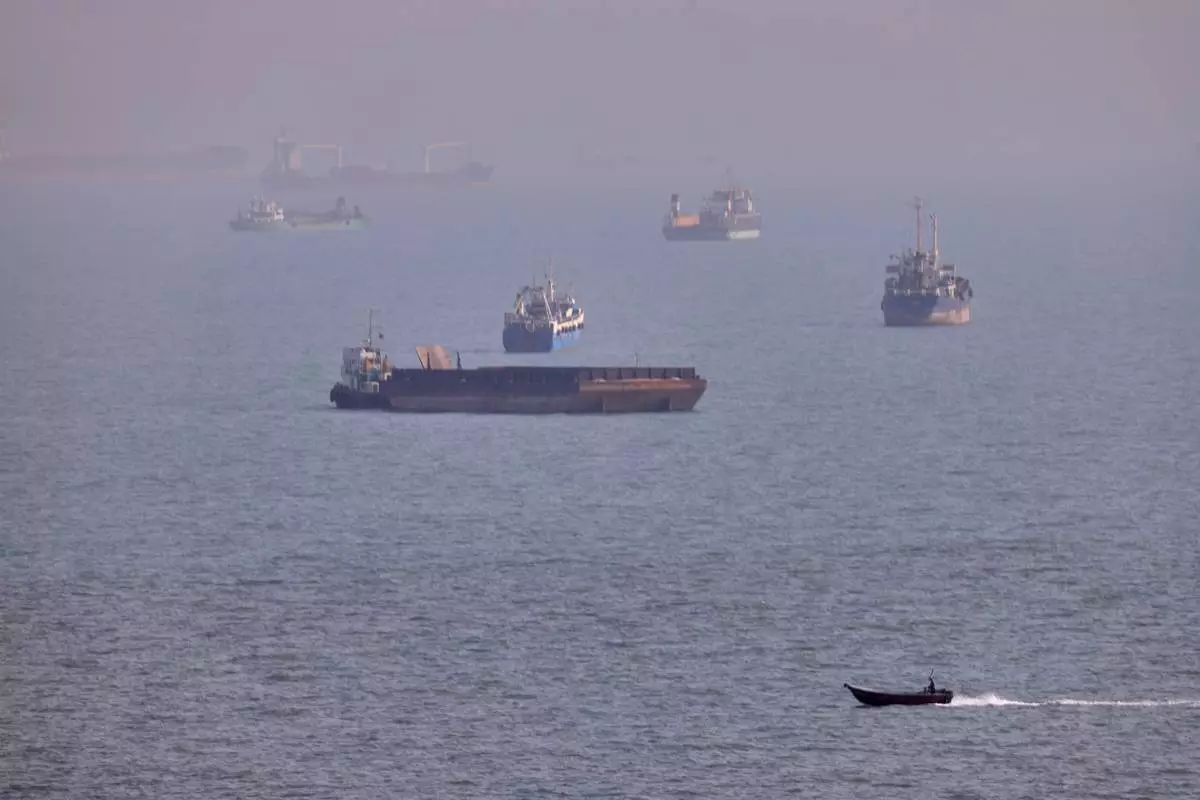
FILE - A small boat sails past cargo ships and other commercial vessels anchored in the Strait of Hormuz off Bandar Abbas, Iran, Wednesday, Aug. 5, 2026. (Amirhosein Khorgooi/ISNA via AP, File)