
DUBAI, United Arab Emirates--(BUSINESS WIRE)--Sep 1, 2026--
Airrived, the company behind the enterprise Agentic OS, today announced the launch of its Sovereign AI Platform, giving governments and enterprises a way to run agentic AI entirely inside their own environments — with nothing required to leave the building. Airrived will showcase the platform live at GISEC Global, taking place 16–18 September 2026 at the Dubai Exhibition Centre (DEC), Expo City, Dubai.
This press release features multimedia. View the full release here: https://www.businesswire.com/news/home/20260901351949/en/
As AI adoption accelerates, a harder question is catching up with it: who actually controls the intelligence running your organization?
Sensitive data crosses borders it was never meant to cross. Token costs swing unpredictably from one quarter to the next, turning AI from a fixed cost into an open-ended liability. Mission-critical systems depend on external providers with no guarantee of continuity. And for the world's most regulated institutions, sending data, prompts or intelligence to an externally hosted AI system isn't a risk worth taking — it's simply not an option.
Airrived built its Sovereign AI Platform to remove that trade-off entirely. The launch follows Airrived's #1 overall ranking in the AWS/CTIB Cybersecurity Startup Accelerator, a global program backed by Amazon Web Services (AWS), CrowdStrike, CyberE71 and the UAE Cyber Security Council — recognition from some of the industry's most demanding cloud and cybersecurity players that Airrived's approach to agentic AI holds up under serious scrutiny.
Organizations can deploy Airrived on-premises, on private GPU infrastructure, or inside fully air-gapped environments — running their own models or Airrived's models entirely within their own infrastructure.
Data stays inside. Models stay inside. Intelligence stays inside.
“AI sovereignty isn't simply about where your data is stored. It's about who controls the entire intelligence stack,” said Anurag Gurtu, Co-founder and CEO of Airrived. “Enterprises should be able to own their data, choose their models, operate their agents and control their infrastructure — without sacrificing the power of agentic AI. That's what we're delivering.”
An Agentic OS Built for Sovereignty
Airrived delivers an end-to-end Agentic OS: organizations can consume pre-built AI applications or build their own agents and agentic applications, all while keeping full control of the infrastructure underneath. The platform unifies agent orchestration, models, enterprise context, reasoning, governance, observability and AI applications into a single sovereign architecture.
With Airrived, organizations can:
The model is already proven in the region: through its partnership with Wizdom, Airrived's Agentic OS powers agentic AI capabilities natively within Wizdom's own data center infrastructure — sovereignty, not in theory, but in production.
The launch arrives as governments across the Middle East accelerate national AI strategies built on the same principle: sovereign control over data, infrastructure and intelligence. From the UAE's National AI Strategy to similar initiatives across the GCC, the region has made clear that AI adoption must go hand in hand with data sovereignty and national digital resilience. Airrived's platform is built to meet that mandate directly, giving governments and regulated enterprises a way to adopt agentic AI without ceding control of their most sensitive data.
The Next Era of Enterprise AI Is Sovereign
For governments, critical infrastructure operators, financial institutions and other highly regulated enterprises, real AI adoption now demands more than powerful models — it demands control.
Airrived believes the next generation of enterprise AI infrastructure will be defined by choice: where intelligence runs, which models power it, who can access it, and where the data ultimately lives.
“Cloud democratized infrastructure. Generative AI democratized intelligence. The next step is making that intelligence truly yours,” Gurtu added. “The future of enterprise AI will not just be agentic. It will be sovereign.”
Airrived will showcase its Sovereign AI Platform live at GISEC Global, 16–18 September 2026, at the Dubai Exhibition Centre (DEC), Expo City, Dubai.
About Airrived
Airrived is the company behind the enterprise Agentic OS designed to make every business user an AI expert. The platform enables organizations to consume, build, deploy, govern and operate AI agents and agentic applications across cybersecurity, IT and enterprise operations. Airrived supports deployments across every enterprise environment — on-premises, private infrastructure and fully air-gapped networks.
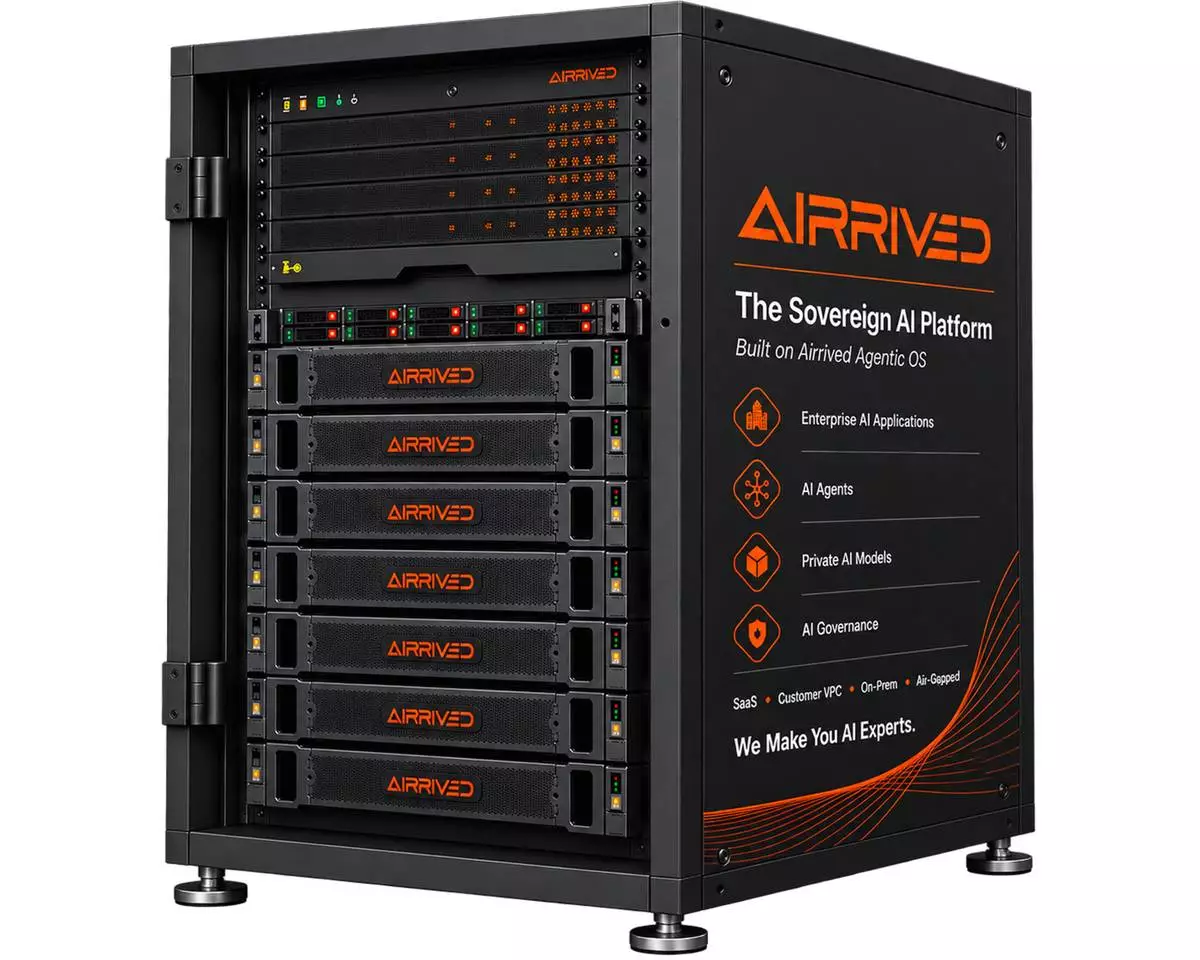
Airrived Launches Sovereign AI Platform, Putting Enterprises Back in Control of Their AI