Iran's president said Tuesday his country is ready to return to the ceasefire deal reached with the United States in June if Washington does the same, in conciliatory remarks following the first exchange of fire between the two countries in a month.
Here’s a look at the latest developments in the Iran war and the wider Middle East. Full coverage can be found here.
Speaking on the sidelines of the Shanghai Cooperation Organization summit in Kyrgyzstan, Iran's President Masoud Pezeshkian said that “if the U.S. returns to its commitments in the memorandum of understanding, the Islamic Republic of Iran will immediately reciprocate,” Iranian state media reported.
The June memorandum of understanding called for an immediate ceasefire and started a 60-day period for negotiations aimed at reaching a wider peace deal. Iran agreed to clear the Strait of Hormuz of mines and allow ships to pass during the period, and the U.S. agreed to end its naval blockade, lift sanctions, issue waivers for Iranian oil exports and begin work on a reconstruction package for Iran, among other things.
The agreement broke down quickly, and while there has been a lull in fighting, the two sides exchanged fire on the weekend.
While Pezeshkian has long favored a negotiated end to the war, Iran’s most powerful force remains the paramilitary Revolutionary Guard, which is pressing for greater concessions from the U.S., including Iranian control over the Strait of Hormuz and financial compensation for the war. Those conditions would likely be unacceptable to Washington.
The leaders of China, Russia and India are all attending the summit in Kyrgyzstan, which has been billed as a counterweight to U.S. global influence.
Iran's foreign minister has already held meetings with his Chinese counterpart and Pezeshkian was due to have talks with Russian President Vladimir Putin later Tuesday.
The British military's United Kingdom Maritime Trade Operations Centre said it received reports of an attack on a ship in the Strait of Hormuz, and a second report of an incident involving a tanker in waters nearby.
In the first incident, the UKMTO said a tanker was hit by three projectiles Monday on its way out of the Persian Gulf through the strait east of Oman.
The monitoring agency said there were no reports of casualties on the boat or any environmental impact from the attack.
In the second incident, the UKMTO said it had received a report “involving a tanker and military forces” on Monday off the coast of Oman, east of the Strait of Hormuz.
Ambrey, a UK-based maritime risk and response company, also said that the vessel had reportedly been stopped and remained adrift. There were no reports of casualties.
There was no immediate claim of responsibility for the attacks, but Iran has fired regularly on ships in the Strait of Hormuz as it continues to restrict traffic through the key waterway. The U.S. has also fired on ships as it maintains its blockade of Iranian ports.
Iraq’s Supreme Judicial Council said Tuesday it had completed investigations into some 5,704 suspected Islamic State group members who were transferred to Iraq from Syria early this year. Hundreds would be released and the others sent to trial, the council said.
The detainees were transferred from detention centers previously run by the Kurdish-led Syrian Democratic Forces amid fears that fighting that broke out between the SDF and government forces and an ensuing power vacuum in some areas would allow militants to flee.
The detainees include people from 67 nationalities, including 3,497 Syrians and 474 Iraqis. Some were European nationals.
The council said investigations failed to establish sufficient evidence in some cases, leading to the release and handover of a Finnish, an American and seven Iraqi detainees to their home countries.
It said Iraqi authorities were also completing procedures to release 457 Syrian detainees due to insufficient evidence to justify continued judicial proceedings.
Japan’s Cabinet on Tuesday approved a 616 billion yen ($3.9 billion) emergency fund to address rising gasoline prices and other fallouts from the Middle East conflict, Prime Minister Sanae Takaichi said in a social media post.
Most of the money will fund government subsidies to keep retail gasoline prices around 170 yen ($1.06) per liter.
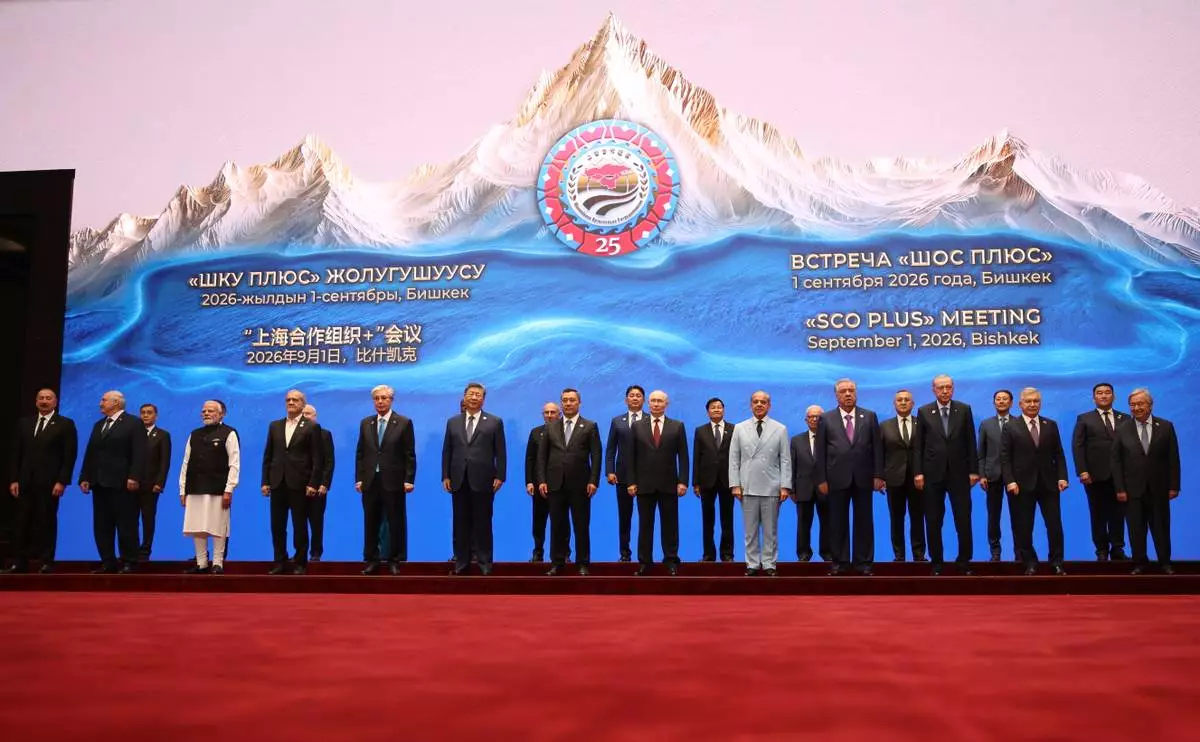
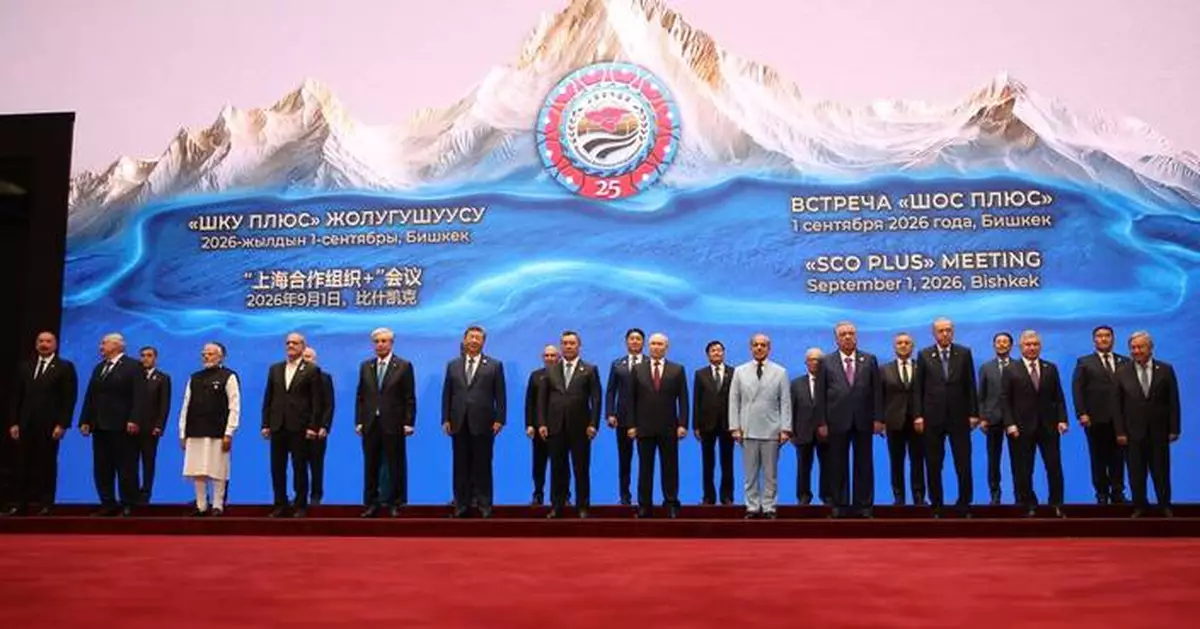
From left, Azerbaijani President Ilham Aliyev, Belarusian President Alexander Lukashenko, SCO Secretary-General Nurlan Yermekbayev, Indian Prime Minister Narendra Modi, Iranian President Masoud Pezeshkian, Kazakh President Kassym-Jomart Tokayev, Chinese President Xi Jinping, Armenian Prime Minister Nikol Pashinyan, Kyrgyz President Sadyr Japarov, Mongolian President Ukhnaa Khurelsukh, Russian President Vladimir Putin, Lao President Thongloun Sisoulith, Pakistani Prime Minister Shehbaz Sharif, Egyptian Deputy Prime Minister Hussein Issa, Tajik President Emomali Rahmon, Collective Security Treaty Organization (CSTO) Secretary General Taalatbek Masadykov, Turkish President Recep Tayyip Erdogan, Secretary General of the Conference on Interaction and Confidence Building Measures in Asia Kairat Sarybay, Uzbek President Shavkat Mirziyoyev, SCO Regional Anti-Terrorist Structure Ularbek Sharsheev and United Nations Secretary-General Antonio Guterres pose for a photo prior to a meeting in the Shanghai Cooperation Organization (SCO) Plus format in Bishkek, Kyrgyzstan Tuesday, Sept. 1, 2026. (Pyotr Kovalev, Sputnik, Kremlin Pool Photo via AP)