SANTA MONICA, Calif. (AP) — The Trump administration is ratcheting up its fight to get more crude flowing through California and reverse the state's efforts to move away from fossil fuels.
Its latest salvo is a federal review of California's coastal management program, which is run largely by a state commission that has had a powerful role for decades in shaping development along the coast. Environmental advocates fear federal officials could use the review to strip the California Coastal Commission of its ability to have a say in projects involving federal agencies that affect the state's rugged coastal bluffs, pristine beaches and world-class surfing spots.
The administration, citing a need for energy security and job creation, has already announced plans for new offshore oil leases in California as well as Florida, where the federal government has not allowed drilling since 1995 because of concerns about oil spills in the Gulf of Mexico.
Trump officials also helped a Texas firm jump-start an old pipeline system that had been idled since its 2015 rupture caused one of California’s worst oil spills, blackening beaches for 150 miles (240 kilometers) from Santa Barbara to Los Angeles and polluting habitat for endangered whales and sea turtles. Federal officials also recently took a step toward authorizing fracking on an old oil platform 9 miles (14 kilometers) off Ventura County — a move opposed by the state’s coastal commission.
“It's just part of that overall belief that they have, that they're going to get rid of renewables and go back to good old-fashioned fossil fuels, and what better place to start than California?” said Deborah A. Sivas, a professor of environmental law at Stanford Law School. “We're the feds — we're going to tell the state what to do.”
California has some working offshore rigs, but there has been no new oil leasing in federal waters since the mid-1980s and no new state leasing for even longer. The state barred new offshore oil leases after a catastrophic spill in 1969 spewed between 3.5 million and 4.2 million gallons of crude into the Santa Barbara Channel. The disaster killed thousands of seabirds and helped give rise to the modern environmental movement.
California now uses so much solar and wind energy that nearly half the state's electricity came from renewable resources in 2024, according to the state's energy commission. That's also the source of a fight with the Trump administration. Last week, state officials sued the federal government over its buyback of an offshore wind lease aimed at discouraging the expansion of wind energy in favor of fossil fuels.
California has also tried to wean residents off gas-powered cars — another push opposed by the Trump administration.
California's coastal commission, an independent agency with appointed members, was formed in 1972. It has often been in the spotlight for taking up high-profile projects on the state's tourism-dependent coast. The panel voted against but later approved a U2 guitarist's plan for mansions on seaside bluffs, though the building proposal was eventually nixed by a court. It also rejected a proposed desalination plant to create drinking water in Huntington Beach.
The commission also has a say in federal projects along California's coast, in line with a 1972 federal coastal management law. More than 30 states have similar programs to protect their coastal resources and all are subject to periodic federal evaluation.
Commerce Secretary Howard Lutnick announced the unexpected review of California’s program in May while denouncing the commission’s opposition to an expanded launch schedule for SpaceX’s Falcon 9 rockets from Vandenberg Space Force Base. Commissioners cited concerns that more launches could harm sensitive species and limit public access to the coast.
“Obstructionist policies that delay critical national infrastructure in the name of environmental extremism are unacceptable,” Lutnick said. He said the review will examine how California has addressed federal priorities on spaceport infrastructure, offshore oil production, pipeline maintenance and desalination projects.
Targeting California raises a fight that could reverberate nationwide, experts say. Until now, no state with a coastal program has been stripped of its authority to review federal projects. Many Californians who spoke at an hourslong public hearing in Santa Monica in August said they don’t want their state to be the first.
“This isn’t about performance. This is about power,” said Maureen Ellenberger, a Santa Barbara resident who is upset about the decision to let Houston-based Sable Offshore Corp. resume pumping through the old pipeline. “It’s about whether the Trump administration can strip California’s authority because they don’t like the answers the coastal commission gave to oil companies.”
The National Oceanic and Atmospheric Administration is carrying out the review. It isn't known when it will be completed.
In the past, California's coastal commission has clashed with elected officials from both political parties. Democratic Gov. Gavin Newsom rushed to the commission's defense this year, but in 2025 suspended its permitting requirements for home rebuilding following the devastating Los Angeles area wildfires.
Trump's battles with the commission began before his first term when he put up a 70-foot (21-meter) flagpole on his golf club in Rancho Palos Verdes. The commission ultimately allowed for it after a lengthy battle.
Last month, the commission unanimously voted to oppose the plan for fracking on a 45-year-old platform in federal waters off Ventura County after a lengthy public hearing. The federal Bureau of Ocean Energy Management released an environmental analysis for the proposal, which energy company DCOR said would more than triple daily oil output in 16 wells from 1,100 barrels to 4,000 barrels.
“This is just simply one of those cases where the juice isn’t worth the squeeze,” Coastal Commissioner Ray Jackson said during a hearing on DCOR LLC's plan. “It creates far too many opportunities for something to go wrong. When something does go wrong it is our ocean, beaches, wildlife and coastal economy that pay the price.”
The company said it’s evaluating whether to appeal to the commerce secretary.
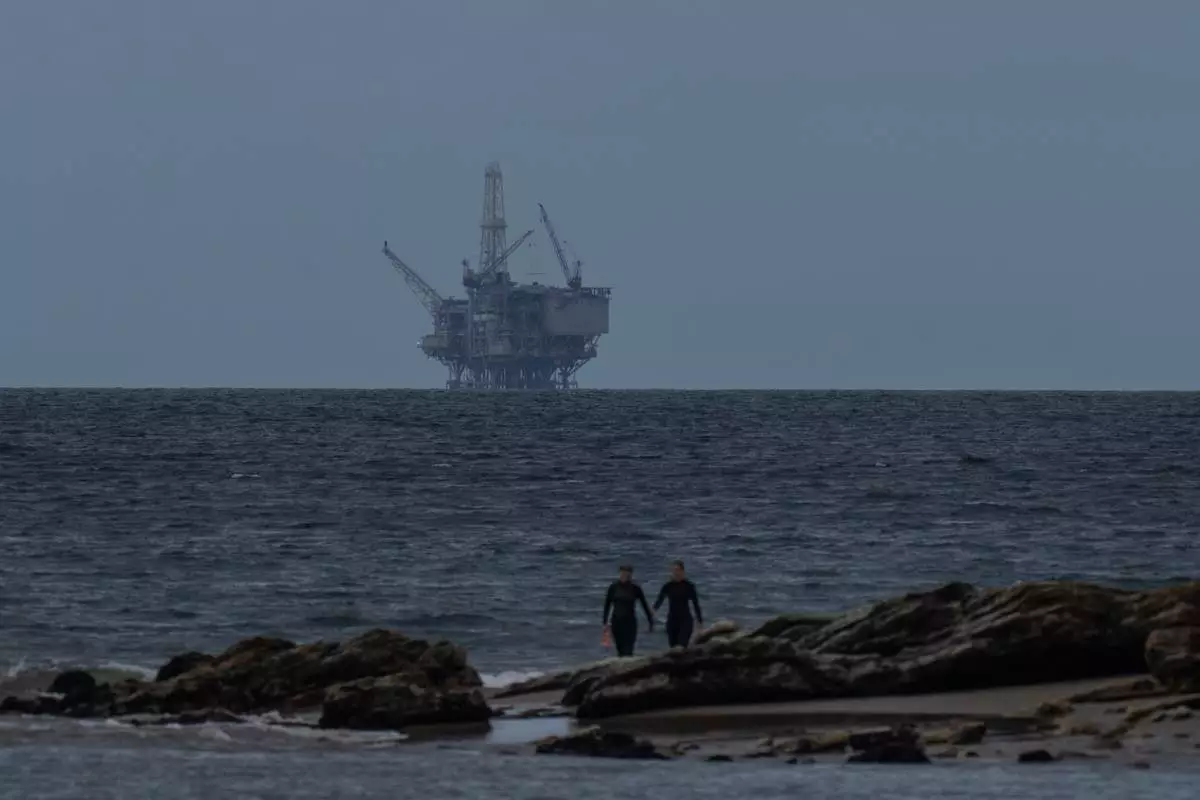
FILE - An offshore drilling platform operated by Sable Offshore Corp. is seen from Refugio State Beach near Goleta, Calif., April 26, 2026. (AP Photo/Jae C. Hong, File)