SAO PAULO (AP) — Brazil's government and the country's exporters of meat, poultry, eggs, honey and other animal products scrambled Thursday after a European Union deadline expired, triggering a suspension of imports over concerns about the use of antibiotics and antimicrobial drugs in livestock.
President Luiz Inácio Lula da Silva's agriculture ministry said Thursday that it would consider reciprocal measures if a satisfactory solution is not reached.
“Brazilian authorities expressed their indignation at the lack of dialogue before the measure was adopted," the ministry said in a statement, adding that the suspension “does not match the depth of the strategic partnership between Brazil and the EU.”
The EU announced the suspension Tuesday, with the measure taking effect two days later. Brazil, the world's largest beef exporter, shipped about 108,000 tons of beef worth about $1 billion to the EU in 2025, according to government figures.
The bloc announced in May that Brazil would be removed from its list of countries authorized to export certain animal products to the bloc, arguing that Brazil had failed to provide sufficient guarantees that its livestock production meet EU standards against antibiotic growth promoters and other restricted drugs.
The Brazilian Association of Meat Exporting Industries, ABIEC, which provides technical support to the government in negotiations with the EU, said the move was concerning for local producers and failed to recognize what it described as the quality of Brazilian beef exports to 170 countries.
“Brazilian beef will continue to be sold in the markets for which it is authorized, but there is no automatic substitute for the European market, since different destinations require distinct products and cuts," said ABIEC in a statement.
The Confederation of Agriculture and Livestock of Brazil sent a document late Wednesday signed by its chairman to Brazil's foreign ministry saying that the EU suspension “results in the clear nullification and impairment of trade benefits legitimately expected by Brazil.”
The Brazilian confederation added that the EU failed to consider the rigor of Brazil’s health inspection system and needed to make amends for such a trade imbalance.
In its Thursday statement, the agriculture ministry said Brazil “reserves the right to resort to appropriate instruments to ensure balanced trade conditions, including reciprocity measures provided for under the national legal framework, as well as relevant mechanisms established in the Mercosur-European Union agreement and the multilateral trading system.”
The EU did not respond to requests for comment from The Associated Press.
European Commission spokesperson Eva Hrncirova said on Tuesday that a new list of countries that comply with EU rules on antimicrobials would take effect Sept. 3, which triggered the case against Brazil.
Meat imports have been a major source of European opposition to the free trade agreement signed in January between the EU and Mercosur, a trade bloc comprising Brazil, Argentina, Paraguay and Uruguay. Brazil is the only Mercosur member affected by the EU suspension.
Robson Goncalves, an economist and professor at Fundacao Getulio Vargas, said he expects the EU to enforce additional measures against Brazil until the EU-Mercosur agreement comes fully into force.
The deal is provisional, pending a decision by the European Court of Justice.
“These are the last attempts to protect European agribusiness from competition with Mercosur agribusiness," said Goncalves, who described the mechanism used to halt Brazilian exports as “a political measure” by the EU as its trade deal with Mercosur has yet to be fully implemented.
“Others like those will come in the next few years,” he said.
Follow AP’s coverage of Latin America and the Caribbean at https://apnews.com/hub/latin-america
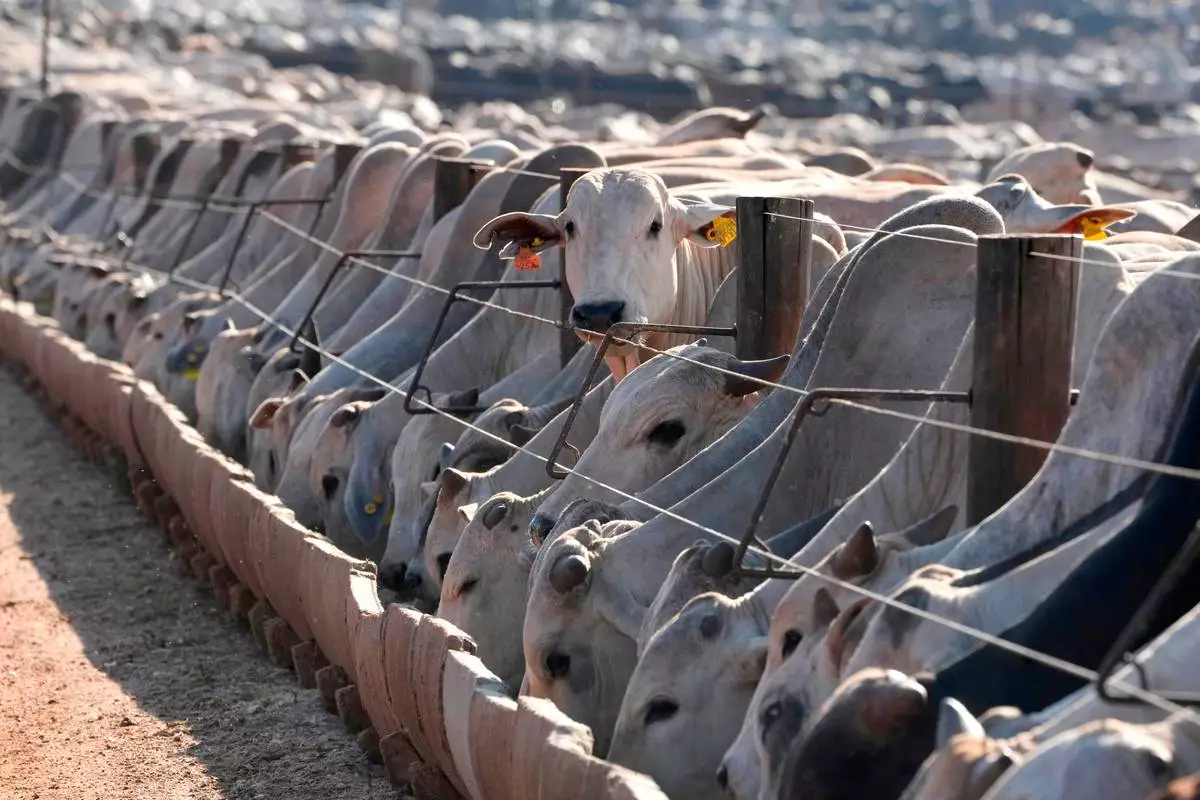
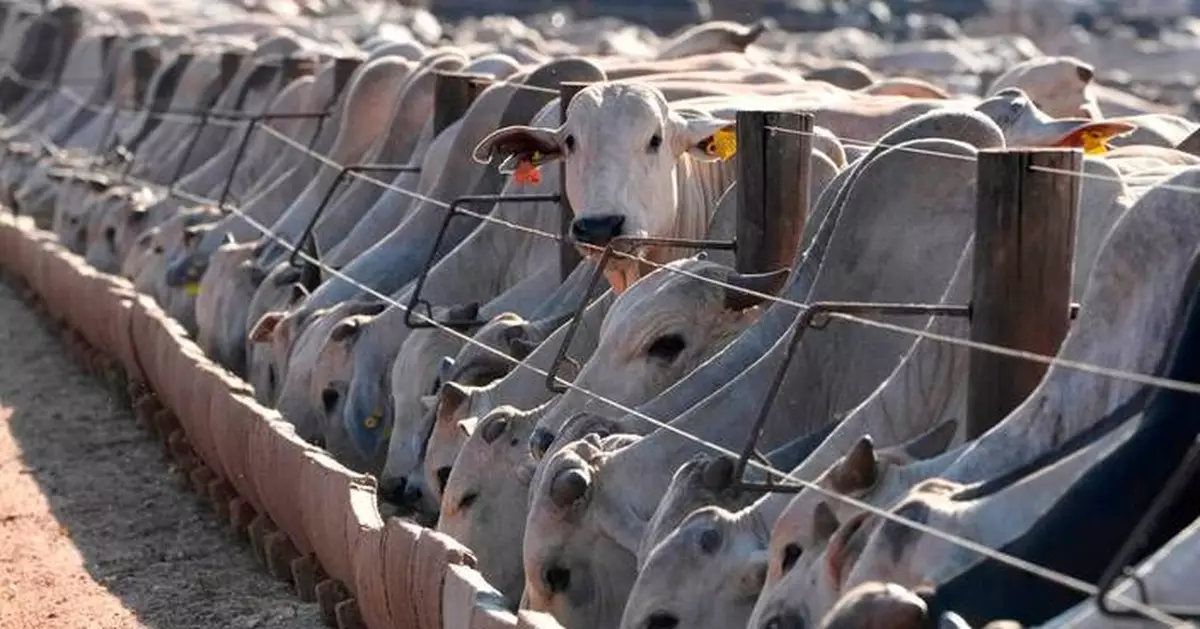
FILE - Cattle eat at a feedlot operated by the Otavio Lage group in Goianesia, Goias state, Brazil, June 13, 2025. (AP Photo/Eraldo Peres, File)
Pieces of President Donald Trump's wide-ranging Washington makeover made their next step toward approval Thursday, but not without substantial critiques of plans for permanent fencing and gates around Lafayette Square in front of the White House.
The plan pits the Secret Service and administration's concerns about presidential security against the park's historical status as an open gathering spot directly in front of the Executive Mansion, where citizens come for everything from tourist selfies to war protests or spontaneous celebrations of election results.
“People came there because they knew this was our country’s town square, where they could come to express their feelings about the direction of our nation,” Pam Fessler, a former federal employee and retired journalist, told the National Capital Planning Commission.
But the body, which this spring approved Trump's White House ballroom proposal after he razed the Executive Mansion's East Wing without authorization, accepted several versions of the proposal despite the criticisms. That sets it up for a final vote in coming months. The panel separately approved the concept for a new White House visitors security screening center on the grounds south of the Treasury Department.
The Secret Service and Trump administration, besides their security arguments, also pitched the fencing as an aesthetic necessity to replace the temporary fencing and barricades that have been erected since 2020 protests over systemic racism and police violence in America. But historic preservationists, legal advocates and residents of Washington, D.C., pushed back Thursday, saying the real solution is simply to reopen the square.
“The proposed modifications claim that a fence will preserve day-to-day openness,” said ACLU attorney Laura Follansbee. But “even when the gates are open, the very presence of a fence will send a message to the public that the park is only open by permission.”
Those planning the designs said it would be too tempting for a president or the Secret Service to simply close the gates even when there is no legitimate security threat.
“It will undoubtedly become routine to shut down the park whenever a protest or mass gathering is expected, on the grounds that it might be disruptive,” Fessler predicted.
Commission Chairman Mark Paoletta, a Trump appointee, rejected concerns about public access to the park.
“I don't think the Secret Service has any intention of shutting this park when there's peaceful protests,” Paoletta insisted. “So this idea that if there's a fence up we're losing our First Amendment rights, I don't accept. OK — time, place, manner. People can come to the park.”
It was Paoletta's first meeting as chairman. White House Counsel Will Scharf previously held the role.
The visitor screening facility drew far less controversy, with commissioners broadly agreeing that it is needed to streamline entry to the complex.
The hearing Thursday was the first time the commission took up the two ideas. Despite the critiques of the fencing proposal, the commission and the separate U.S. Commission of Fine Arts have thus far not been obstacles to Trump’s plans for the capital. The fine arts panel, which is controlled by Trump appointees, approved the visitors’ center plans at its July meeting. It heard a presentation on the Lafayette Square fencing but took no action.
Planning Commissioner Evan Cash, who is not a Trump appointee, expressed frustration Thursday that the Secret Service was pushing the Lafayette Square project only a decade after winning approval for a 13-foot security fence around the White House perimeter.
“I swallowed a lot of stuff then that I never would have swallowed if I knew that we were going to be coming back and pushing people another block away from the White House,” he said.
Paoletta countered by alluding to the multiple assassination attempts against Trump, including two during the 2024 campaign and a third this past April as he attended a Washington dinner with White House journalists. Those concerns were heightened in May after U.S. Secret Service officers fatally shot a man who opened fire near a White House security checkpoint.
But Lafayette Square fencing still would be a marked permanent change to the usual access and appearance of the grounds in front of the White House. The square last had permanent fencing in the late 1800s.
The administration’s 79-page proposal for the 8-acre (3-hectare) park calls for fencing all the way around with larger gates at the north and south entrances. Options call for either including or excluding monuments located at each of the park’s four corners.
The White House Visitor Screening Facility, meanwhile, has been viewed as a noncontroversial part of the administration's call for increased security measures.
The administration says the permanent facility, which it wants open by July 2028, would replace a series of temporary tents that have been used for years, in a bid to improve security on the White House complex and enhance the experience for visitors. The original design had it being built underground near the southern end of Sherman Park, just southeast of the White House. But consultations with other entities led to it being moved to the western edge, away from utility infrastructure.
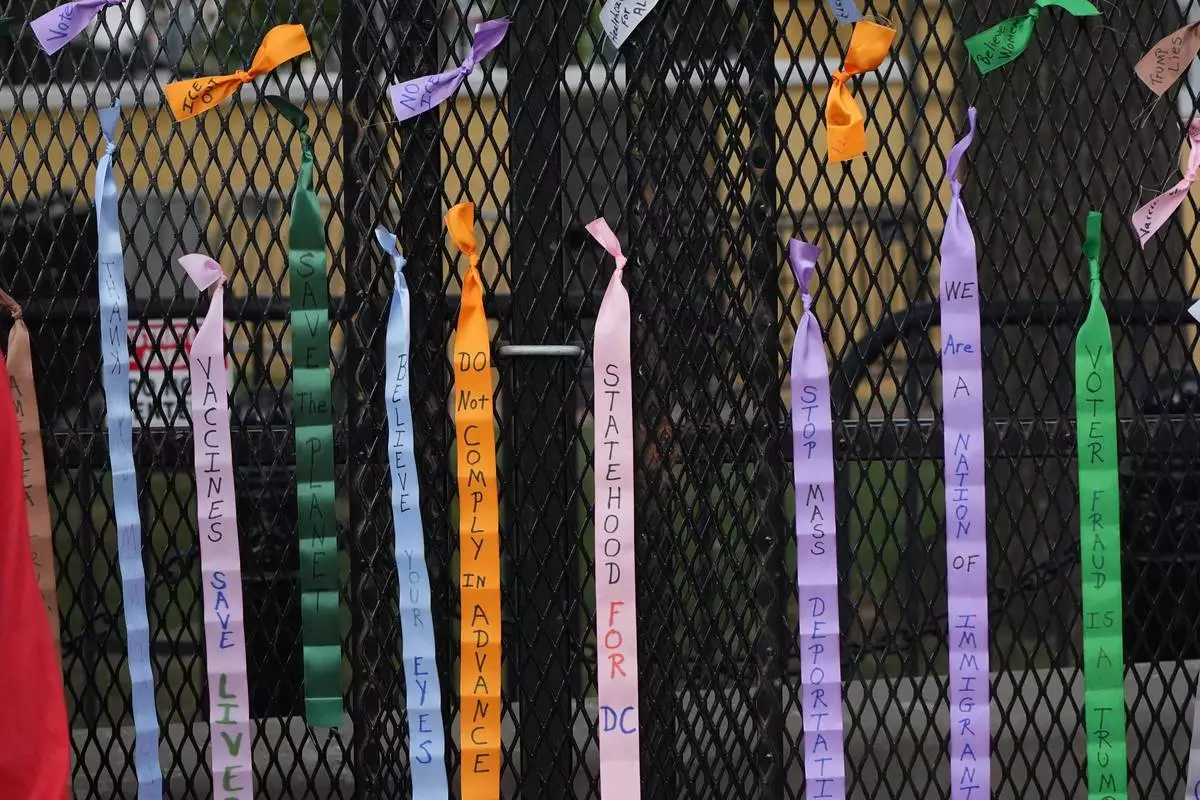
Protest ribbons are tied to a fence at Lafayette Park, near the White House, Tuesday, Aug. 25, 2026, in Washington. (AP Photo/Alex Brandon)