Skip to Content Facebook Feature Image

China, Egypt deepen research ties as joint team tackles tech challenges

China

China

China

China, Egypt deepen research ties as joint team tackles tech challenges

2026-09-04 16:46 Last Updated At:17:07

As China and Egypt mark the 70th anniversary of their diplomatic ties this year, cooperation between the two countries in education and science is continuing to expand thanks to closer exchanges under the Belt and Road Initiative.

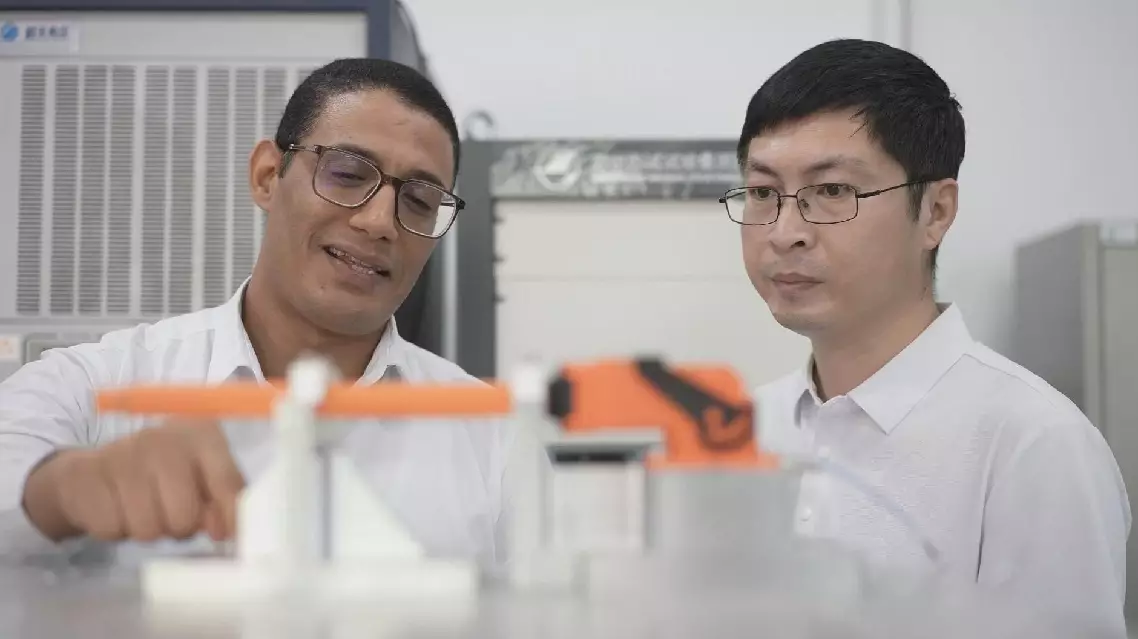
At Harbin Institute of Technology (HIT) in northeast China's Heilongjiang Province, researchers from China and Egypt are advancing a joint project aimed at solving technical problems in gas-turbine power generation.

Nasser Sayed, an associate professor from Egypt's Menoufia University, is working with a team led by Hou Lei, a professor at HIT's School of Astronautics, to apply theories in nonlinear dynamics and vibration control to predict and mitigate abnormal vibrations, an effort intended to improve unit stability and support upgrades to gas turbines used for electricity generation.

Sayed said the collaboration has reshaped his approach to research and shifted his focus from pure theory toward turning ideas into practical products.

"The work with the team here is changing my ideas about research in general. My research at first was just theoretical. Now, [it has] converted the idea from theory to product," said Sayed.

The partnership is supported by China's national key research and development program under an intergovernmental international science and technology innovation cooperation initiative.

With the help of the very program, HIT and Menoufia University have jointly established a China-Egypt joint laboratory to address shared technological bottlenecks faced by the gas-turbine industry, a key component of natural-gas power generation.

"As Egypt has strong capabilities in the technology of active vibration control, we work together to combine [our researches] to provide much stronger theoretical support for forward design," said Hou.

Based on the research's progress, Sayed has been selected for Talented Young Scientist Program sponsored by China's Ministry of Science and Technology.

Visiting China for the first time, he said he hopes more Egyptian students can come to China for academic exchanges.

"I think now we plan to bring some students from Egypt to Chinese (China). The lab here is very advanced and world-class. The Chinese institution admittedly search about new idea and new technology to improve their people's life. For the life, work, for the research, China is really an attractive country," said Sayed.
China, Egypt deepen research ties as joint team tackles tech challenges

China, Egypt deepen research ties as joint team tackles tech challenges

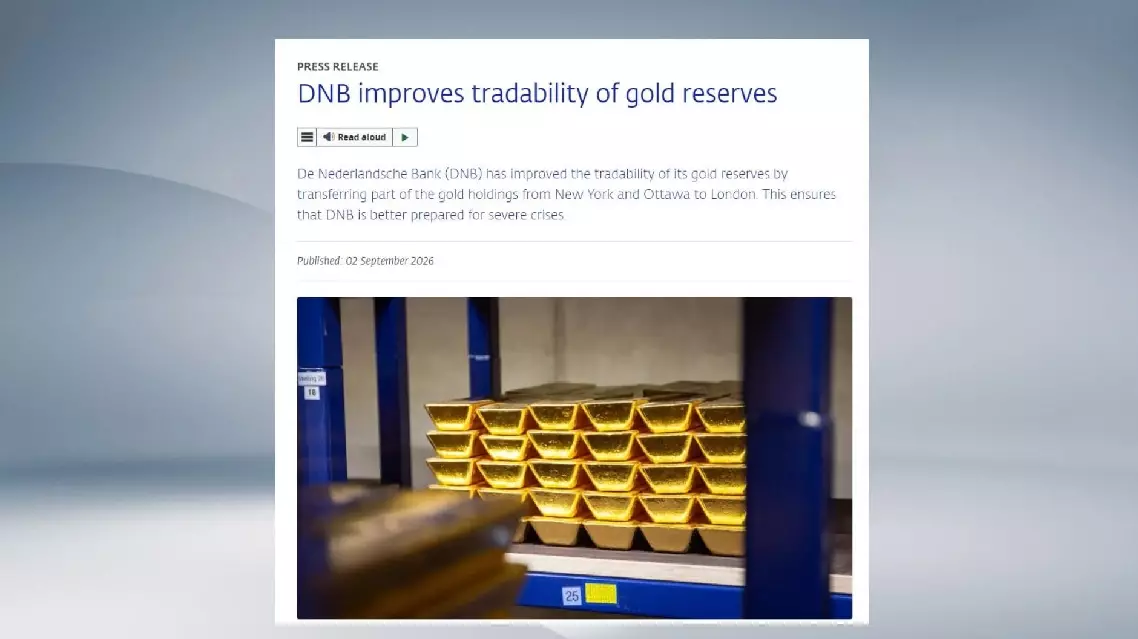
The Dutch central bank said Wednesday it has shifted about 86 tonnes of its gold reserves from New York and Ottawa to London, a move aimed at improving gold transferability and strengthen crisis preparedness.

The relocation was made in two batches, according to a De Nederlandsche Bank (DNB) news release. About 59 tonnes of the gold were relocated by selling in the New York market and buying equivalent bullion in London. More than 27 tonnes were physically transported from the United States and Canada to the central Dutch city of Zeist, with an equal amount of gold meeting international market standards then transferred from Zeist to London, leaving the total size of the Dutch gold reserves unchanged.

According to the DNB, the Netherlands held 612.4 tonnes of gold at the end of 2025, mainly across Zeist, London, New York and Ottawa. After the adjustment, the share stored in Zeist stayed at 30.8 percent, while the portion in New York dropped sharply from 31.3 percent to 18.5 percent and the Ottawa share fell from 19.7 percent to 18.5 percent. London's share rose from 18.1 percent to 32.1 percent.

The gold held with the Bank of England is regarded as the world's most easily tradable gold and will therefore be the most readily available for the DNB in a crisis situation, the Dutch central bank said.

The decision reflects the DNB's growing concern about transatlantic tensions since Donald Trump reclaimed presidency. The central bank previously warned that the U.S. could easily cut off Dutch payment transactions and urged reduced dependence on the U.S.

France has moved in a similar direction. In April, the French central bank announced it had completed the transfer of 129 tonnes of gold that had been stored in New York since the late 1920s. The operation, carried out in 26 stages between July 2025 and January 2026, involved selling the New York holdings at market prices and purchasing equivalent gold in Europe for transport to Paris. All of France's 2,437 tonnes of gold reserves are now held domestically.

Netherlands relocates 86 tonnes of gold reserves from U.S., Canada to UK

Netherlands relocates 86 tonnes of gold reserves from U.S., Canada to UK

Recommended Articles