From the sprawling Obelisk Solar Power Project to off-grid rural villages, Chinese solar technology is transforming Egypt's energy landscape and accelerating the country's green transition.
Solar energy is expanding rapidly across Egypt as the country receives some of the world's most intense and prolonged exposure to ultraviolet (UV) radiation.
In Naga Hamadi in the southern Qena governorate, the UV index can climb to as high as 14 and remains at extreme levels for over five hours a day.
The abundant sunshine makes the region an ideal location for the Obelisk Solar Power Project.
Spanning over 20 square kilometers, the facility boasts a total capacity of 1,000 megawatts (MW). It also features a battery energy storage system capable of holding 200 megawatt-hours (MWh) of electricity, ranking it among Africa's largest solar-plus-storage initiatives.
Given the extreme heat in southern Egypt, equipment durability is paramount. Therefore, when Scatec, the Norwegian developer of the project, selected its hardware, it opted to rely primarily on Chinese solar technology.
Industry experts point to several drivers behind Egypt's growing appetite for China's green energy solutions.
"The swift supply, the cost and efficiency, and the guarantees, because Chinese OEMs (original equipment manufacturers) have the capability to give warranty and also guarantees to the project developer. They are also thinking about localizing -- some of [the project's] battery storage systems are localizing some components in Egypt, so this may be very, very cost-efficient to project developers like Scatec and others," said Osama Fawzy Georgy Henein, founder and CEO of Hydrogen Intelligence - H2lligence, an intelligence platform focused on green hydrogen and renewable energy in Africa.
Hundreds of miles away in the northern Sharqiya governorate, solar power brings an equally transformative impact on local communities.
The small village of Al Basaisa began using solar energy nearly 50 years ago, making it a pioneer in Egypt's renewable energy push.
"Solar power has changed the village entirely. Power cuts are frequent, but solar energy is continuous. I would pay up to 10 dollars a month for normal electricity bills. But only one dollar a month for solar lets me use a socket and three lamps," said Mohamed Mansour, a local resident.
For years, high costs stood as the main obstacle to widespread solar adoption in the village, until Chinese companies came with cutting-edge technology at affordable prices.
"The main obstacle to solar energy becoming popular is the cost. The organization has raised awareness and now we have a waiting list of subscribers. Growing competition among companies now is making it cheaper and has improved the quality," said Solaiman Hussieny, project manager of Al Basaisa Social Development, an initiative focused on rural social development.
Today, the village's main facilities, including a three-story NGO building, a local mosque, and a number of households, are powered entirely by solar energy.
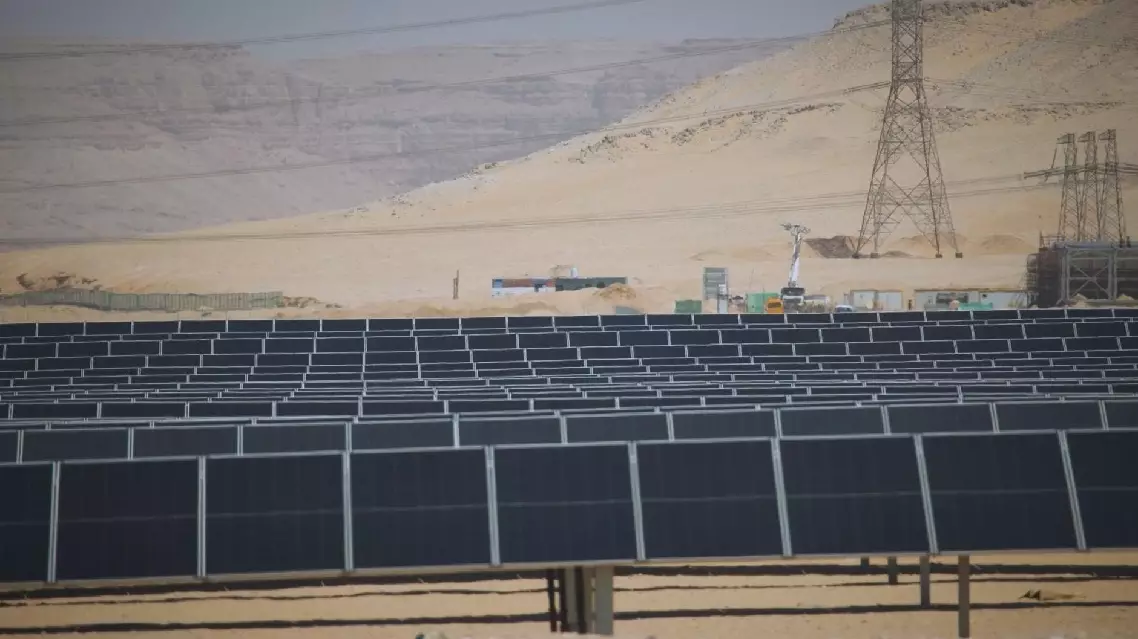
Chinese solar tech powers mega projects, transforms energy landscape in Egypt