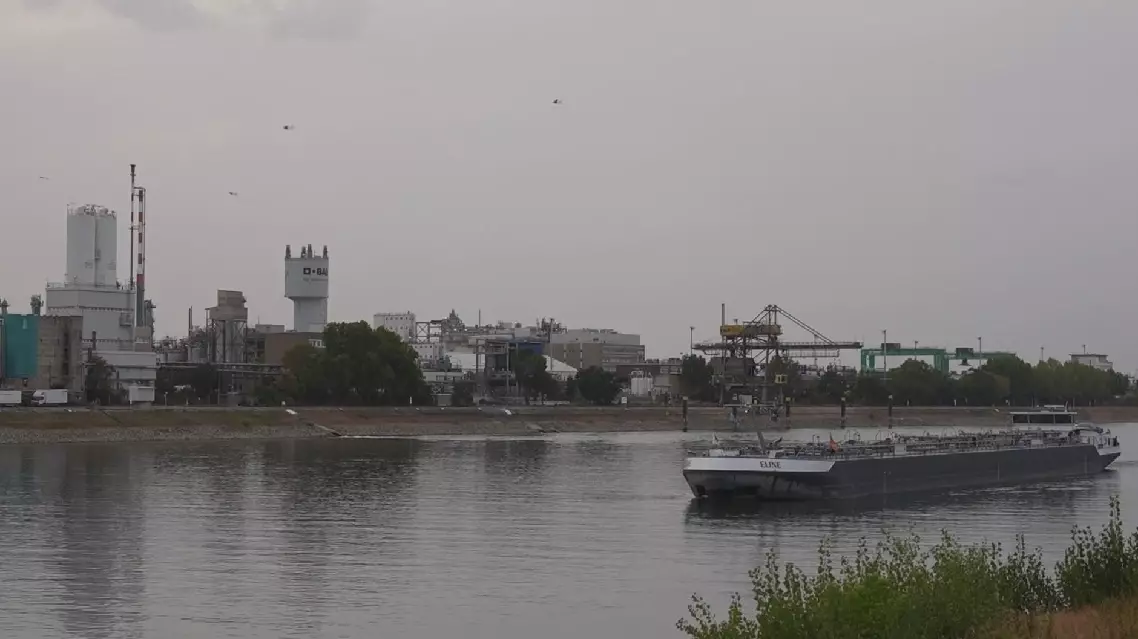
Persistent heat and scant rainfall so far this summer pushed the water level on Germany's Rhine River to record lows, straining shipping and industry on Europe's vital waterway.
In the small riverside town of Kaub, with fewer than 800 residents, the Rhine River levels play an outsized role. Despite its size, Kaub is critically important to river freight. Just as a barrel's capacity depends on its shortest stave, the amount of cargo vessels can carry depends on the water levels at Kaub.
"Here in Kaub, the Rhine is a mountain river. The channel is narrow, with shallow areas and rocks, making passage difficult for ships. When levels are low, ships are forced to cut their loads. This creates a major problem, because the less cargo they carry, the higher the shipping cost per unit," said Bernd Vogt, mayor of Kaub.
This summer's low-water spell led to a dramatic figure that locals would not forget. On August 14, the river measured just six centimeters deep at Kaub, the lowest since records began. Ferry crossings halted, unable to operate safely.
"It was extremely challenging. We had to suspend service. There just was not enough water under the ferry. It was too risky to continue," said Andre Kimpel, ferry operator.
Recent rainfall has raised levels slightly, with the river at Kaub reaching 59 centimeters by August 27, allowing ferries to resume. But levels remain well below normal.
The impact stretched far beyond Kaub. About 100 kilometers south in Ludwigshafen, home to chemical giant BASF's headquarters, Rhine shipping disruptions were also felt. The BASF site, sprawling along the river, has relied on this "lifeline" for over 160 years, with nearly 40 percent of its freight typically moved by inland waterways.
During low water, BASF had to deploy special shallow-draft vessels and shift key supplies onto trains and trucks to keep production running smoothly.
The banks of the Rhine are home to many of Germany's key chemical, steel and energy companies, with large volumes of raw materials and products transported via this waterway. Prolonged low water levels can not only drive up shipping costs and cause logistical delays, but may also affect industrial production.
For this industrial nation's western region, which has long depended on Rhine transport, finding ways to keep this crucial artery running smoothly amid increasingly frequent episodes of extremely low water will be a long-term challenge.
Low Rhine River levels pose threat to Germany's industry
Amidst overlapping global challenges, international experts at the 2026 Global Governance Forum in north China's Hebei Province emphasized that rebuilding confidence and cooperation in global governance requires enhanced dialogue, the establishment of common rules in emerging fields, and a fairer, more inclusive international system that amplifies the voice of the Global South.
Held from October 23 to 25 in Xiong'an, China's "city of the future" built on the North China Plain, the forum brought together nearly 400 representatives from over 90 countries. Spanning five major sectors and 22 thematic seminars, the event provided a platform for diverse stakeholders in politics, economy, technology, culture, and think tanks to jointly address governance challenges and promote inclusive, multi-stakeholder global governance reform.
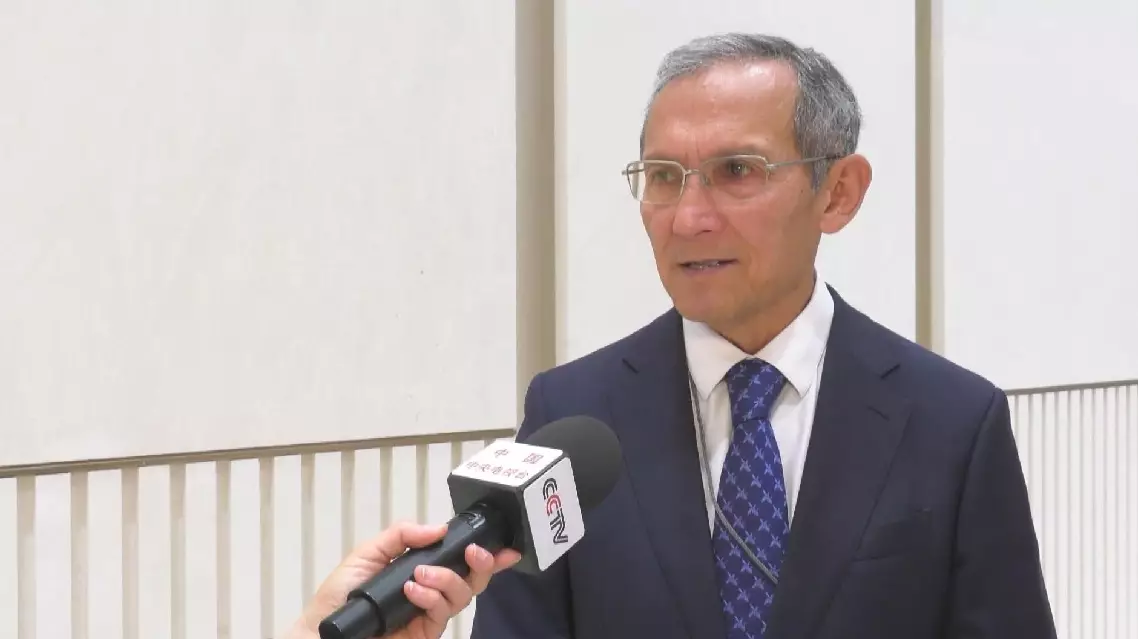
"In this conference, I met some American representatives, a remarkable businessman. I asked him, 'what are you doing here?' And he said, 'I wanted to discuss Global Governance Initiative.' I said, 'Listen, I don't believe because whatever China proposes, the U.S. will object. And he said no. And he mentioned specific subject -- AI. He said, 'I want to make my humble contribution into establishing (of) global governance in AI.' So among Americans, this idea is also receiving some understanding. More dialogue is required and I would underline the weight of this forum," said Djoomart Otorbaev, former prime minister of Kyrgyzstan.
In today's world, where deficits in peace, development, security, and governance are intertwined, rebuilding confidence and cooperation is the most scarce international public good. In response, China has proactively set the agenda to address pressing concerns, such as advancing the reform of the UN-centered governance system, cooperating on new frontiers like cyberspace, outer space, and AI, and bridging civilizational divides amidst geopolitical rivalry.
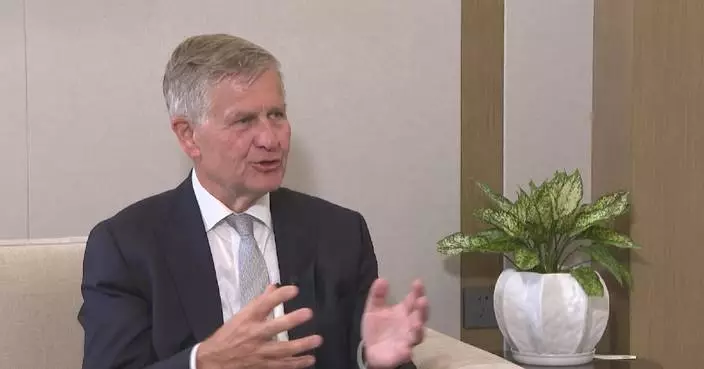
"And there were some specific initiatives which we also have discussed, which is to set the global governance for the outer space, for the deep seas, for some areas of the planet like the Antarctica, where there is various needs for more common rules. One area the world is looking for is artificial intelligence and we need to regulate globally and efficient intelligence to avoid the worst. So if we work together, we can get the benefits and make sure that we make it much more difficult to do the harm," said Erik Solheim, chairman of the EU-Asia Centre and former UN under-secretary-general and former executive director of the UN Environment Programme.
"The world has become a global village, but this global village is now fighting. There's a problem going on in the Middle East, there's a problem going on in Africa, but China is trying to promote a conclusive thing so that the world can be peaceful. Because of this Global Governance Initiative, China has been able to tell the world (that) how to work together," said Khalid Taimur Akram, executive director of the Pakistan Research Center for a Community with a Shared Future.
Since its proposal over a year ago, the Global Governance Initiative has garnered support and responses from over 160 countries and international organizations.
During the forum, China announced pragmatic measures to further implement the initiative, reaffirming its firm support for multilateralism and the core status of the United Nations, while emphasizing the need to enhance the representation and voice of the Global South in international affairs to translate the initiative from a Chinese proposal into broader international practice.
"It's that combination of defense of the games that arise from the existence of the international system, but improving it, updating it, performing it, making it fairer, particularly to the great mass of developing countries, which is why the Chinese proposals meet a lot of support, particularly from the Global South, but also from fair minded people in other countries," said Keith Bennett, vice chairman of UK 48 Group Club.
Participants of Global Governance Forum hail China's contribution to fairer international order