China's sustainable aviation fuel (SAF) sector is poised for explosive growth, yet industry players must navigate a complex web of challenges from raw material security and traceability to international certification and airport infrastructure before the green fuel can truly take flight, experts warn.
A landmark case in point unfolded at Beijing Capital International Airport, where Air China Flight CA963 bound for Brussels was refueled with sustainable aviation fuel produced entirely from waste cooking oil collected from local catering businesses in Changping District.
The operation marked the country's first full-chain application, from feedstock collection and processing to refueling and carbon credit settlement, showcasing the viability of domestically sourced bio-jet fuel.
"China has fully mastered the technology for SAF production with products serving the green transformation of domestic civil aviation and contributing to global aviation carbon reduction through exports. However, scaling up production must go hand-in-hand with raw material security and international certification," said Tan Li, associate researcher of the Research Institute of Energy Conservation and Environmental Protection under the China Center for Information Industry Development.
Despite being the world's largest producer of waste cooking oil with an estimated 5 to 6 million tonnes collectible annually, China's feedstock base falls far short of the industry's long-term needs, according to Tan.
The market price of domestic SAF currently hovers between 15,000 and 20,000 yuan (roughly 2,100-2,800 U.S. dollars) per tonne, which is three to five times that of conventional jet fuel, making widespread adoption economically prohibitive.
Chinese producers also face a stringent, lengthy and costly certification process, as they have mostly to rely on U.S. or European authorities for product approval. Tan said China urgently needs to develop its own independent certification system to reduce reliance on foreign agencies.
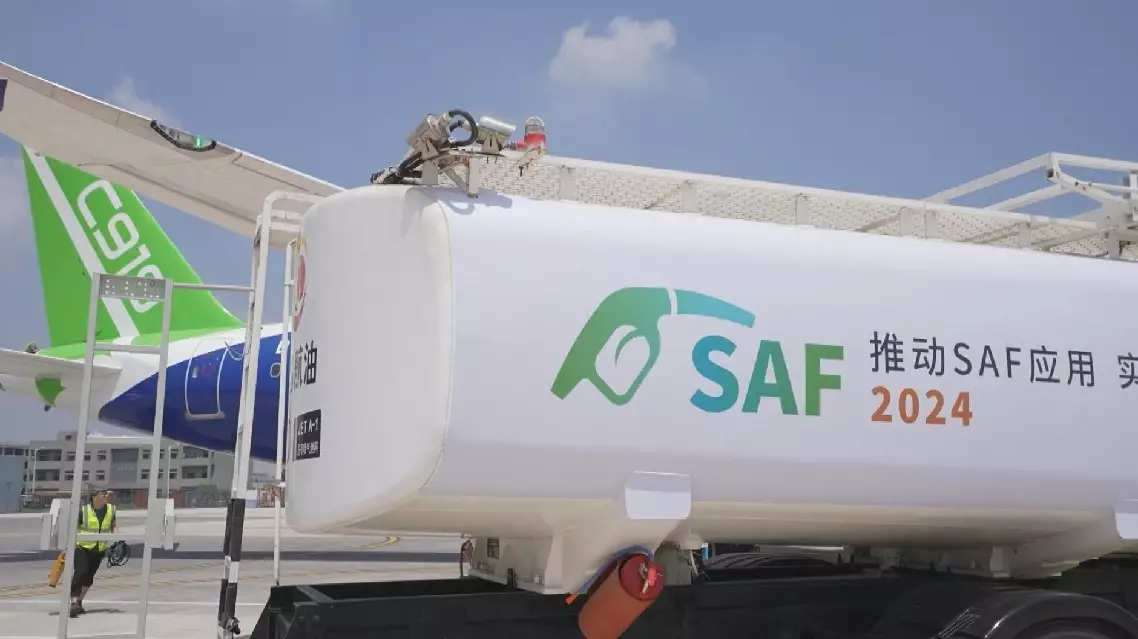
SAF is an alternative to conventional aviation fuel. It can be made from many different sustainably sourced materials, such as used cooking oil, biomass waste and residues, and renewable energy and carbon. SAF can significantly reduce lifecycle carbon emissions, typically by around 80 percent compared to conventional aviation fuel.
China's bio-jet fuel industry promising but hurdles remain