China has seen rapid growth in sustainable aviation fuel (SAF) exports so far in 2026.
Since January, the country has added a national tariff subheading for "bio-jet fuel" to its tariff schedule, establishing the green product's independent classification and officially assigning it a dedicated commodity code.
Under separate supervision, bio-based aviation kerosene no longer counts toward the export quota for conventional refined oil products, creating favorable conditions for sustained, stable exports.
"On January 1, 2026, SAF and HVO were officially assigned independent customs tariff codes. This has enabled the smooth operation of SAF export supervision, tax rebate accounting, and international trade statistics, significantly improving companies' export efficiency," said Tan Li, associate researcher of the Energy Conservation and Environmental Protection Institute with China Center for Information Industry Development.
While optimizing the export channels, the demand from overseas markets is also rising.
Since 2025, the European Union and the United Kingdom have officially implemented mandates requiring SAF blending, starting at 2 percent, rising to 6 percent by 2030, and reaching 70 percent by 2050.
However, their respective production capacity falls far short of demand, leaving a substantial supply gap.
"According to data from the General Administration of Customs, China exported 2.2301 million metric tons of industrial-grade mixed oil in the first seven months of 2027, an increase of 54.79 percent year on year. As recycling systems become more standardized, the resource value of these materials continues to be unlocked," said Qiu Xiao, energy analyst at Sublime China Information Co., Ltd.
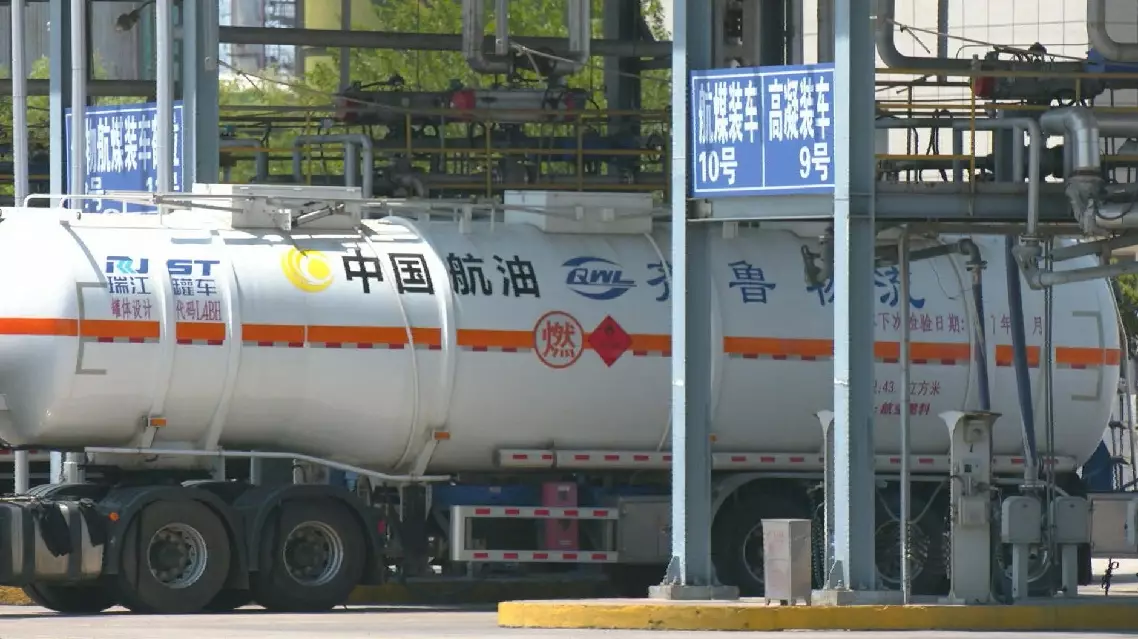
China's sustainable aviation fuel exports surge in 2026