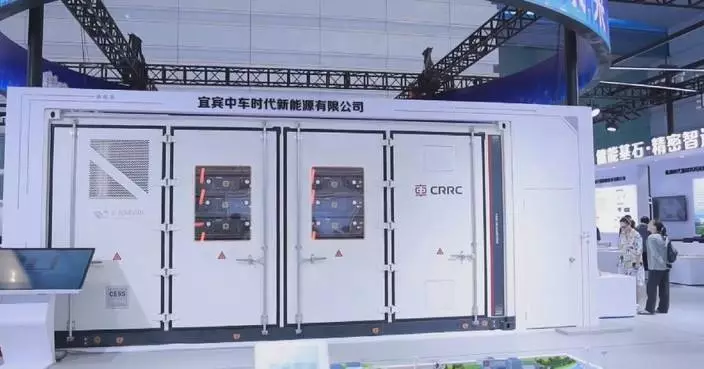
Smart and unmanned technologies are on display at the ongoing three-day Eighth China Grain Trade Conference, which opened Saturday in Changsha City, central China's Hunan Province.
More than 3,100 companies nationwide are attending the event, highlighting new technologies and products for grain production, storage, processing, and purchasing.
One of the attention-grabbing exhibits is an intelligent grain-leveling robot designed by Seedlight Robot for grain storage sites. The robot moves quickly within grain piles, autonomously avoid obstacles, and achieve precise positioning to smooth uneven piles into a flat surface.
"The main unit can plan the operating route for the grain-leveling robot. The radar can detect how even the grain surface is, and the robot itself acts as the hands and feet that do the [grain-leveling] work. It can largely replace manual grain-leveling operations and significantly reduce labor intensity and labor costs," said Li Yue, a representative with the Seedlight Robot (Shenzhen) Co., Ltd.
In the grain and oil machinery zone, an intelligent multifunctional rice-processing system developed by the Anhui Jiexun Optoelectronic Technology Co., Ltd. is demonstrating how artificial intelligence can automate key stages including hulling, milling and polishing. The system also integrates impurity removal and finished-product quality inspection to enable unmanned operation.
"Compared with traditional processing methods, this technology [embedded in the system] can reduce our broken-rice rate by about 3 percent, increase the whole-rice yield from 600 kilograms per ton to around 618 kilograms per ton, and cut energy consumption by roughly 20 percent," said Xu Yefei, a representative with the Anhui Jiexun Optoelectronic Technology Co., Ltd.
In addition, grain testing is moving rapidly toward full automation. A comprehensive unmanned grain testing system designed by the Beijing Guomao Dongfu Engineering Technology can evaluate wheat, rice, corn and soybeans. In one stop, the machine automatically analyzes 13 quality indicators, six types of toxins, four heavy metals and pesticide residues without human intervention. "The continuous testing time for a single sample is no more than 30 minutes. It can effectively address problems in traditional grain procurement inspections, such as too many testing items, complicated operating procedures, long processing times and the influence of human factors," said Liu Fangfang, a representative with the Beijing Guomao Dongfu Engineering Technology.

Smart, unmanned equipment on show at China Grain Trade Conference
Glacial lakes of the Donglin Zangbo River Basin in Gyrong County of southwest China's Xizang reveal no abnormal changes after the area was struck by a massive mudslide on August 26 as satellite remote sensing monitoring has detected, an official said at a press conference in the county on Sunday.
The fast-moving chain mudslide, triggered by a high-altitude glacier collapse on the Nepalese side, struck the Gyrong Port on the China-Nepal border on August 26, and had left 43 people dead and 519 others missing as of 18:00 Saturday, according to the press conference.
At an elevation of 5,140 meters, a glacier spanning 620,000 square meters located in the upper reaches of the Cuojian River broke off. The collapsing ice rapidly swept up loose rock and debris along its path, flowing into the Guobaxiaqu River, a boundary river between China and Nepal, before joining the Donglin Zangbo River.
After the mudslide disaster, Chinese experts conducted continuous satellite monitoring of 11 glacier lakes each with an area of more than 0.1 square kilometers across the Donglin Zangbo River Basin. At the press conference, authorities confirmed these lake areas remain normal.
Norbu Tsering, deputy head of the emergency rescue headquarters and acting mayor of Xigaze City, said that in recent years, Xizang has organized comprehensive surveys of its glacier and glacier lake resources using multi-source remote sensing images, field investigations, and reference data from glacier-related research.
"Surveys show that there are over 33,000 glacial lakes across Xizang. Following the principle of 'targeted priorities and precise risk prevention,' we have prioritized 187 high-risk glacial lakes for satellite remote sensing monitoring, and conducted ground-based monitoring and drone surveillance on 49 extremely high-risk lakes of them," said Norbu Tsering.
He noted that they have established an interdepartmental data-sharing mechanism among meteorological, hydrological, natural resources, and emergency management agencies, and have put in place a system of regular expert consultations for glacial lake risk assessment. A short-term early warning "call-response" mechanism was also set up, along with emergency evacuation protocols. Regular drills are conducted for residents living downstream during the flood season.
"However, this ice-rock collapse erupted all of a sudden, which is extremely unusual in nature, and it is hard for current observation and monitoring methods to precisely capture precursor signals before the event. In the wake of the August 26 mudslide in Gyirong County, we have mobilized expert teams and technical resources to conduct continuous satellite remote sensing monitoring of 11 glacial lakes each with an area of more than 0.1 square kilometers in the Donglin Zangbo River Basin. To date, no abnormalities have been detected in their surface areas. As the disaster occurred on the Nepalese side, broader monitoring and early warning efforts will require enhanced cooperation among all relevant countries," said Norbu Tsering.
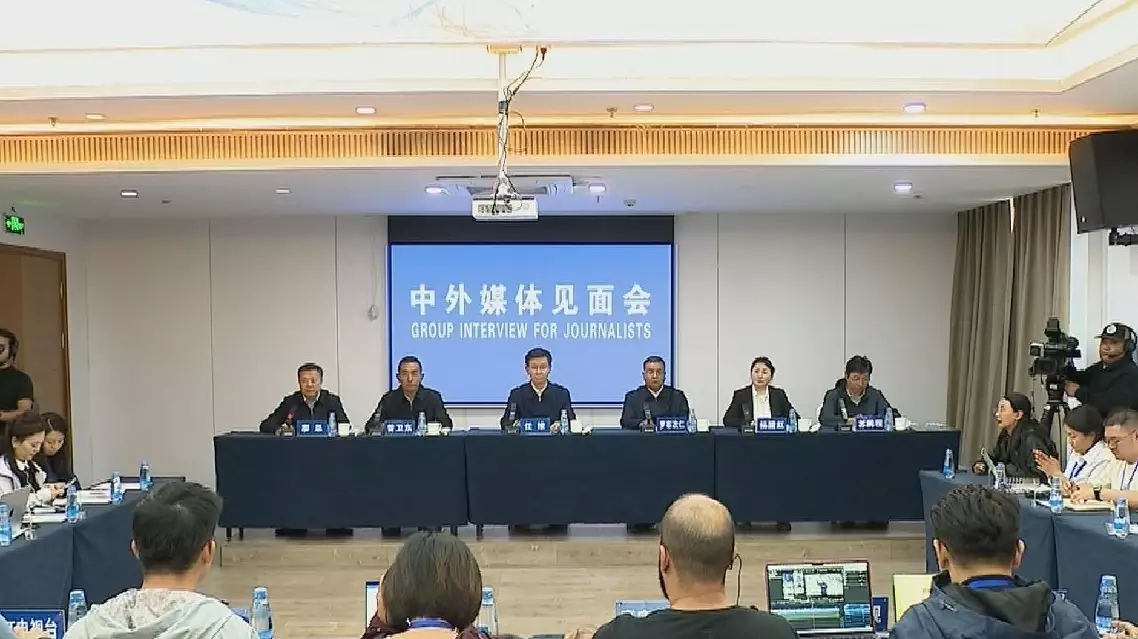
Glacial lakes in Donglin Zangbo basin show no abnormal changes