CHAMONIX-MONT-BLANC, France (AP) — For centuries, French and Italian mountain communities on the flanks of Western Europe's highest peak have gazed upon seemingly eternal glaciers and snow that gave the colossus its name: Mont Blanc, the white mountain.
But climate warming is dismantling the picture at alarming speed.
Click to Gallery
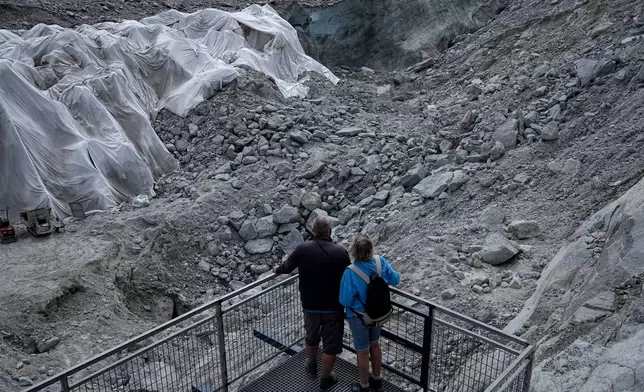
People look at the 'Mer de Glace' glacier as tarpaulins cover the ice cave to prevent it from melting, at the Montenvers station in Chamonix, France, Saturday, Sept. 5, 2026. (AP Photo/Laurent Cipriani)
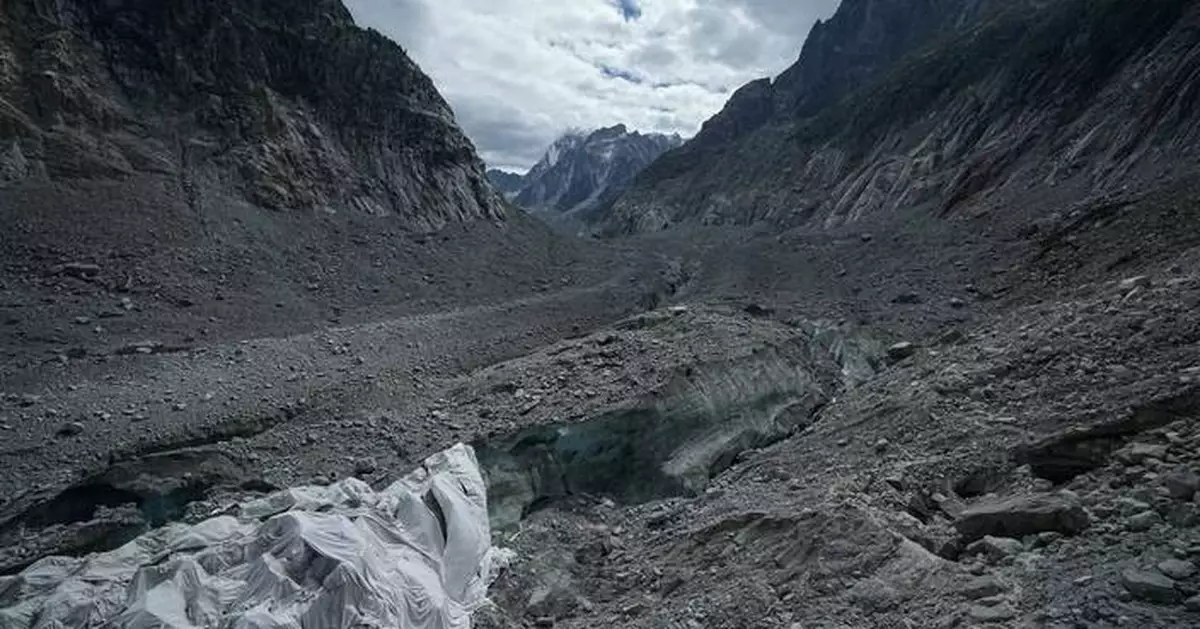
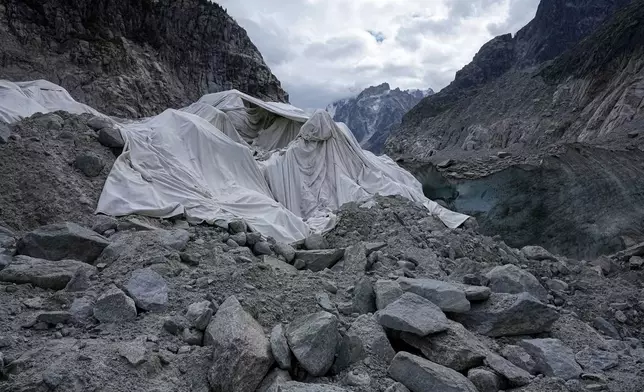
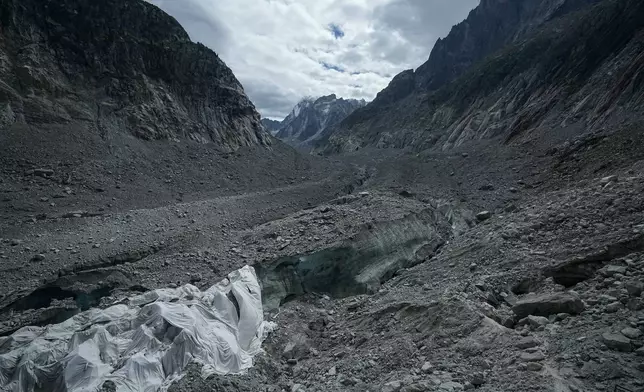
Tarpaulins cover the ice cave of the 'Mer de Glace' glacier to prevent it from melting, at the Montenvers station in Chamonix, France, Saturday, Sept. 5, 2026. (AP Photo/Laurent Cipriani)
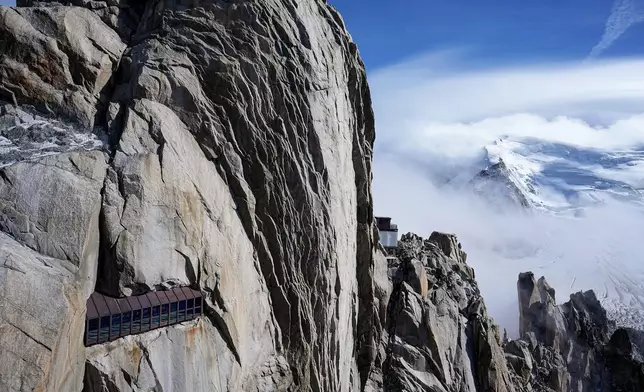
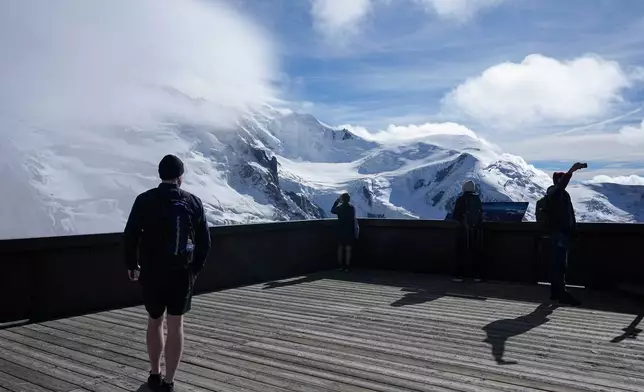
The Mont-Blanc massif mountains are seen from the Aiguille du Midi in Chamonix, France, Saturday, Sept. 5, 2026. (AP Photo/Laurent Cipriani)
Tourists enjoy the view on the Mont-Blanc massif mountains from the Aiguille du Midi, in Chamonix, France, Saturday, Sept. 5, 2026. (AP Photo/Laurent Cipriani)
Tarpaulins cover the ice cave of the 'Mer de Glace' glacier to prevent it from melting, at the Montenvers station in Chamonix, France, Saturday, Sept. 5, 2026. (AP Photo/Laurent Cipriani)
Europe's record heat waves this summer savaged permafrost that for millennia has acted like glue on the Alpine landscape. Defrosting cliffs came apart as high-altitude cold gave way to higher temperatures, sending rock falls cascading from the heights. A famously dangerous rock-prone gully that climbers have long braved on ascents to the summit, 4,805 meters (15,766 feet) up, became temporarily impassable.
“We weep for our mountain, the way it's changing. It hits us in the gut,” said Stéphane Bozon, a deputy mayor in Chamonix-Mont-Blanc, a French town at the foot of the giant that straddles France's border with Italy.
“From mid-July onward, we saw an increase in rock falls. We saw areas becoming difficult to access because of glacial retreat and snowmelt on the glaciers, with crevasses opening up and rock collapses making some areas difficult to reach or traverse,” he told The Associated Press.
Each degree of warming can have an outsized impact. On the Aiguille du Midi peak, which rises to an altitude of 3,842 meters (12,605 feet) in the Mont Blanc range, average temperatures for July have soared. From a chilly 1.6 C (33.8 F) in 1994, the monthly average for this July was the warmest ever recorded, at 3.3 C (37.4 F), says Meteo France, the national weather service.
“The mountain really dried out, with temperatures unlike any I had ever experienced,” Bozon said.
In the wake of devastating floods in the Himalayas, AP talked to researchers, climbers and residents coping with the risks and uncertainties of climate change on Mont Blanc.
The Aug. 26 floods that swept through Nepal and China were triggered after a collapse of bedrock and glacier ice sent debris and water surging through multiple Himalayan rivers. Initial assessments of many scientists are that climate change played a key role in creating conditions for the catastrophe.
As Earth’s global average temperature rises because of the burning of oil, gas and coal, the chances of such disasters increase.
In the Alps, glaciers once admired for their icy majesty are being eyed with trepidation as they shrink and lose stability.
Bozon, who is in charge of safety for Chamonix, says his town urgently needs to prepare for “serious scenarios” of chunks of glacier or mountain potentially falling onto inhabited areas.
“We have to move quite quickly because this summer has shaken us and year after year we’re being shaken by the glaciers’ retreat,” he said.
In Italy, researchers are also documenting dramatic damage wrought by heat on glaciers this year. In Lombardy, Alpine glaciers have lost more than 40% of their surface area since 1991, according to the region's glacier service.
“While it used to snow at high altitudes in the past, now it rains,” said Vanda Bonardo, head of the Italian branch of the International Commission for the Protection of the Alps, a nongovernmental organization.
“So we’ve also seen the effects on the stability of the terrain,” she said.
Permafrost that has held Alpine peaks in its icy grip for thousands of years acts as a cement, helping to hold their steep rock faces together. It took a beating from the succession of heat waves.
“That doesn't mean that all the rock faces will collapse in the coming years or decades but quite a number of them are on the verge of becoming unstable and remain stable today only because of the presence of that ice. As the ice changes, we have seen a huge, huge number of rock falls and rock collapses this year,” said Ludovic Ravanel, a researcher at Savoie Mont Blanc University who specializes in climate change's impact on mountain snows, glaciers and frosts.
A collapse is a major fall involving more than 100 cubic meters (3,531 cubic feet) of rock — more than enough to fill a large shipping container. Ravanel expects this year's tally of collapses in the Mont Blanc massif “will probably reach around 400.” He says that is about 10 times more than two decades ago.
The last time things got close to this bad was the ’’catastrophic year″ of 2022, he said, with nearly 300 collapses.
“This has really been one of the defining features of the summer of 2026,” he said.
Chamonix-based mountain guide Stuart MacDonald says it shocks him to see how rapidly and extensively glaciers that hang from the flanks of the Mont Blanc massif are retreating.
When he guides people up the peaks, he points them to “where the glacier was last year and this is where it was 10 years ago. And that usually has quite an effect.”
Melting and the risk of rock falls made his job “pretty challenging” this summer and forced him to cancel plans to lead a group to Mont Blanc's summit last week.
“You hear it before you see it and then you’ll turn round and you’ll just see an enormous cascade of rocks coming down a slope and it can be quite terrifying,” MacDonald said.
“What’s most scary is that sometimes these rocks are falling on routes that we used to be climbing at this time of year,” he added. “It can be depressing sometimes when you look at something that you maybe climbed in July or August in the past and you see that it’s absolutely impossible to do it now.”
Leicester reported from Paris. Associated Press journalists Trisha Thomas and Paolo Santalucia in Rome and Angela Charlton in Paris contributed.
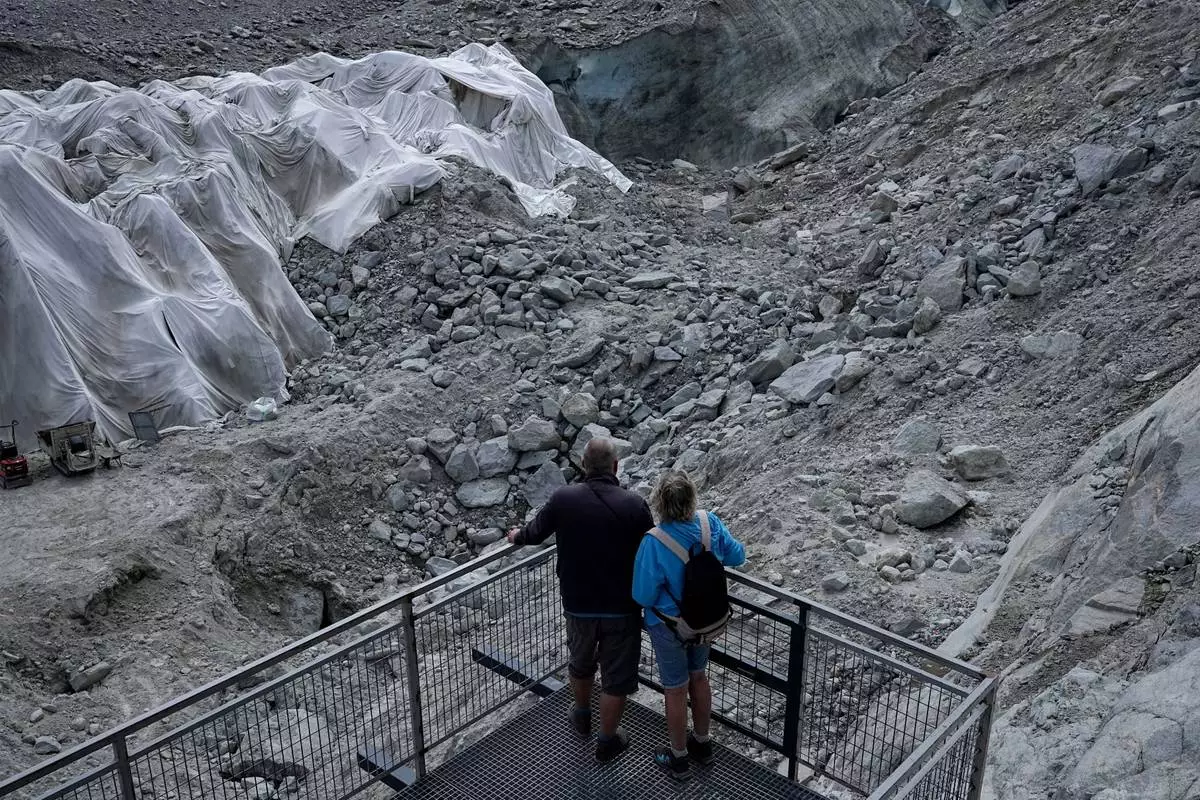
People look at the 'Mer de Glace' glacier as tarpaulins cover the ice cave to prevent it from melting, at the Montenvers station in Chamonix, France, Saturday, Sept. 5, 2026. (AP Photo/Laurent Cipriani)
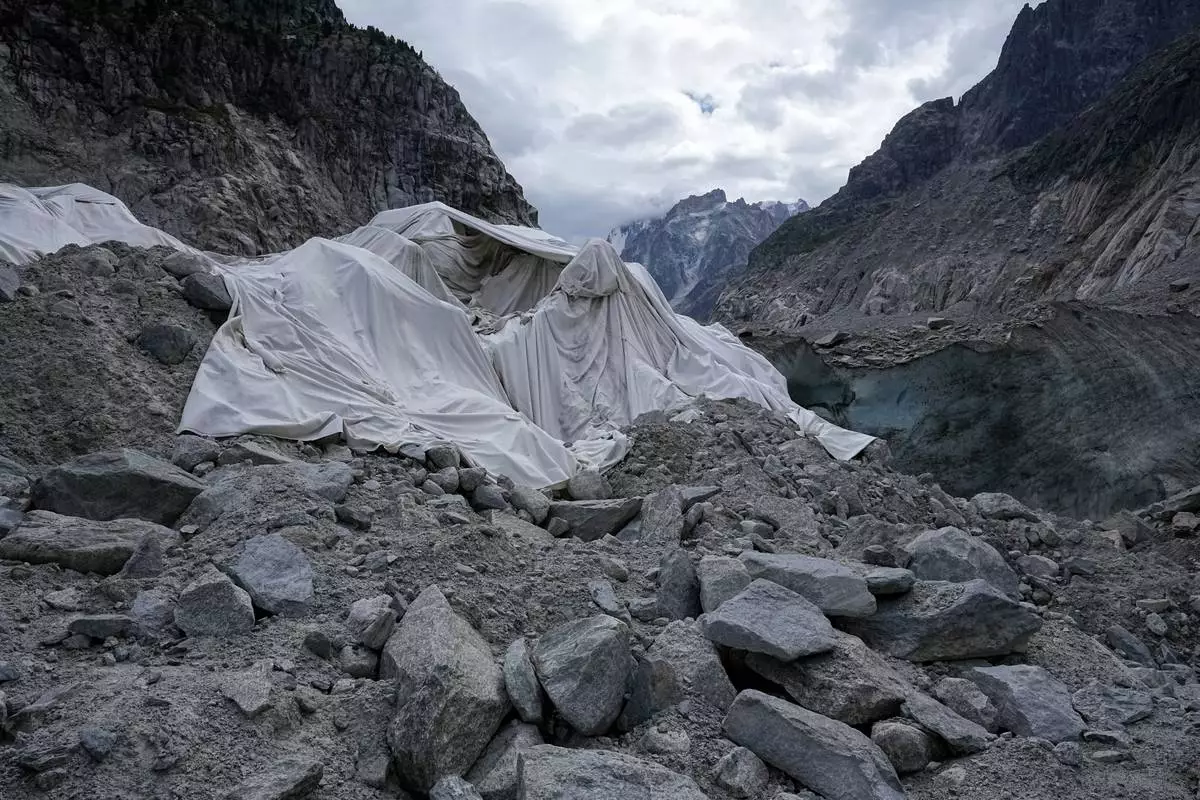
Tarpaulins cover the ice cave of the 'Mer de Glace' glacier to prevent it from melting, at the Montenvers station in Chamonix, France, Saturday, Sept. 5, 2026. (AP Photo/Laurent Cipriani)
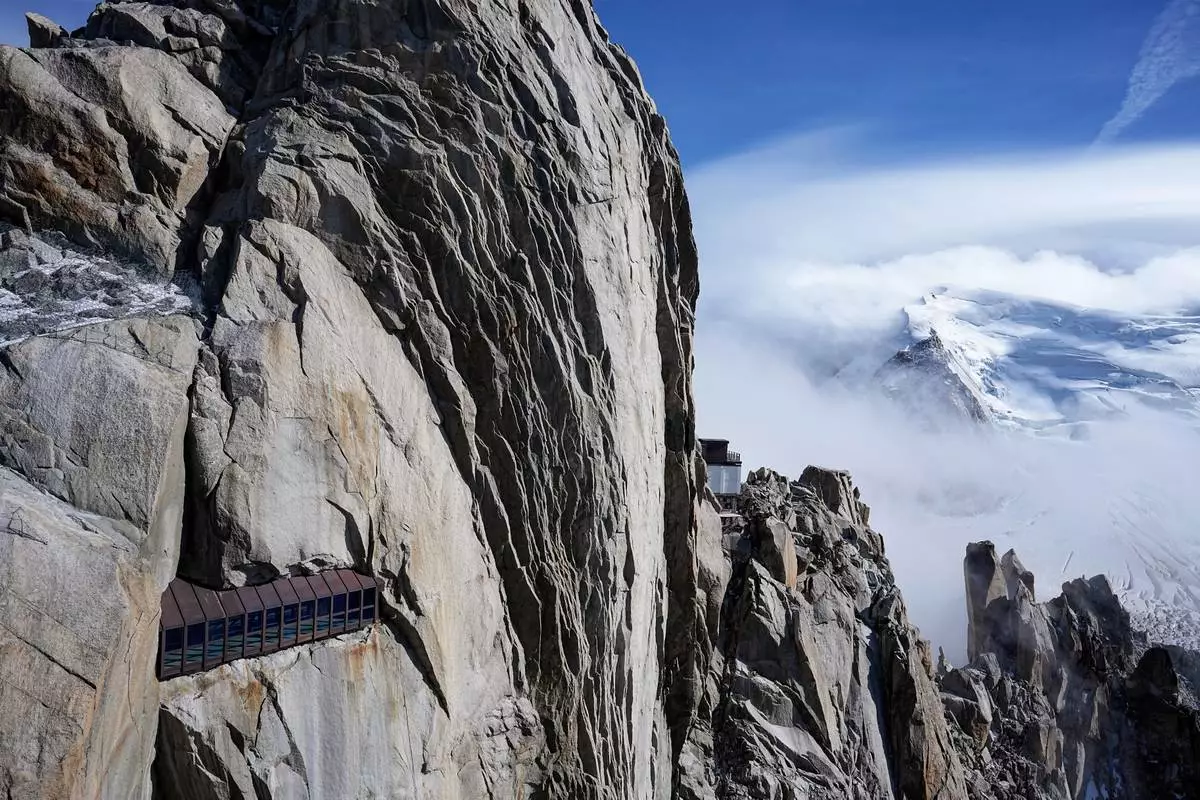
The Mont-Blanc massif mountains are seen from the Aiguille du Midi in Chamonix, France, Saturday, Sept. 5, 2026. (AP Photo/Laurent Cipriani)
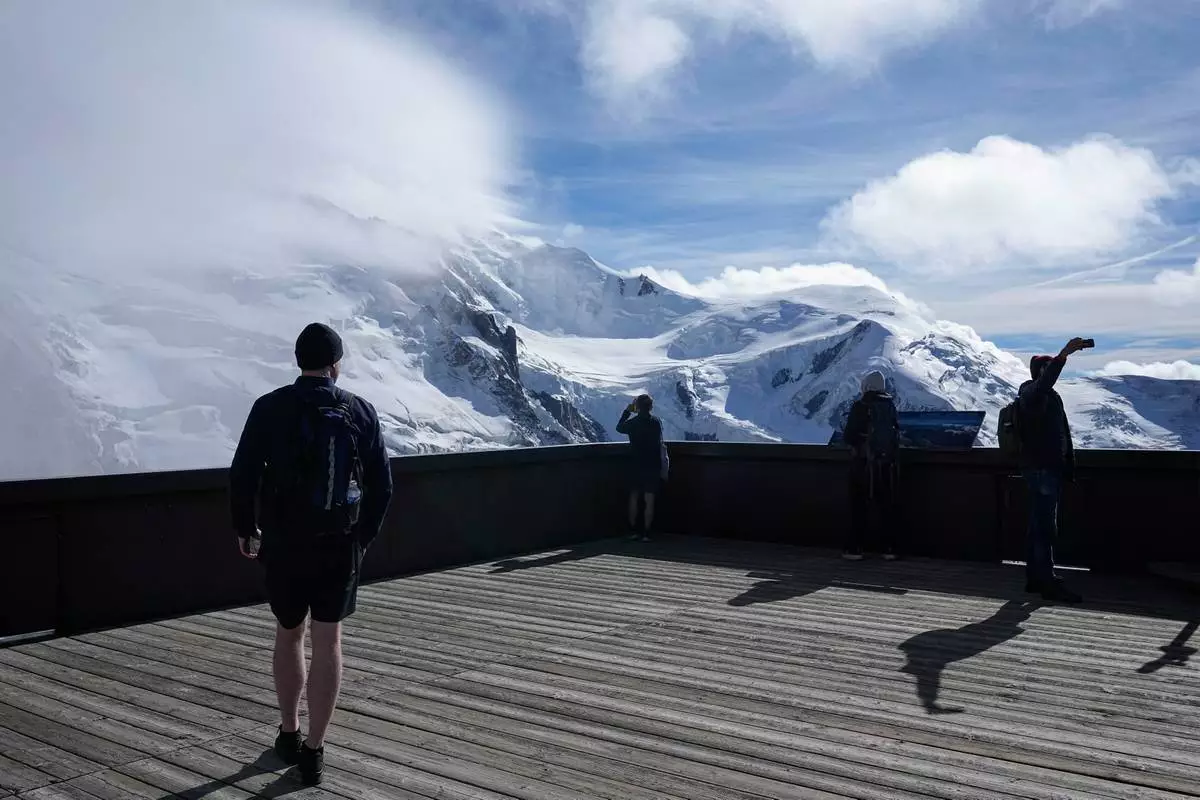
Tourists enjoy the view on the Mont-Blanc massif mountains from the Aiguille du Midi, in Chamonix, France, Saturday, Sept. 5, 2026. (AP Photo/Laurent Cipriani)
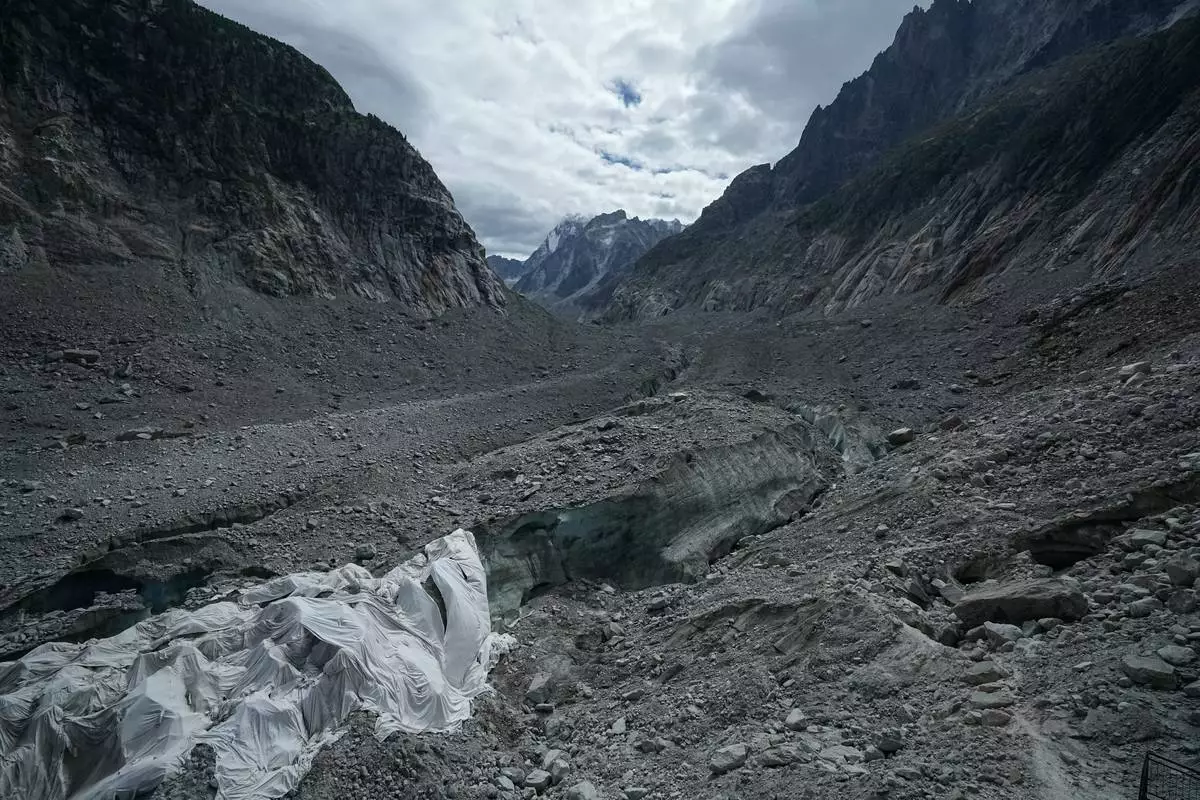
Tarpaulins cover the ice cave of the 'Mer de Glace' glacier to prevent it from melting, at the Montenvers station in Chamonix, France, Saturday, Sept. 5, 2026. (AP Photo/Laurent Cipriani)
CONCORD, N.H. (AP) — Stefany Shaheen, the daughter of retiring U.S. Sen. Jeanne Shaheen, won the Democratic primary in New Hampshire’s 1st Congressional District.
Shaheen, a former Portsmouth city councilor, emphasized her advocacy for medical research and innovation. She talked about her own daughter’s struggle with Type 1 diabetes and the family’s battles with insurance companies to cover her care.
Shaheen was in a close race with U.S. Marine Corps combat veteran Maura Sullivan. Both aired attack ads. Shaheen accused Sullivan of accepting most of her campaign contributions from out of state, while Sullivan’s ad talked about her opponent’s “fancy last name.”
The Democratic incumbent, U.S. Rep. Chris Pappas, is giving up his seat after four terms to run for the Senate.
THIS IS A BREAKING NEWS UPDATE. AP’s earlier story follows below.
CONCORD, N.H. (AP) — Republican John E. Sununu and Democrat Chris Pappas will compete for an open U.S. Senate seat in New Hampshire in a race that has emerged as one of a handful around the country that could determine control of the chamber in November.
Sununu, a former U.S. senator, and Pappas, a member of the U.S. House, are vying to replace U.S. Sen. Jeanne Shaheen, whose decision not to seek reelection created a cascade of competitive races. Both entered their respective party primaries as strong front-runners and now have just eight weeks to make their case to general election voters.
Republicans view the seat as an opportunity to regain a foothold in a region long dominated by Democrats in Congress. Democrats, meanwhile, need a net gain of four seats to retake the chamber, and keeping New Hampshire in their column is a critical part of that effort.
In other top races, Anthony DiLorenzo won the Republican primary for the 1st Congressional District, while Lily Tang Williams won the GOP primary in the 2nd District, where she’ll face U.S. Rep. Maggie Goodlander, a Democrat seeking a second term.
Still outstanding were the results in the Democratic primary for the 1st District, where the candidates included Shaheen’s daughter, Stefany Shaheen, and retired Marine Maura Sullivan.
Pappas, who is giving up his seat in the 1st Congressional District after four terms, defeated four other candidates, including democratic socialist Karishma Manzur, who had been gaining on him in recent weeks.
Speaking to supporters at his family's restaurant in Manchester, he quickly sought to link Sununu to President Donald Trump, who endorsed Sununu even though Sununu called him “a loser” during the 2024 presidential campaign.
“While New Hampshire families are struggling to make ends meet, John Sununu has thrown his lot in with Donald Trump and supports the policies that cater to big corporations and billionaires while they make life harder for Granite Staters,” said Pappas, whose campaign also quickly posted a negative ad on social media calling Sununu “a sequel we can't afford.”
“We've got to turn the page on Donald Trump's reckless leadership, on corruption, on the rigged economy and on costs, and this is not the time to turn it back to a failed politician from the past," he said at his victory party.
Sununu, who spent six years in the U.S. House and one term in the Senate before being ousted by Shaheen in 2008, called Pappas a career politician who has held office for virtually his entire adult life.
“He’s not an independent voice for New Hampshire,” Sununu said at his victory party at a Manchester ski area. “Chris Pappas has three main qualities: ineffective, partisan and out of touch with New Hampshire.”
Sununu defeated seven other Republicans to win the primary, including former U.S. Sen. Scott Brown, who accused him of coasting on his name. Sununu's father and younger brother are both former governors.
Jim Loomis, 83, of Bow, said he backed Brown in 2014 but not on Tuesday because “he never got traction back again.” He acknowledged Sununu had been out of politics for even longer but still voted for him.
“I think what he’s done for work over the years has kept him close enough to what’s going on, and then with his family ties, I just think he’s got a more stable base,” Loomis said.
Stefany Shaheen and Sullivan were the leading candidates among seven seeking the Democratic nomination in the 1st District.
Shaheen is a former city councilor in Portsmouth. She founded a business to help people with chronic medical conditions after one of her daughters was diagnosed with Type 1 diabetes. She also is part of a bio-tech initiative in New Hampshire to advance regenerative medicine.
Speaking to her supporters Tuesday night while the race remained too early to call, Shaheen said she was campaigning to “take on Donald Trump and his disastrous corruption, his endless war, his attacks on small business with these disastrous tariffs, the skyrocketing costs families are facing in New Hampshire and across the country.” But she also said running against the president wouldn’t be enough, that she would give voters a reason to turn out for the general election.
“We can bring the real change that’s needed, starting with healthcare, starting with Medicare for all,” she said.
Sullivan is a retired Marine and Iraq War veteran who served as an assistant secretary at the Department of Veterans Affairs under President Barack Obama. A vice chair of the New Hampshire Democratic Party, Sullivan ran for the 1st District seat in 2018, losing in an 11-candidate primary to Pappas in his first congressional bid.
She spoke briefly to her supporters Tuesday night, saying the tight race was far from over.
On the Republican side, political newcomer DiLorenzo, who owns a chain of car dealerships and has been endorsed by Trump, won the Republican primary. He defeated three other candidates, including Hollie Noveletsky, a veteran and nurse practitioner who runs a steel fabrication company and ran for the same seat two years ago.
“Our campaign is about prosperity,” DiLorenzo told supporters. “I believe that Washington, D.C., needs more pragmatic businesspeople.”
In the 2nd District, first-term incumbent Goodlander overcame a primary challenge from Paige Beauchemin, a progressive state lawmaker and nurse. Tang Williams, who was the nominee two years ago and was making her third attempt at the seat, won the Republican primary.
In contrast to the all-Democratic congressional delegation, Republicans dominate state government.
Republican Gov. Kelly Ayotte defeated two little-known opponents in her primary as she seeks a second two-year term. Cinde Warmington, a healthcare attorney, was unopposed for the Democratic nomination.
Voters also were nominating candidates for the entire state Legislature, where Republicans hold a roughly 40-vote majority in the 400-member House and outnumber Democrats in the Senate 16-8.
Accustomed to going first when it comes to presidential primaries, New Hampshire is among the last states to hold state-level primary elections. But legislation passed this year moves future state primaries to the second Tuesday in June.

Camille Coulborn of Chesterfield, N.H., fills out her ballot inside a voting booth in Chesterfield during the New Hampshire State Primaries on Tuesday, Sept. 8, 2026. (Kristopher Radder/The Brattleboro Reformer via AP)

Republican U.S. Senate nominee John E. Sununu gesturing while addressing supporters in Manchester, N.H., on Tuesday, Sept. 8, 2026, shortly after winning his party's primary election. (AP Photo/Rodrique Ngowi)

Republican U.S. Senate nominee John E. Sununu gesturing while addressing supporters in Manchester, N.H., on Tuesday, Sept. 8, 2026, shortly after winning his party's primary election. (AP Photo/Rodrique Ngowi)

Karishma Manzur, Democratic candidate for U.S. Senate, talks with a group of potential voters outside Brothers Cortado in Bicentennial Square in Concord, N.H., Friday, July 24, 2026. (Geoff Forester/The Concord Monitor via AP)

Former Sen. John E. Sununu, who is seeking the GOP nomination for his old seat, takes a selfie with supporter Sudie Francouer, in Berlin, N.H., Saturday, Aug. 22, 2026. (AP Photo/Holly Ramer)

Former U.S. Sen. Scott Brown, a Republican who previously represented Massachusetts and is making his second run for Senate in New Hampshire, addresses voters at an American Legion hall in Londonderry, New Hampshire, on Thursday, Aug. 27, 2026. (AP Photo/Holly Ramer)

FILE - Rep. Chris Pappas, D-N.H., speaks during a news conference at the Capitol, April 29, 2025, in Washington. (AP Photo/Rod Lamkey, Jr., File)

Former U.S. Sen. Scott Brown listens to a voter in Londonderry, New Hampshire, on Thursday, Aug. 27, 2026, as he campaigns for the GOP nomination for the state’s open Senate seat. (AP Photo/Holly Ramer)

Former Sen. John E. Sununu, who is running for his old seat nearly 18 years after being ousted, mingles with voters at the Coos County Republican Committee BBQ in Berlin, N.H., Saturday, Aug. 22, 2026. (AP Photo/Holly Ramer)