Yemen's west coast has seen a sharp escalation in fighting between Houthi forces and Saudi-backed government troops, with hundreds of casualties reported and military experts warning of a potential war of attrition near the strategic Bab al-Mandab strait.
The clashes are concentrated along the Red Sea coast toward Bab al-Mandab, the strait linking the Red Sea and the Gulf of Aden and a key shipping route between Asia and Europe.
The Saudi-backed National Resistance Forces, which support the Yemeni government, say they lost around 500 fighters and that nearly 1,500 others were wounded in fighting between August 9 and September 10.
The commander of the National Resistance Forces has announced the formation of the Tihama Resistance Force as an independent unit under the Joint Operations Command of the Saudi-led coalition. He said its mission is to retake coastal areas lost by forces opposing the Houthis.
Military experts say the restructuring of forces could pave the way for a new phase of fighting along the western coast, with the area potentially becoming a prolonged war of attrition.
"I believe that the remaining battles inside Yemen, no matter how much Saudi Arabia mobilizes, supports, or deploys forces that it considers support for the Yemeni government, are, from my military assessment, fronts that are not influential nor effective. Yet, clashes may continue there, and there may be a war of attrition," said Abdulghani Al-Zubaidi, a military analyst in Sanaa.
On the ground, fighting was reported in Dhubab, near Bab al-Mandab, between government forces and the Houthis. The Houthis said Saudi aircraft carried out dozens of airstrikes in several provinces. Government sources said five of those strikes targeted the Bab al-Mandab area alone.
Meanwhile, the Yemeni government says it has told UN envoy Hans Grundberg that it remains ready for peace and stressed that navigation through Bab al-Mandab is safe. The UN says it is continuing efforts to reduce tensions and bring the parties back to the political process.

Fighting between Houthis and Saudi-backed forces in Yemen escalates
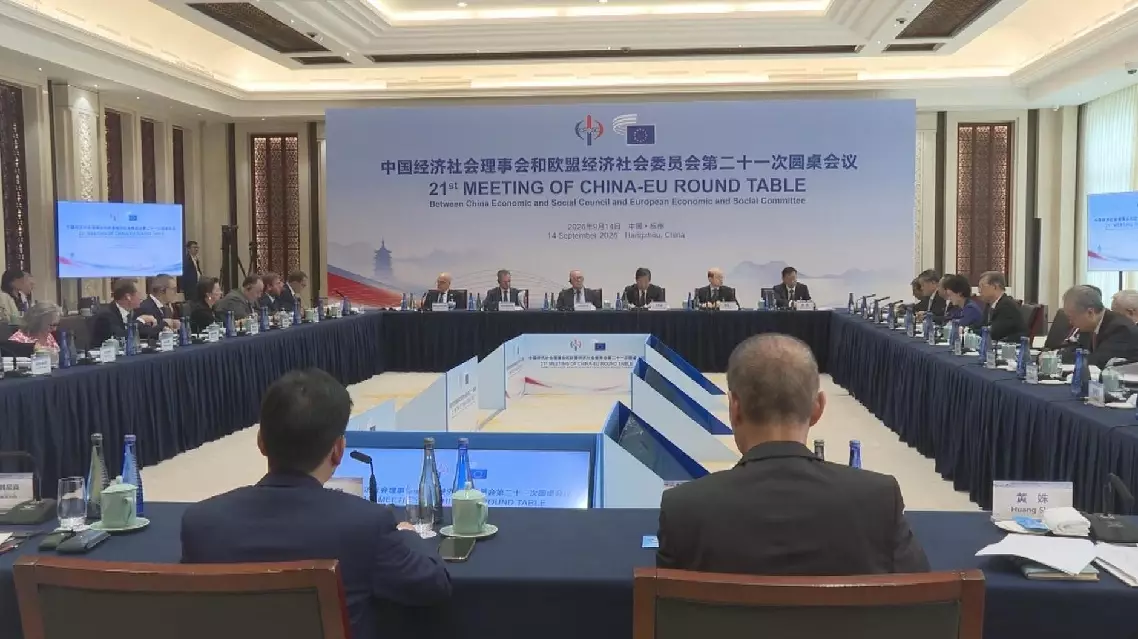
Chinese and European representatives called for closer cooperation on trade, investment, electric vehicles and artificial intelligence at a round-table meeting in Hangzhou, eastern China's Zhejiang Province, on Monday, highlighting areas of shared economic interest despite strains in broader China-EU relations.
Thirty-seven representatives attended the 21st China-EU Round Table, co-hosted by the China Economic and Social Council and the European Economic and Social Committee, advisory bodies representing business, labor and other social groups.
The discussions covered poverty reduction, trade and investment, and artificial intelligence. Participants said cooperation between China and the European Union, two of the world's largest economies, remained important for trade and global growth.
Paul Rubig, a member of the Employers' Group at the European Economic and Social Committee, said stronger two-way investment could support trade and boost consumers' purchasing power.
"I think it's very good to see that the investment on both sides should be developed in a more professional way. So it's very interesting for China companies to invest into Europe and vice versa, because that would align a good trading policy. And if it's in products or in services, for the consumers it's important to gain buying power. And you gain buying power in export and import," said Rubig.
Electric vehicles were another focus of the talks, as Chinese new-energy vehicles gain a growing presence in Europe despite tariffs. Delegates said sharing experience could help make advanced electric-mobility technologies more widely available.
Ioannis Paidas, president of the International Association of Economic and Social Councils and Similar Institutions, said China had established a substantial lead in electric-vehicle technology.
"It is true that China has indeed pulled far ahead when it comes to electric vehicle technology. Even in Europe right now, millions of vehicles featuring Chinese electric technology with top performance are on the roads. In my own country, Greece, 60 percent of the electric buses that have been brought in for Athens and Thessaloniki are Chinese-made electric buses. It must be said here that because Europe has a great many automotive industries, China ought to share its latest developments in electric vehicle technology with Europe, so that Europe too can acquire cutting-edge technology for electric mobility," said Paidas.
Trade links between China and Europe have also continued to expand. The China-Europe Railway Express operated 12,988 services from January through July in 2026, up 17.6 percent from a year earlier, according to China State Railway Group.
Participants said the discussions showed continued scope for practical cooperation in trade, investment and emerging technologies.
Chinese, EU representatives call for closer trade, investment ties