VANCOUVER, British Columbia--(BUSINESS WIRE)--Sep 15, 2026--
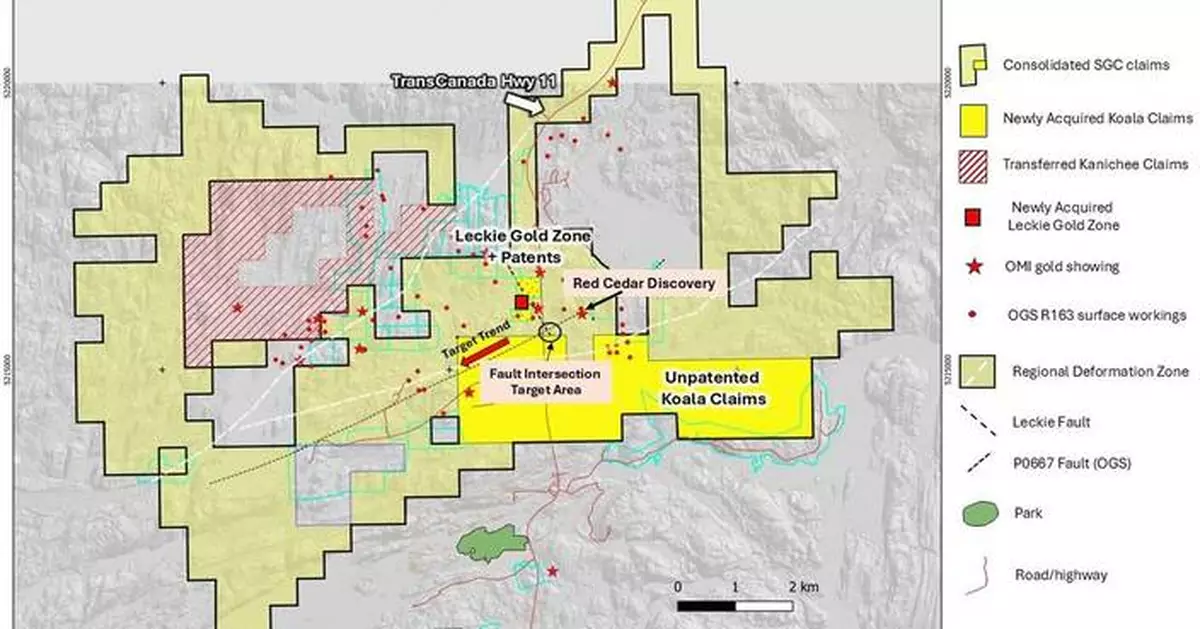
Solstice Gold Corp. (TSXV: SGC) (“ Solstice ” or the “ Company ”) is pleased to announce, further to its August 24, 2026 news release, it has closed the acquisition of two patented claims totaling 24 hectares, which host the Leckie Gold Zone (“ LGZ ”). The LGZ includes a 160 m-deep shaft, underground development on five levels and more than 23,000 m of historical drilling that has confirmed significant historic gold and silver mineralization. The agreement also includes a strategically located group of 43 unpatented mining claims totaling 9.4 km 2, adjacent to the Company’s Red Cedar Discovery and approximately 260 m from the LGZ patents. This acquisition consolidates a substantial portion of this largely unexplored part of the Abitibi Subprovince in Ontario, known for its gold potential ( Figure 1 ). It also significantly expands Solstice’s core land position, adds the LGZ as a focus for expansion drilling and enhances the Company’s ability to explore the Strathy Gold Project at a larger district scale. Unlike much of the Abitibi, the Temagami Greenstone Belt is under-explored and has not been the subject of modern regional-scale exploration techniques.
This press release features multimedia. View the full release here: https://www.businesswire.com/news/home/20260915603337/en/
Pablo McDonald, CEO, stated, “ Closing the Leckie Gold Zone acquisition cements the Strathy Gold Project as the newest exciting exploration play in the Abitibi. We now have district-scale control of gold potential in the Temagami Greenstone Belt, including an area of historical drilling that hosts significant historical gold intercepts that are open for follow up. Strathy now combines near-term brownfields exploration upside at the Leckie Gold Zone with significant greenfields discovery potential across a district-scale land package. Our focus now turns to commencing groundwork immediately in preparation for drilling the Leckie Gold Zone and surrounding discoveries to demonstrate a possibly much larger gold system and potential resource. We believe this next phase of exploration has the potential to be an important catalyst for value creation for Solstice Gold shareholders.”
Key Highlights of the Acquisition and Consolidated Project:
Next Steps: Preparation for Phase 1 LGZ Drilling
Surface work on the LGZ including detailed mapping and relogging and sampling of historical core will commence immediately after Solstice gains access to the claims. This surface work will add important data and context to our drill targeting, and will lead to a detailed drill program to be executed starting in Q4, 2026.
Purchase Agreement
Pursuant to a definitive purchase agreement, dated August 22, 2026, among the Company, Koala Canada Exploration Inc., Lithium of Nevada Pty Ltd. and Resilience Minerals Limited, the Company paid $600,000, issued 2,000,000 common shares (the “ Common Shares ”), and transferred 11 unpatented claims of the Company to arm’s length parties as consideration for the patented and unpatented claims as well as supporting technical data (the “ Transaction ”). The Common Shares are subject to a hold period of twelve months from closing pursuant to the terms of the purchase agreement and are also subject to a statutory hold period of four months and one day in accordance with applicable Canadian securities laws. No finder’s fees were paid with respect to the Transaction. The Transaction remains subject to final approval of the TSX Venture Exchange.
References:
Historical Sampling and Drilling Data and Information
The sampling, drilling data and other historical scientific and technical information presented in this news release (the “ Historical Exploration Information ”) is historical in nature. It was prepared and published before Solstice acquired an interest in the property. The reader is cautioned that the Historical Exploration Information is based on prior data and reports previously prepared by third parties without the involvement of Solstice. Solstice has undertaken some limited independent analysis of the Historical Exploration Information in order to attempt to verify the results (see “Solstice Resampling Confirms Gold and Silver Grades” above). The limited analyses to date conducted by Solstice confirmed that a sample of certain check assays of the historical assay results are consistent with the published historic assay results. However, the reader is cautioned not to treat the Historical Exploration Information as current. No qualified person has completed sufficient work to verify the Historical Exploration Information; accordingly, the information may not be reliable. Other than Solstice’s limited testing, no independent quality assurance/quality control protocols are known for the historic samples and drill holes and therefore the Historical Exploration Information may be unreliable. Solstice considers the Historical Exploration Information relevant as the Company will use this information as a guide to help plan future exploration and drilling programs. Solstice considers the Historical Exploration Information to be reliable only for this limited purpose. The Company's future exploration work will include efforts toward further verification of the Historical Exploration Information through drilling and assay results.
About Solstice Gold Corp.
Solstice is an exploration company with quality, district-scale gold projects in established mining regions of Canada. Our 57 km 2 Strathy Gold Project hosts high-grade gold mineralization, including visible gold, over a wide area straddling two NE-SW-trending structures. It is located in the Abitibi Subprovince of Ontario and has never been systematically explored in its history. Alpha IP surveys totaling over 34 line km completed in 2024 and 2025 defined 50 new targets and show that the largest IP anomaly corresponds with the Red Cedar Discovery of 8.5 g/t Au over 3.5 m. Follow-up drilling at Red Cedar intersected multiple high-grade intercepts with visible gold, as well as a “Leckie-type” intercept approximately 600 m from the Leckie Gold Zone, which has been the focus of more than 23,000 m of historical drilling. The acquisition of the Leckie Gold Zone consolidates the Strathy Gold Project and unlocks, for the first time, the potential to expand the historically significant Leckie Gold Zone and unlock the substantial potential for future discoveries and resource expansion at Strathy.
Our Qaiqtuq Gold Project which covers 662 km 2, hosts a 10 km 2 high grade gold boulder field, is fully permitted and hosts multiple drill-ready targets. Qaiqtuq is located in Nunavut, only 26 km from Rankin Inlet and approximately 7 km from the Meliadine Gold Mine owned by Agnico Eagle Mines Limited.
Our district-scale Atikokan Gold Project is approximately 26 km from the Hammond Reef Gold Project owned by Agnico Eagle Mines Limited. Our 194 km 2 Red Lake Extension (RLX) and New Frontier projects are located at the northwestern extension of the prolific Red Lake Camp in Ontario and approximately 45 km from the Red Lake Mine Complex owned by Evolution Mining.
Solstice is committed to responsible exploration and development in the communities in which we work. For more details on Solstice Gold, our exploration projects and details on our recently acquired portfolio of projects please see our Corporate Presentation available at www.solsticegold.com.
Solstice’s Chairman, David Adamson, was a co-award winner for the discovery of Battle North Gold Corporation's Bateman Gold deposit and was instrumental in the acquisition of many of the district properties in the Battle North portfolio during his successful 16 years of exploration in the Red Lake.
Paul Chamois, M.Sc. P.Geo., Senior Geologist, is the Qualified Person as defined by NI 43-101 standards responsible for reviewing and approving the technical disclosures of this news release.
Neither TSX Venture Exchange nor its Regulation Services Provider (as that term is defined in the policies of the TSX Venture Exchange) accepts responsibility for the adequacy or accuracy of this release.
On Behalf of Solstice Gold Corp.
Pablo McDonald, Chief Executive Officer
For further information on Solstice Gold Corp., please visit our website at www.solsticegold.com.
Forward-Looking Statements and Additional Cautionary Language
This news release contains certain forward-looking statements (“ FLS ”) including, but not limited to, gold potential in the Temagami Greenstone Belt, greenfields discovery potential across a district-scale land package, the Company’s planned exploration and expansion activities, including drill testing, execution of a drill program in Q4 2026, and expansion at the LGZ and the Red Cedar Discovery, and the potential for resource development and unlocking value. FLS can often be identified by forward-looking words such as “approximate or (~)”, “emerging”, “goal”, “plan”, “intent”, “estimate”, “expects”, “potential”, “scheduled”, “may” and “will” or similar words suggesting future outcomes or other expectations, beliefs, plans, objectives, assumptions, intentions or statements about future events or performance. The Company disclaims any intention or obligation to update or revise any forward-looking statements, whether as a result of new information, future events or otherwise, save and except as may be required by applicable securities laws.
Since forward-looking information address future events and conditions, by their very nature they involve inherent risks and uncertainties. Actual results could differ materially from those currently anticipated due to a number of factors and risks. These risks include, but are not limited to risks generally related to the integration of properties into the Company’s current property holdings, title risks associated with the acquisition and general risks relating to the Company’s business including that there is no guarantee that continued exploration at Solstice exploration projects, all of which are at an early stage of exploration, will lead to the discovery of an economic gold deposit, the ability of the Company to continue exploration at its projects and the risk of future lack of access to the projects as a result thereof, delays in obtaining or failures to obtain required governmental, environmental or other project approvals, inability to locate source rocks, inflation, changes in exchange rates, fluctuations in commodity prices, delays in the development of projects, regulatory approvals and other factors. FLS are subject to risks, uncertainties and other factors that could cause actual results to differ materially from expected results.
All forward-looking statements are based on the Company’s current beliefs as well as various assumptions made by Company management and information currently available to them including that testing and expansion at the Red Cedar Discovery may not occur when anticipated or at all. There can be no assurance that such assumptions will prove to be accurate and actual results and future events could differ materially from those anticipated in such. Forward looking statements reflect the beliefs, opinions and projections on the date the statements are made and are based upon a number of assumptions and estimates that, while considered reasonable, are inherently subject to significant business, economic, competitive, political and social uncertainties and contingencies.
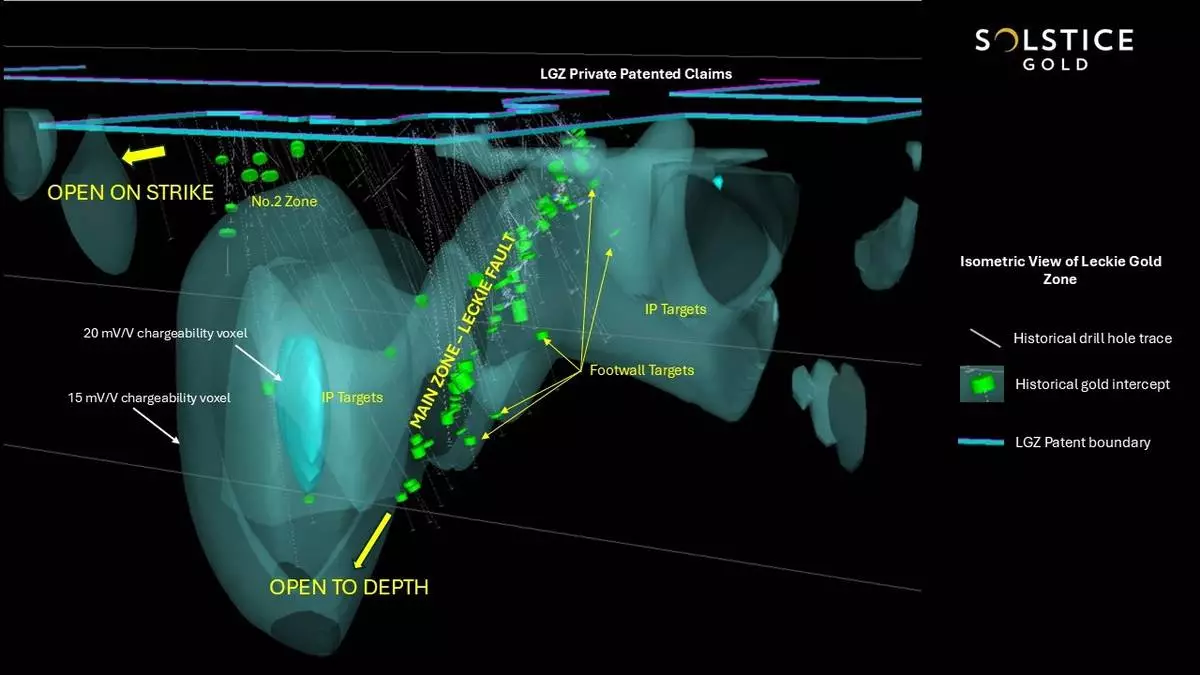
Isometric view of Leckie Gold Zone subsurface. Blue shapes show high chargeability voxels (IP). The main mineralized zone responds well to IP, meaning that undrilled areas of high chargeability are obvious targets for expansion.
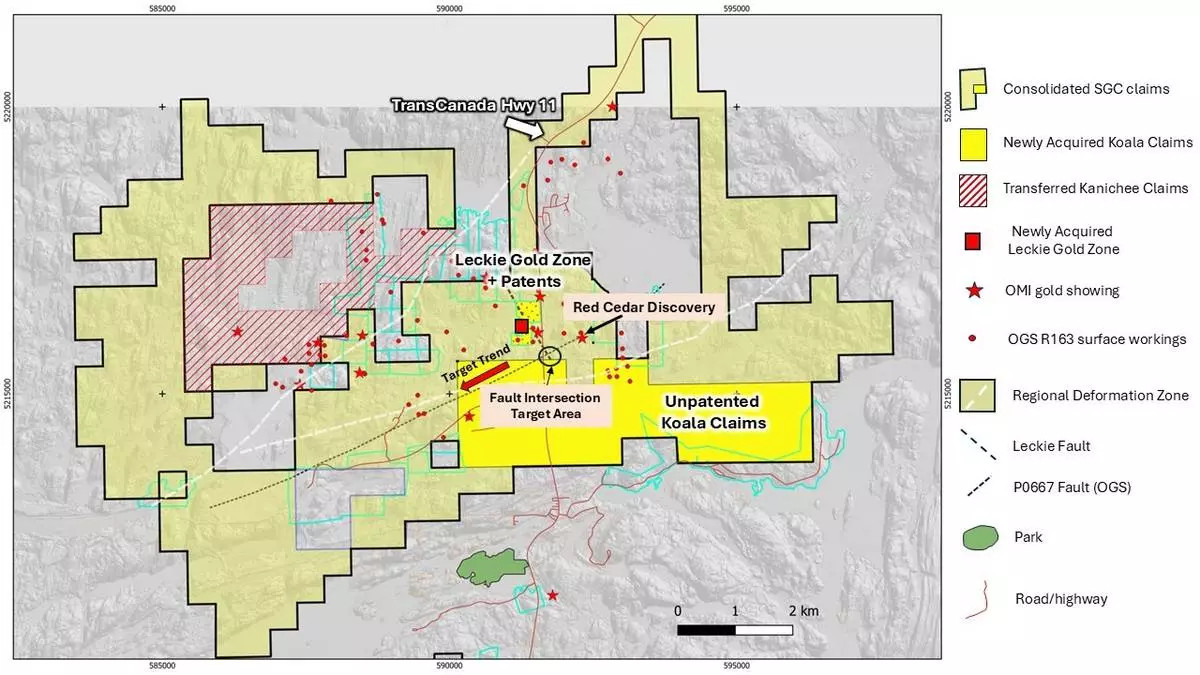
Consolidated Strathy Gold Project after addition of the Leckie Gold Zone and Southern Unpatented Claims. Note both claim groups’ proximity to the new greenfields Red Cedar Discovery.