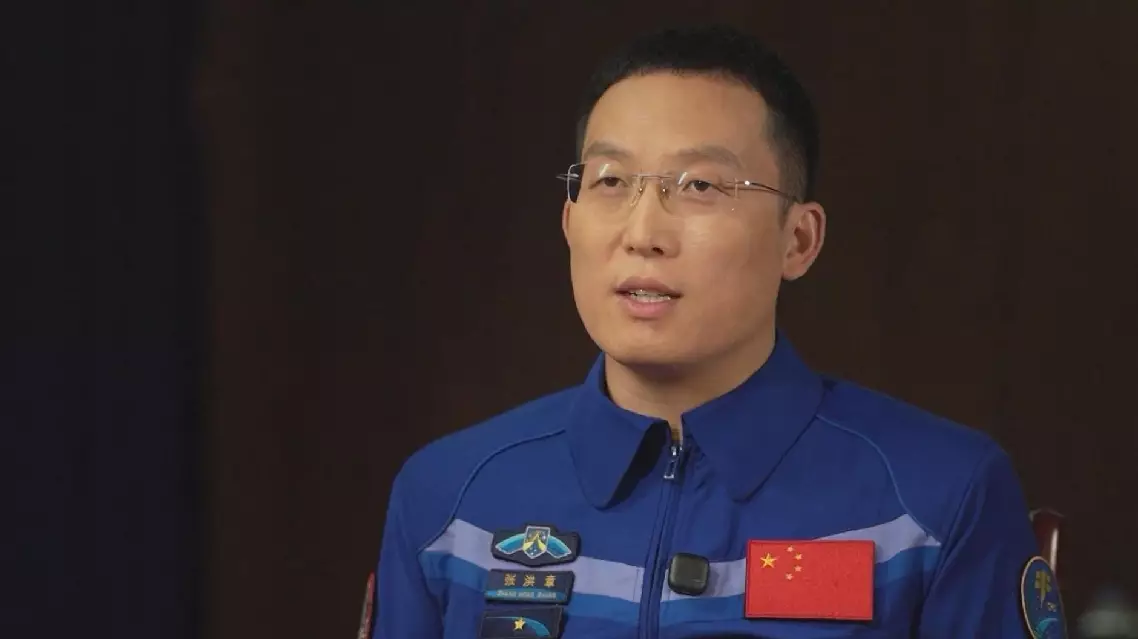
Astronaut Wu Fei, a member of the Shenzhou-21 crew, has shared his journey from spacecraft engineer to astronaut — and the little-known story of how the cracked Shenzhou-20 return capsule was brought safely home.
Wu was born in 1993 in Baotou, north China's Inner Mongolia Autonomous Region. In 2010, he was admitted to Beihang University in Beijing, where he majored in aircraft design.
After completing his master's degree, he became an engineer at the China Academy of Space Technology under the China Aerospace Science and Technology Corporation. There, his work focused on thermal testing for spacecraft.
In May 2018, China began selecting its third group of astronauts, adding two new categories of astronauts: space engineers and payload specialists. Wu applied without hesitation.
In September 2020, he was recruited as an astronaut.
"When we first received training, we actually encountered many problems, including the transition from experts in our own field to acquiring a broad breadth of knowledge. While we have our own role, becoming astronauts still requires us to understand all the systems," Wu said.
From an engineer to an astronaut, Wu had to overcome more difficulties than expected. At first, he was kind of acting rashly, but later he found that could get him nowhere.
"I told myself to see the pattern and then establish a scientific training method. my commander (Zhang Lu) has spent more than 10 years tempering himself to carry out the task, and he is willing to share with us the precious experience he has accumulated. We should make good use of this resource — our inheritance: how to learn from his experience, and how to stand on the shoulders of giants to do more sophisticated exploration and complete our tasks better," Wu said.
Wu has worked to verify the thermal control systems for the Tianhe core module and the Wentian lab module of China's space station, and said that he would find operating the spacecraft he had helped test and develop to be "very meaningful."
"As a space engineer, I paid more attention to the parameters of the whole instrument when I was on duty to maintain the operation of the whole space station, because my duty was to monitor these parameters before going to space. When I am in orbit, I finally have the opportunity to see its actual operating state, so I would often go to see the parameters and find out how each system works," Wu said.
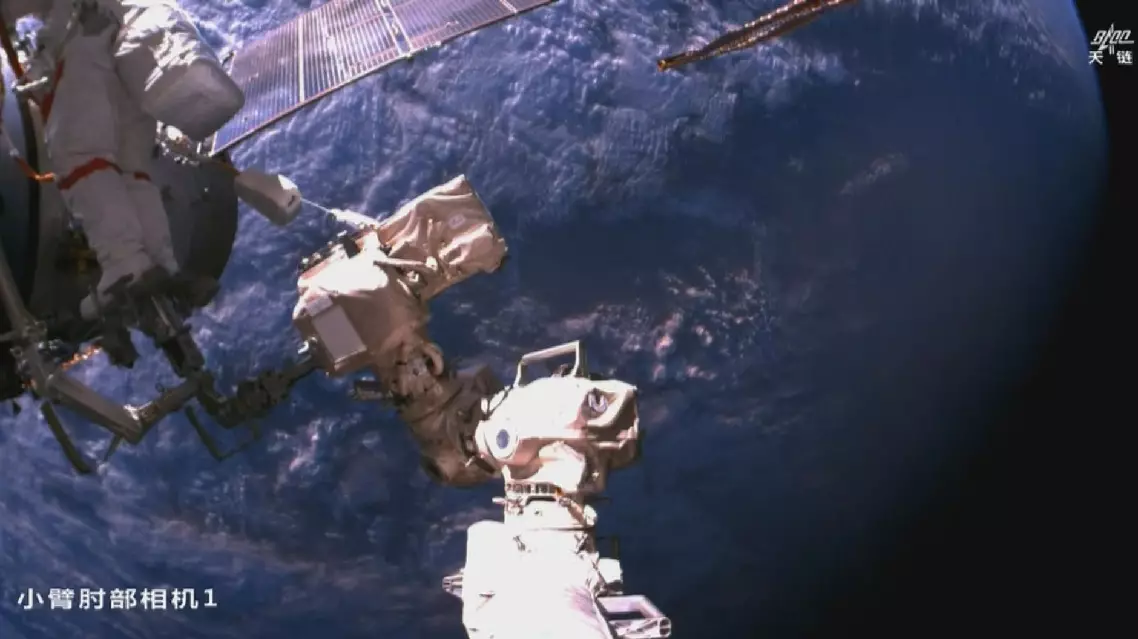
Three extravehicular activities also gave him the opportunity to observe the Earth and space from a different perspective.
"I was a little nervous when I saw the whole Earth for the first time as I opened the cabin door. That perspective is hard to describe — I was standing in a very high place, looking down, with nothing in between," Wu said.
He said it was very striking to see the Earth from a distance, set against the backdrop of space, for the first time.
"Knowing our achievements we have made in science and technology have reached beyond the atmosphere when I see a space station full of science and technology right in front of me — that is a very exciting feeling," Wu said.
China launched the Shenzhou-22 spaceship from the Jiuquan Satellite Launch Center in northwest China at 12:11 (Beijing Time) on Nov 25, 2025, successfully accomplishing the first emergency launch mission in the country's manned space program.
The spaceship, flying without a crew aboard, carried a cargo of space food, medical supplies, fresh fruit and vegetables, as well as devices for treating the cracked window on the Shenzhou-20 spaceship.
The return mission of sending the three Shenzhou-20 astronauts back to Earth, initially scheduled on Nov 5, 2025 by the Shenzhou-20 spaceship, was delayed following a suspected debris impact.
"After the crack occurred in the porthole of the Shenzhou-20 spaceship, whether it could withstand the high temperature and pressure during the entire return process was something that the staff on Earth couldn't accurately judge from a distance. As for the porthole structure itself, we can't remove it, because it becomes a vacuum when removed. But the measure we can take is to protect it. We reinforced it inside the cabin. It is inevitable that similar problems may happen in follow-up tasks. How can we judge to what extent it is reliable or unreliable? (Sending the spaceship back) provides the experts on Earth with such an opportunity to research," Wu said.
The return capsule of the Shenzhou-20 spaceship, carrying no astronauts, touched down at the Dongfeng landing site in north China's Inner Mongolia Autonomous Region at on Jan 19, 2026. On-site inspections confirmed that the return capsule's overall appearance was normal and that items inside were in good condition.
Wu said before the Shenzhou-20 spaceship touched down on Earth, he was more concerned about the reinforcement work.
"What we are more worried about is whether our reinforcement work is done well enough to achieve the expected effect and bring this precious research opportunity back to the Earth completely," he said.
Engineer to astronaut: Wu Fei on little-known story behind Shenzhou-20's safe return