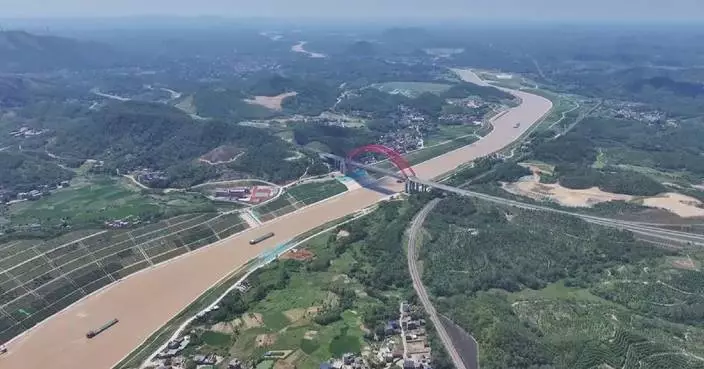
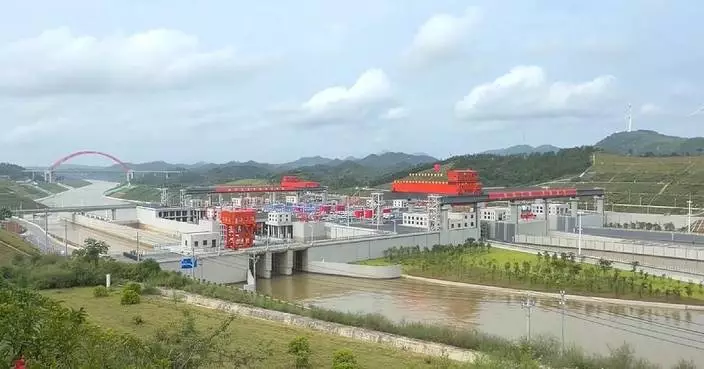
Funing Port in southwest China's Yunnan Province, a key modern port facility designed to operate alongside the Pinglu Canal opened on Wednesday, has entered its final stage of construction.
After its operation, a brand-new waterway directly connecting to the sea will be opened up.
Built at a cost of 72.7 billion yuan (about 10.75 billion U.S. dollars), the 134.2-kilometer Pinglu Canal runs from Nanning, capital of south China's Guangxi Zhuang Autonomous Region, to the Beibu Gulf, the closest maritime outlet for much of southwest China.
It stretches along the New International Land-Sea Trade Corridor, a strategic trade route connecting China's inland regions with ASEAN and other global markets.
Funing Port will feature 19 cargo berths for vessels of up to 1,000 tons and two passenger berths. The primary work for Phase I, comprising one passenger berth and three cargo berths, has been completed.
Final-stage work is now progressing rapidly, including road paving, equipment installation and testing, and connection to the external power grid.
The project is expected to be completed by the end of October and pass final acceptance inspection by year end.
"Once operational, Funing Port will, on one hand, bring Yunnan closer to the sea; and on the other hand, transform the province's freight transportation model, as it provides a new option for long-distance, high-volume, and cost-effective transport. It is also expected to become a key port logistics hub connecting Yunnan with the Guangdong-Hong Kong-Macao Greater Bay Area and the Pan-Beibu Gulf Economic Rim, while strengthening links between China and ASEAN countries," said He Yongsheng, president of YCIC Funing Port Investment and Construction Co., Ltd.
At present, goods from Yunnan bound for overseas markets need to depart from Shuifu Port, travel along the Jinsha River and then the Yangtze River, covering a distance of approximately 2,800 kilometers.
Once Funing Port is completed and put into operation, Yunnan will gain new waterborne routes to the sea, with one via the Pearl River, covering approximately 1,300 kilometers, and the other southward via the Pinglu Canal to Qinzhou Port, covering just over 700 kilometers.
Clearly the Funing Port has great advantage in distance. With its large carrying capacity and low cost, water transport is particularly suitable for transporting bulk commodities.
Yunnan's aluminum industry is expected to benefit from the Pinglu Canal.
"For example, aluminum products from Funing Industrial Park will reach Southeast Asian countries and ASEAN nations more quickly through Funing Port. In addition, specialty products from Southeast Asian countries can also enter the Chinese market more conveniently via this channel," said Du Yuxiang, deputy director of Yunnan Funing Industrial Park's Administrative Committee.
In the future, the Funing Port will also be connected to railway, enabling seamless integration of road, rail, and water transport.
The Pinglu Canal fills a crucial gap in Yunnan's waterborne route to the sea, further highlighting the province's strategic location as a gateway and regional center bridging South Asia and Southeast Asia.
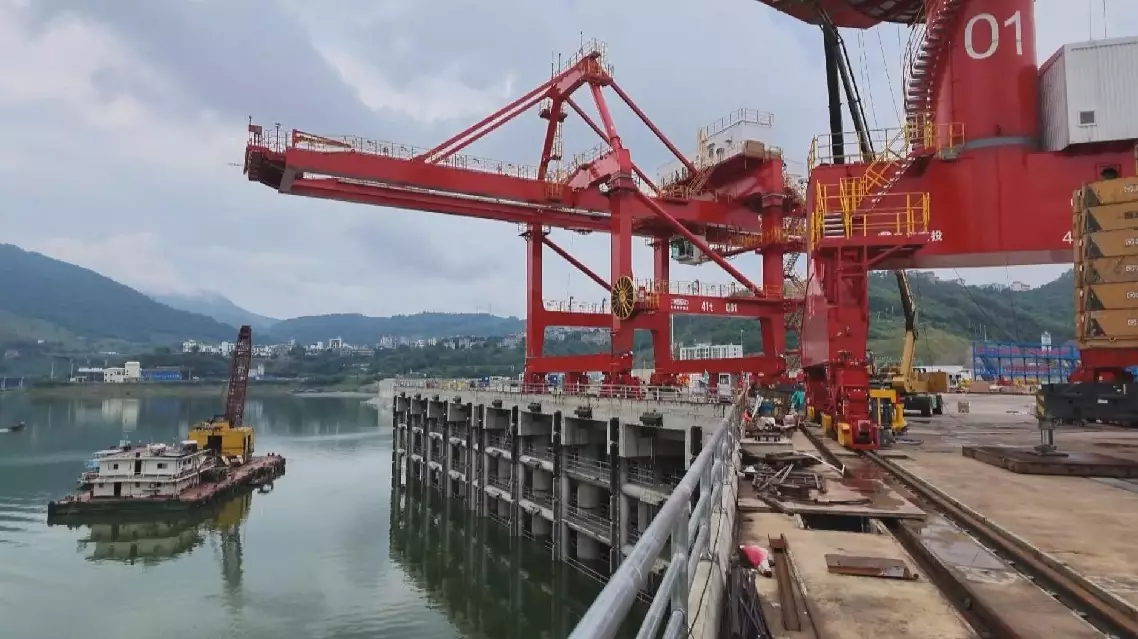
Key port in China’s Yunnan about to finish construction