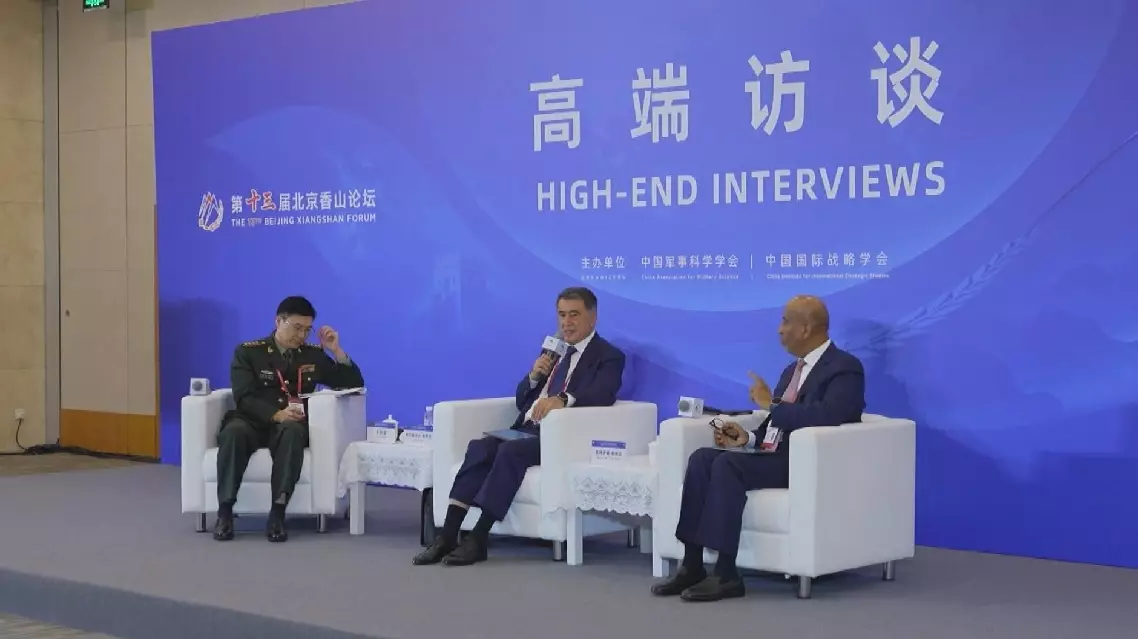
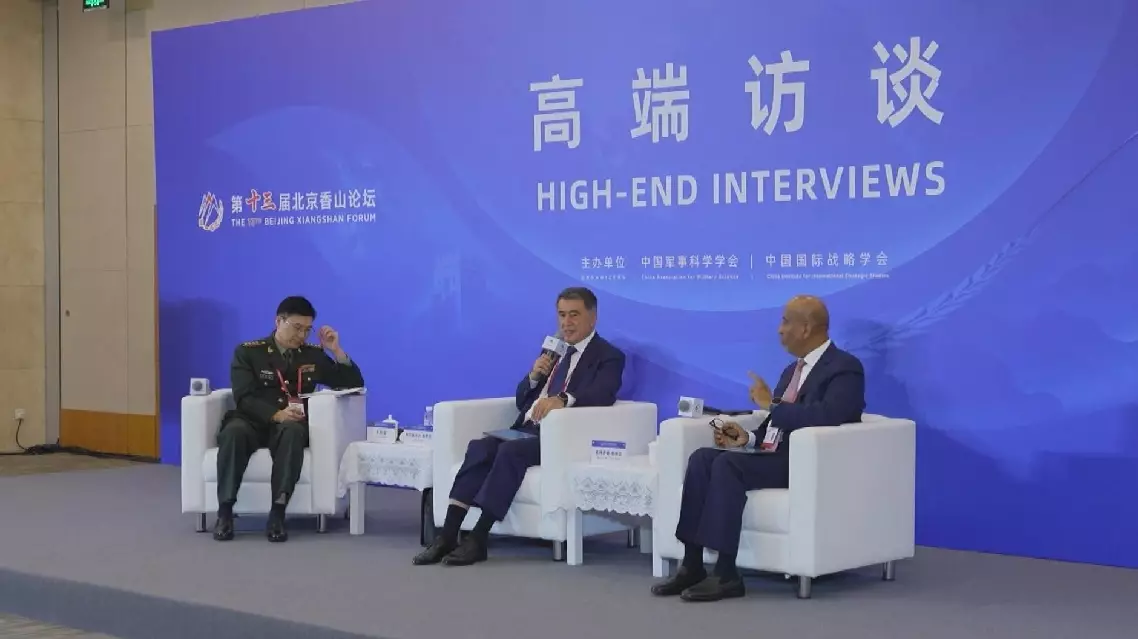
Experts attending the 13th Beijing Xiangshan Forum on Tuesday stressed the importance of improving global AI governance and preventing the technology from being weaponized.
The experts carried out in-depth exchanges revolving around AI's role in global security at a forum session focused on frontier issues, including AI-related risks and challenges, cooperative oversight mechanisms, and intensifying competition over the use of AI in the military domain.
Many of them voiced support for China's proposal to establish the World Artificial Intelligence Cooperation Organization (WAICO), holding that it is a timely step toward improving global AI governance.
"The establishment of the World Artificial Intelligence Cooperation Organization, WAICO, is very timely. And it is [a] more important step in developing global AI governance. WAICO should therefore create a permanent mechanism for both governments and experts to exchange information about serious AI-related risks," said Vladimir Norov, chairman of the Central Asia Artificial Intelligence Association, a regional hub that advances AI in Central Asia by bringing together experts, companies and educational institutions.
As the host of the dialogue, Zhu Qichao, an expert with China's National University of Defense Technology, has been a long-time researcher of AI, national security and military governance.
Zhu said the expanding race to militarize AI is making risk control and governance increasingly urgent. He argued that ethical boundaries must be upheld, while misuse of AI must be prevented and the transformation of intelligent technologies into tools of war must be avoided.
"We must adhere to the concept of tech for good and AI for good. And we must respect international law. Human beings must firmly retain the ultimate decision-making power over the use of AI weapons, [which] is an absolute red line that cannot be crossed," Zhu said.
He then highlighted the current imbalance in global AI development, as there has been a significant technological gap between nations, pointing out that AI research and development is largely driven by private technology companies, whose actions are bound by the laws of sovereign states.
As a result, promotion of balanced global AI development faces multiple diplomatic and structural challenges, according to Zhu.
"When carrying out AI-related cooperation with other countries, one should respect the sovereignty of each nation. In face of the norms of international relations and the Charter of the United Nations, all nations are equal and should show mutual respect. In the process of promoting the application of emerging technologies, one should not use coercive methods to force other countries to accept the relevant technologies," he said.
This year marks the 20th anniversary of the Beijing Xiangshan Forum, which was launched in 2006 as a "track-two" think-tank exchange, with the ongoing edition being held in the Chinese capital from Tuesday to Thursday.
Xiangshan forum attendees stress improving AI governance, preventing its weaponization
Xiangshan forum attendees stress improving AI governance, preventing its weaponization