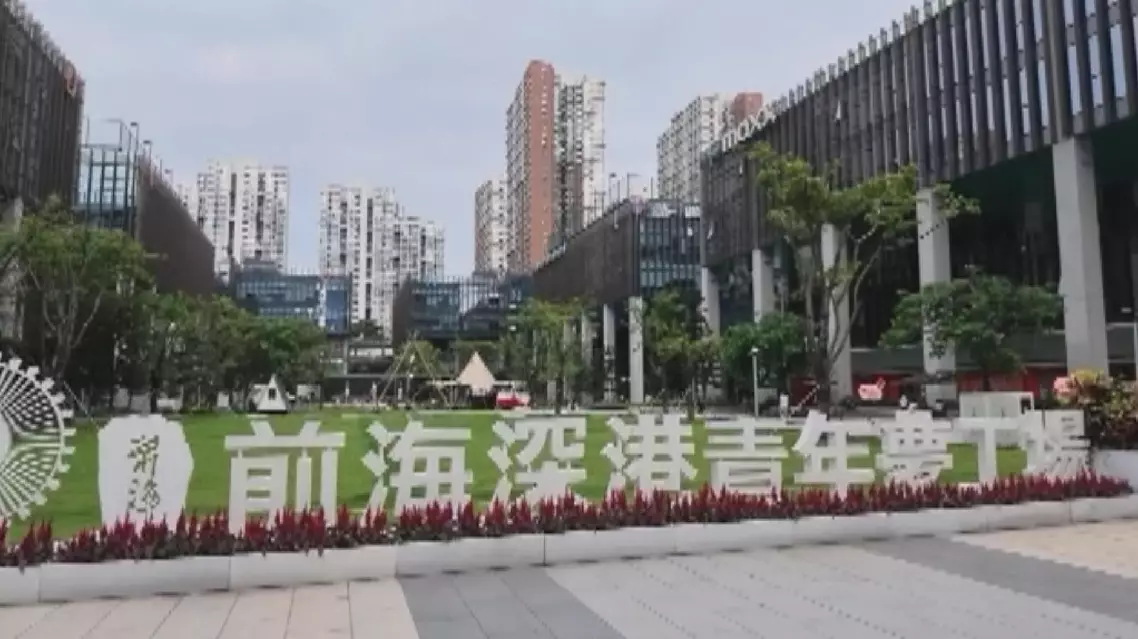
The Hong Kong Special Administrative Region (HKSAR) unveiled its first five-year plan for economic and social development (2026-2030) on Wednesday, specifically calling for enhanced use of major cooperation zones like Qianhai, which lies between Hong Kong and Shenzhen in Guangdong, to give more startup businesses a foothold on both sides of the border.
The blueprint calls for deeper cooperation across the Guangdong-Hong Kong-Macao Greater Bay Area (GBA) in areas including technology, industry and talent.
Libpet, which makes autonomous buggies to help passengers at airports, is one of the startups that is taking advantage of this greater cooperation, embodied in the Qianhai cooperation zone.
The idea behind Libpet began in Hong Kong, where founder and CEO Xu Huafeng and his team developed their first prototype. But when it came time to actually manufacture it, Xu looked across the border to Shenzhen and Qianhai.
"The potential client loved our product. The key point is that how can we to manufacture that. Therefore, we need to find a place that have, first, a lot of great engineering; second, a lot of great suppliers to help us to manufacture the robots. So that's why we choose Qianhai because it can provide these two good advantages," said Xu Huafeng, founder and CEO of Libpet.
Eighteen months ago, Xu brought his company to the Qianhai Shenzhen-Hong Kong Youth Innovation and Entrepreneur Hub, or E-Hub - an incubator for young entrepreneurs from Hong Kong and Macao. Today, his teams in Hong Kong and Shenzhen bring different strengths to the business.
"It's very good at the business development part, and also for the R and D part. And in Shenzhen, the people in here is very good at engineering, value efficiencies, and also know how to manufacture the thing," Xu said.
Xu travels between the two cities several times a week. His experience offers one example of the kind of cross-boundary integration Hong Kong now wants to deepen.
"When it comes to the relationship between Qianhai and Hong Kong, we always look at how many Hong Kong companies are right now in Qianhai, and how many Hong Kong people are working here. But actually, if we look deeper in terms of our cooperation, what matters the most is the alignment of rules and mechanisms," said Gary Wong Chi-him, chief Hong Kong and Macao liaison expert at the Qianhai Authority in Shenzhen.
Qianhai is now home to more than 11,000 Hong Kong-funded firms and over 13,000 Hong Kong resident workers, according to the Qianhai Authority, whose remit includes helping Hong Kong's professional services enter the mainland market, expanding cross-boundary data links, and supporting young entrepreneurs through the E-Hub.
Hong Kong's first 5-year plan to help deepen integration within Greater Bay Area