Commemorative activities were held in China's cities to mark the 95th anniversary of the September 18 Incident that signifies the start of Japan's 14-year invasion of China.
The incident foreshadowed World War II and made China the first to resist fascism.
During the Chinese People's War of Resistance Against Japanese Aggression which lasted until 1945, China suffered a total of 35 million military and non-military casualties, accounting for a third of the total casualties of all the countries in World War II.
In Yangquan City, north China's Shanxi Province, representatives of college faculties and students gathered at the Monument to the Hundred-Regiment Campaign, presenting flower baskets and paying their profound respects to the revolutionary martyrs.
By reviewing their admission oath to the Communist Youth League of China, the young people expressed their firm determination to carry forward the revolutionary traditions and heritage.
The faculties and students also visited the memorial hall commemorating the Hundred-Regiment Campaign, relived the arduous years of the war and reflected on the great spirit of the resistance.
"As the youth of the new era, we will keep this mission in mind and study hard. We'll carry forward the revolutionary traditions and spirit through concrete actions and fuel the push toward national rejuvenation with the power of youth," said Guo Zhenyu, a student of the Shanxi Institute of Technology.
Meanwhile, a themed exhibition commemorating the revolutionary martyrs is on display in Harbin City of northeast China's Heilongjiang Province.
The exhibition features a curated selection of precious cultural relics, historical archives, and literature. The diverse exhibits cover a wide range of categories, including weapons, historical publications, martyrs' personal belongings, production tools, military medals, and the official seals of mass organizations.
"I am profoundly moved, especially by seeing the tools used by the martyrs of the Northeast Anti-Japanese United Army. The revolution was not easy, the founding of the People's Republic of China was hard-won, and today's great era did not come easily. We must, first and foremost, cherish what we have, and secondly, continue to strive forward," said Yang Wenbin, a visitor from southwest China's Sichuan Province.
On the night of September 18, 1931, the Japanese Kwantung Army bombed a section of the South Manchuria Railway near the Liutiao Lake on the northern outskirts of Shenyang.
The Japanese blamed Chinese troops for the act and used this as a pretext to attack Beidaying (the Great Northern Barracks), where the Chinese Northeast Army was garrisoned, and then bombarded Shenyang.
The September 18, 1931 Incident marked the start of China's war of resistance against Japanese aggression.
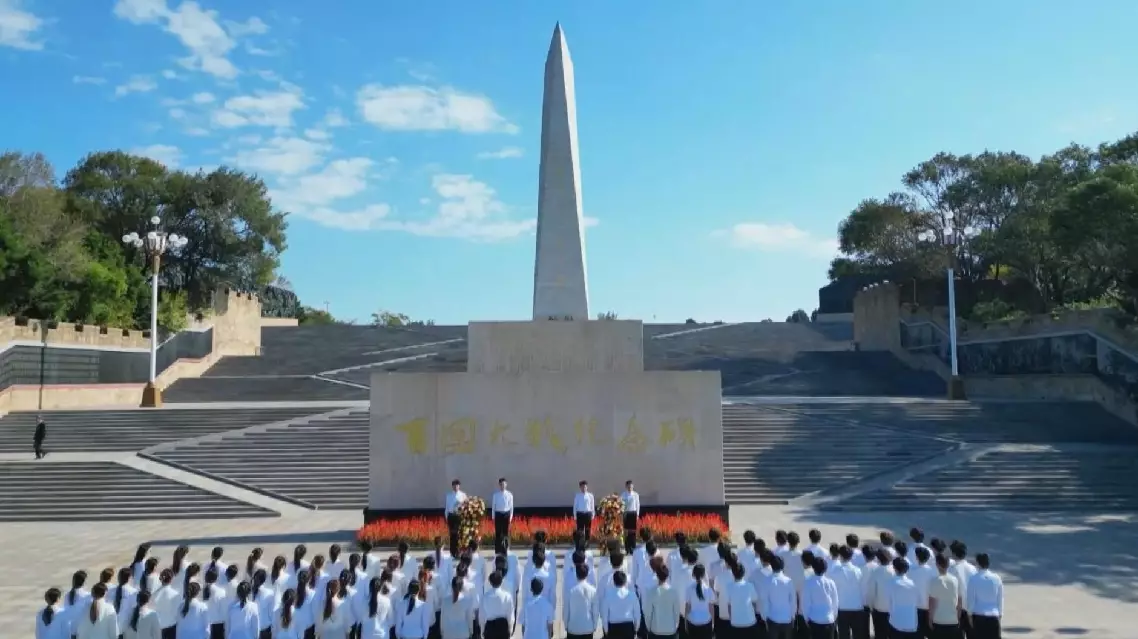
Themed activities held in Chinese cities to commemorate September 18 Incident