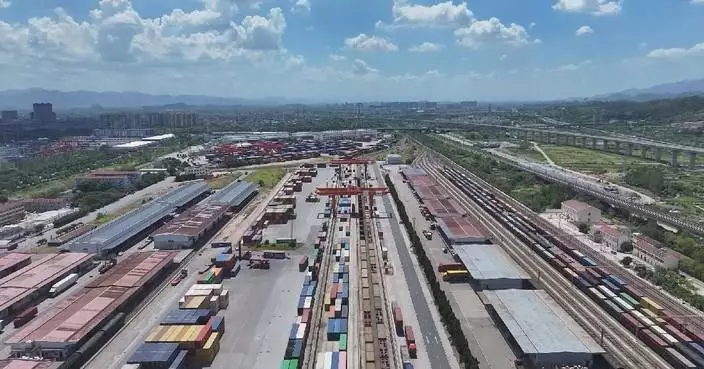
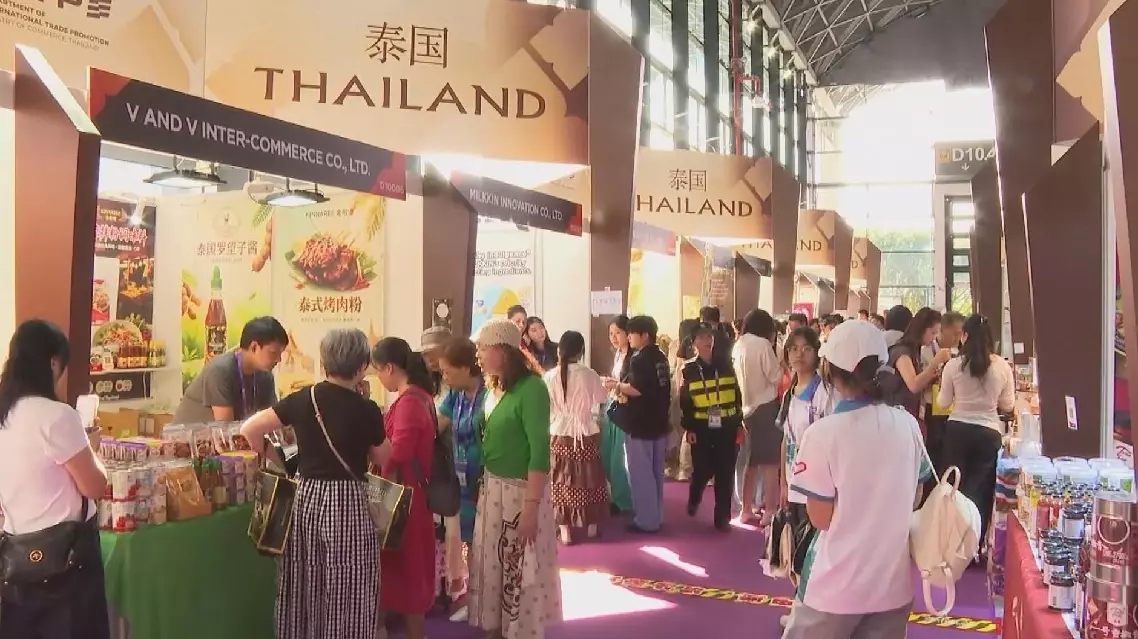
Business people from Thailand are seeking closer cooperation with Chinese partners at the "Export to China" campaign of the 23rd China-ASEAM Expo, which kicked off Thursday in Nanning, capital of south China's Guangxi Zhuang Autonomous Region.
A total of 109 Thai companies are exhibiting agricultural and food products, beauty and personal care, logistics, textiles and many other products at the expo with Thailand serving as the thematic country for the "Export to China" campaign.
For many business representatives from Thailand, their message is the Chinese market remains highly attractive, and the future of China-Thailand cooperation looks increasingly promising.
"This is my 10th time attending the expo in Nanning, and every time the feedback has been excellent. After the expo, our agents distribute Thai products right here in Nanning, reaching customers across China," said a Thai exhibitor
For many Thai companies, the China-ASEAN Expo is more than a showcase, it is a gateway to China's vast consumer market.
"We’re here to see how Chinese consumers respond to our classic flavors, and to understand what they really want. This year, we also want to explore using Chinese materials to upgrade and innovate our products," said Zhang Zhengkun, a staff member of Waydhanar Company from Thailand.
The momentum behind the business cooperation is clear. From this January to August, total trade between China and Thailand reached 129.17 billion U.S. dollars, up 26.6 percent year on year.
China has remained Thailand's largest trading partner and its top export market for agricultural products for 13 consecutive years.
"China and Thailand share close cultures, especially in food, wellness, and traditional lifestyles. If we research and co-develop these products and services together, we can better serve markets in China, in Thailand, and around the world," said Yang Kaise, deputy secretary-general of Thai Chamber of Commerce in China.
Themed on "CAFTA 3.0 Opportunities, Better Life," the 23rd China-ASEAN Expo and China-ASEAN Business and Investment Summit will run till Monday.
Thai businesses seek deeper trade ties at 23rd China-ASEAN Expo in Nanning
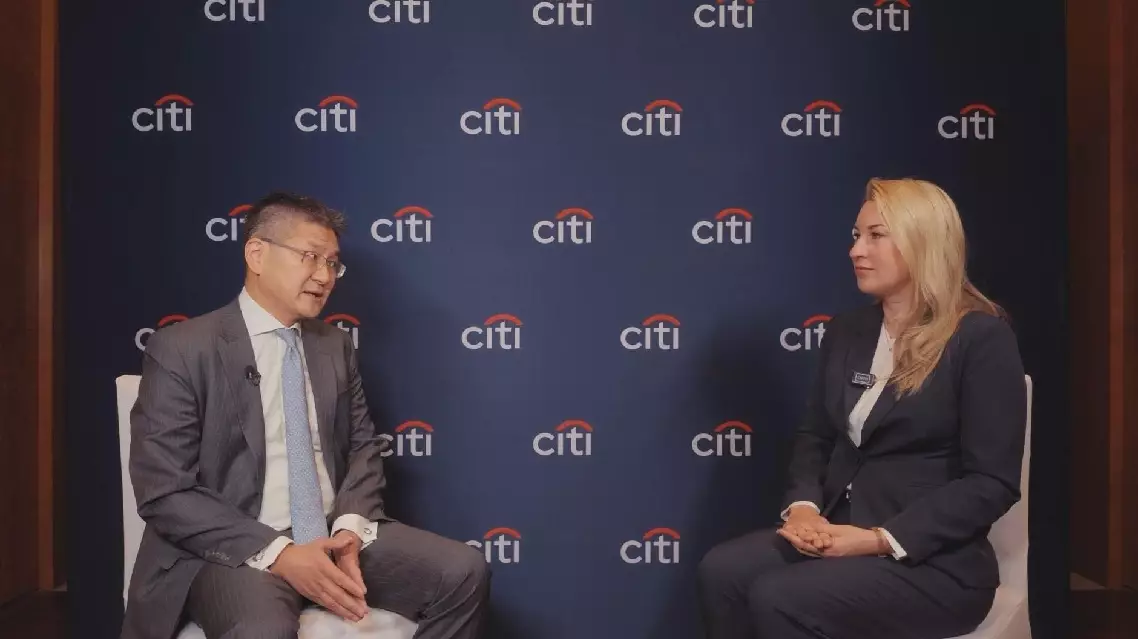
Citi is making a major push in China with the launch of a wholly-owned securities unit to expand its onshore business, a step Simon Yuan, the bank's head of China investment banking, described as a milestone while pointing to the key sectors and elements that will shape China's pull on international investment.
In October, the China Securities Regulatory Commission approved Citigroup's plan to establish a wholly-owned securities company in the country.
The firm, Citigroup Securities (China) Company Limited, will be registered in Shanghai with registered capital of 1.2 billion yuan (about 180 million U.S. dollars).
"This is a very important milestone to complete a very important part, piece of our overall platform for Citi in China. This is the first time allowing us to combine our global capital markets and investment banking expertise with local underwriting, research, brokerage, and trading capabilities under one wholly-owned securities platform, which again is very, very exciting. Near term opportunities, I think it's domestic securities and the underwriting, be it, equity capital markets, debt capital markets and et cetera, as well as complemented by the trading research, brokerage capabilities," Yuan said, "adding that Citi will also play a role in mergers and acquisitions advisory.
Yuan said Citi brings a very strong foundation to the new onshore business, noting that the bank serves 70 percent of the Fortune 500 companies operating in China along with hundreds of leading Chinese corporates, and has been serving Chinese companies from its offshore presence for a very long time.
Speaking of the biggest growth drivers in A-share issuance and what will attract the most capital, Yuan highlighted emerging sectors such as AI and advanced manufacturing. "I think it will continue to be China's drive to further build its technology, self-sustainability, AI adoption, those strategic industries that are in line with the Chinese national development priorities. So that will include everything around AI technology, semiconductors, chips, optical connectivity, providers, printed circuit board manufacturers, large language models, maybe even some of the data center companies. In addition to that, advanced manufacturing is also important. In the medium term, China has built some highly competitive, innovative technology companies in biotech space with very strong out-licensing capabilities to global major pharmas. So they will play a role as well," he said.
Turning to what it will take to keep foreign institutional investors engaged for the long term, Yuan pointed to considerations he said weigh on every allocation decision.
"I think China has come a very long way to build some great, innovative companies. And those have already attracted the very strong foreign investor following. I think a long-term sustained capital markets require a broader and very long-term confidence coming from global, institutional investors. And to achieve that, a few very key elements are important. So that is a market transparency, market accessibility, liquidity, and more predictable regulatory framework. These are all very important considerations to international institutional investors," he said.
Wholly-owned securities company in China a milestone: Citi executive